Why Do Car Door Speakers Distort at High Volume?
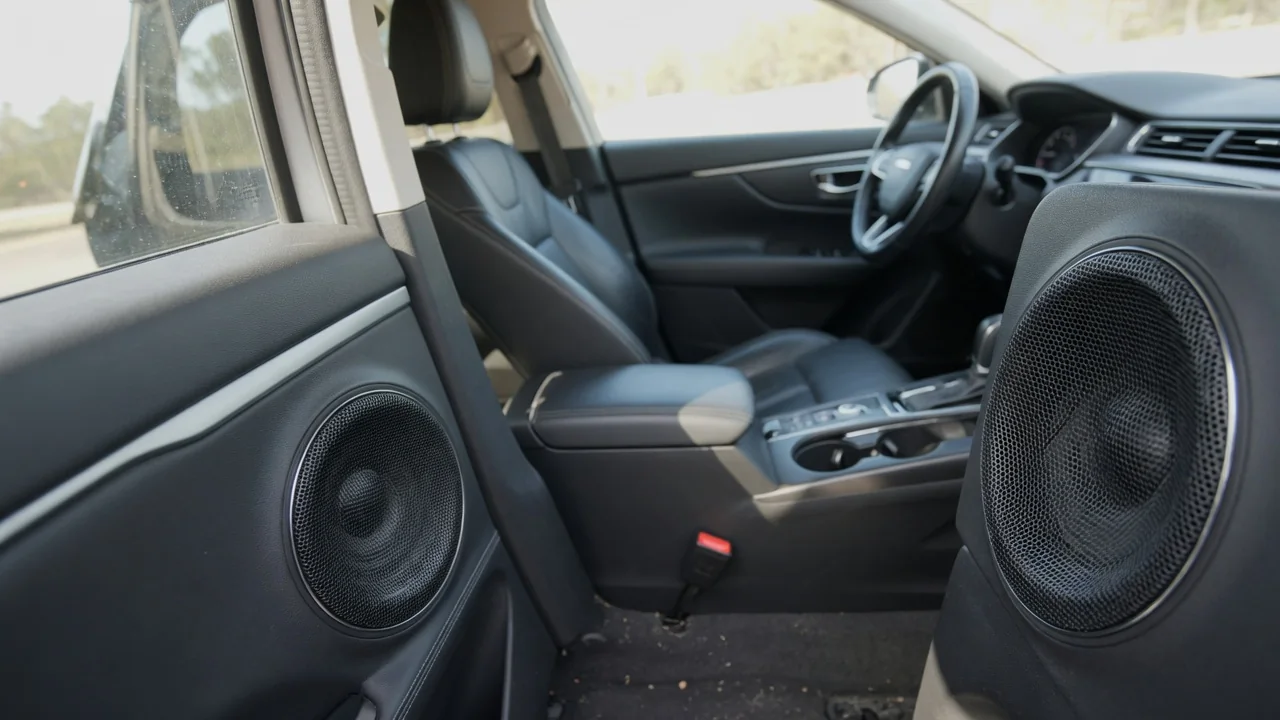
Car door speaker distortion at high volume rarely comes from a single fault. When the sound turns harsh, buzzy, or muddy as you raise the volume, the cause usually lies in one of three places: the signal driving the speaker, the mechanical limits of the speaker itself, or the door that houses it. Audio settings can push all three toward their limits at once. Here is why door speakers distort when played loud and how each mechanism tends to sound.
Power and Excursion: Where Amplifier and Speaker Run Out
Every amplifier has a maximum output voltage, set by its power supply. Many factory head units contain a small built-in amplifier that runs from the vehicle's electrical system, so its headroom is modest. When the volume asks for more output than the amplifier can deliver, the tops of the waveform are flattened, a condition called clipping. Clipping adds harmonics that were never in the recording, which is heard as harshness, grit, or a crackly edge on loud passages. Because those added harmonics carry energy into higher frequencies, a clipped signal can also stress tweeters more than a clean signal at a similar overall level.
The speaker has limits of its own. To make sound, the cone moves in and out, and the distance it travels is called excursion. Low frequencies require far more excursion than midrange or treble at the same loudness, so deep bass is the most demanding content for a door speaker. As the cone approaches the end of its usable travel, the voice coil starts to leave the strongest part of the magnetic field and the suspension stiffens. Motion stops tracking the signal accurately, producing a muddy, flubby, or distorted bass sound. Pushed further, the cone can mechanically bottom out, which is often heard as a sharp slap or crack on bass notes.
Heat adds another limit. Much of the electrical power sent to a speaker becomes heat in the voice coil, and as the coil warms its resistance rises. During long, loud listening the speaker can lose output and sound more strained, a behavior known as power compression.
Door Vibration: When the Door Becomes Part of the System
A car door is not a purpose-built speaker enclosure. It is a hollow structure of thin sheet metal with openings for wiring, latches, and window mechanisms. Sound radiating from the back of the cone enters that cavity, and at low frequencies it can partly cancel the sound from the front, so the speaker loses bass and the listener often compensates by turning the volume or bass up. The door also provides little controlled air pressure behind the cone, so the cone moves more freely and reaches its excursion limits sooner than it might in a sealed box.
Large panels also vibrate. The outer door skin, the inner sheet metal, and the plastic trim panel can resonate at certain frequencies, and loose clips, wiring harnesses, rods, or a poorly secured speaker mounting adapter can buzz against nearby surfaces. These rattles are not electrical distortion, but at high volume they are easy to mistake for it. A useful clue is that rattles usually appear on specific bass notes and may change if you press firmly on the trim panel, while amplifier clipping tends to affect the whole sound once the volume crosses a certain point.
Settings That Push Door Speakers Too Far
Tone controls change how much power and excursion the speaker needs. Raising bass, applying a loudness function, or boosting low bands on an equalizer all add energy where door speakers struggle most. A boost that sounds fine at moderate volume can drive the amplifier into clipping or the cone past its comfortable travel once the master volume rises. Cutting bass slightly, or lowering a boosted low band, often allows a higher clean volume. Some factory systems also adjust equalization automatically with volume or vehicle speed, so the tonal balance at high volume may differ from what you hear at low levels.
Signal level from the source matters as well. A phone, media player, or app with its own volume and equalizer settings can send an already distorted or overly hot signal to the head unit, and low-quality or heavily compressed audio files can sound harsh when played loud regardless of the speakers. In systems with an aftermarket amplifier, an input gain set too high can cause clipping well before the head unit's volume reaches its maximum, because gain is a level-matching control rather than a volume knob.
If the head unit or amplifier offers a high-pass filter, it can keep the deepest bass out of the door speakers, reducing excursion and allowing them to play louder cleanly. This works best when another speaker, such as a subwoofer, covers the removed low frequencies. Fader and balance settings matter too: shifting most of the output to one pair of speakers makes those speakers work harder for the same perceived loudness.
Practical Implications and Limits
Knowing the mechanisms helps narrow down a problem before replacing anything. Distortion that appears on all music at roughly the same volume setting points toward clipping or source level. Distortion that appears mainly on bass-heavy tracks suggests excursion limits or bass settings. A buzz tied to specific notes, or to one door only, suggests a rattle, a loose mount, or a single damaged speaker. Testing with a different source and with tone controls set flat separates settings problems from hardware problems.
Repeated distortion is not only an annoyance. Sustained clipping and over-excursion can overheat voice coils, damage suspensions, or tear surrounds. Once a speaker is damaged, it may buzz or crackle even at moderate volume, which is a sign that the cause is no longer just settings.
There are also limits that no adjustment removes. A door speaker of a given size, in a door of a given construction, can produce only so much clean bass, and different vehicles use different speaker sizes, amplifiers, and built-in tuning. Damping material, sturdier mounting, an external amplifier, or a separate subwoofer can extend clean output, but the benefit depends on the specific vehicle and installation. For model-specific options and the audio settings your system actually provides, the owner's manual or the system's documentation is the right reference.