Why Do Car Door Seals Have Hollow Sections?
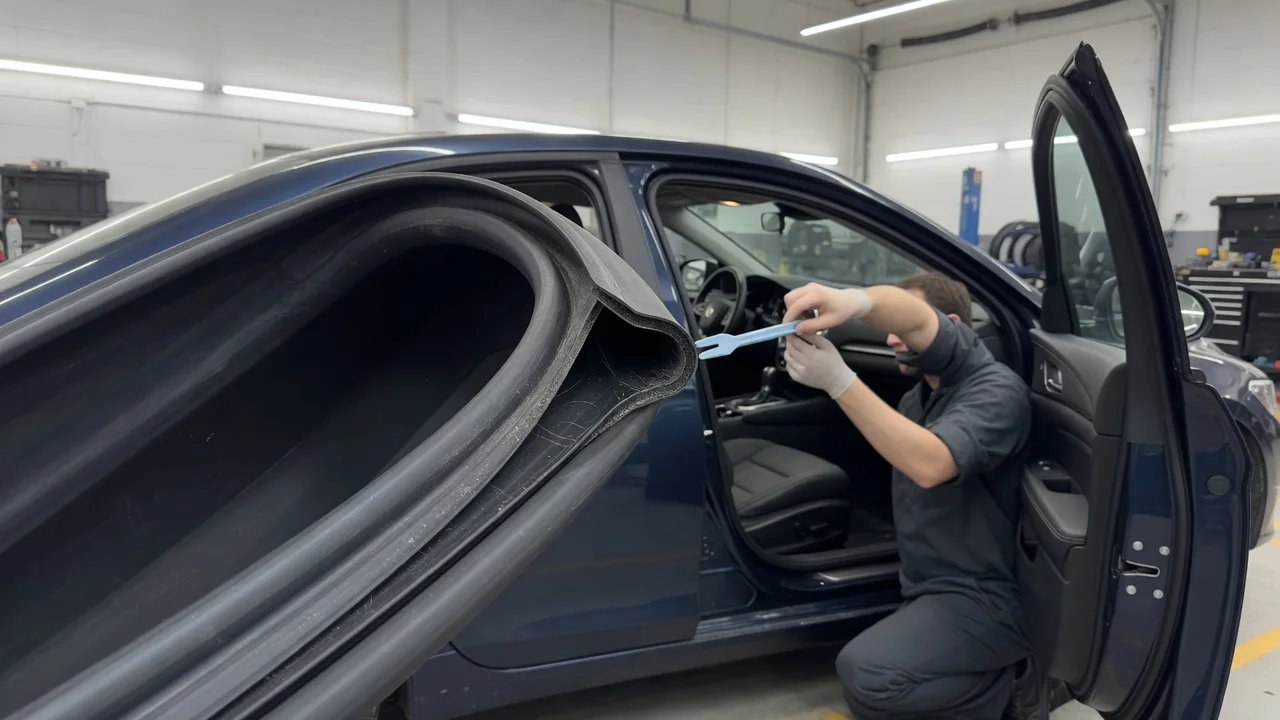
Run a finger along the rubber strip around a car door opening and you will usually find that part of it is a soft, hollow tube rather than a solid band. That shape is deliberate. Hollow car door weatherstrips let one piece of rubber compress easily, keep water and wind out across an uneven gap, and still let the door close without excessive force. Here is how each of those jobs depends on the hollow section.
Compression
A door seal has to fill a gap between the door and the body that is never perfectly uniform. Stamped panels, hinge alignment, paint thickness and assembly tolerances mean the distance can vary from one point to another around the opening. It can also shift slightly as the body flexes on the road. A solid rubber strip would press firmly only where the gap is narrowest and might leave voids where it is widest. A hollow bulb behaves differently. Its thin walls bend and the tube flattens progressively, so it can take up a wide range of gap sizes while staying in contact along the whole perimeter. In engineering terms, the hollow profile provides a large usable deflection range for a modest amount of material.
The hollow shape also controls how the contact force develops. When a closed tube is squeezed, its walls fold and roll against the mating surface, which spreads the load into a band instead of concentrating it at a sharp point. Many door seals are made from sponge or cellular rubber, commonly an EPDM compound, which makes the walls even softer. After the door closes, the seal keeps pressing outward because the bent walls act like a spring trying to return to their round shape. That elastic recovery maintains contact over time. It also explains why a seal that has taken a permanent set, meaning it no longer springs back fully, gradually loses effectiveness.
Water sealing
Keeping rain out depends less on how hard the rubber is pressed than on whether it touches continuously. Water needs only one small gap to find a path, so the seal's ability to conform matters more than raw force. Because the hollow bulb wraps around minor surface irregularities, such as a slightly wavy flange or the transition at a corner, it can keep an unbroken contact line where a stiffer section might bridge over a low spot. Its rounded face also tends to concentrate pressure in a narrow band of contact, which helps it act as a barrier rather than a loose cushion.
On most vehicles the hollow bulb is only part of a broader system. Doors often use more than one sealing line, for example one seal on the body opening and another on the door itself, with the space between them acting as a buffer. Water that gets past the outer surfaces is generally meant to drain away through openings at the bottom of the door and body rather than being stopped entirely by a single strip. The bulb's role is to keep water, dust and wind noise from reaching the cabin at the final barrier. The number of seals and where they sit varies by design, so the exact layout on a particular car is best confirmed in its service information.
Closing effort
A seal that pushes back hard enough to block water could easily make a door difficult to shut. The hollow section helps resolve this trade-off. Thin walls bend more readily than a solid block of rubber, so the seal offers relatively low resistance at the start of compression and builds force gradually as it flattens. The latch can therefore engage with a reasonable push, while the seal still ends up with enough contact pressure once the door is fully closed. Designers adjust wall thickness, bulb size and rubber density to strike this balance for a given door.
Air also plays a part. When a door swings shut, it pushes air into a nearly closed cabin, and that brief pressure rise resists the final movement of the door. Vehicles usually have pressure relief vents in the body to let that air escape. Within the seal itself, some hollow profiles include small openings so air inside the bulb can move in and out as it compresses, which keeps the tube from behaving like an inflated cushion. Closing effort therefore depends on the seal, cabin venting, hinge condition and latch adjustment together, not on the rubber alone.
Practical implications and limits
For owners, the hollow design explains several common symptoms. A bulb that has flattened with age, torn, or been crushed by a misaligned door can no longer spring back into the gap. That may show up as wind noise at speed, a damp carpet or water marks along a sill. A door that suddenly needs a firmer slam after a seal replacement may point to a profile that differs from the original, or to a seal that is not yet fully seated in its channel. Neither symptom proves the seal is the cause, since door alignment, blocked drains and glass seals can produce similar effects, but the door seal is a sensible place to start inspecting.
Care is mostly about preserving flexibility. Keeping the rubber clean and avoiding harsh solvents helps the walls stay supple, and rubber-safe conditioners are commonly used to reduce sticking in freezing weather. Cold makes rubber stiffer, so a door may feel firmer to close in winter even when the seal is healthy. Puncturing the bulb, or gluing it in a way that stops it from flexing, defeats the purpose of the hollow section.
The general explanation also has limits. Seal profiles, materials and the number of sealing lines differ between manufacturers, body styles and even door positions on the same vehicle. A specific symptom or replacement choice should therefore be checked against that vehicle's documentation or the part's fitment data. A hollow section is a design solution for balancing compression, sealing and effort, not a guarantee that any hollow strip will fit or perform the same way on a different car.