Why Do Car Degreasers Need Careful Dilution?
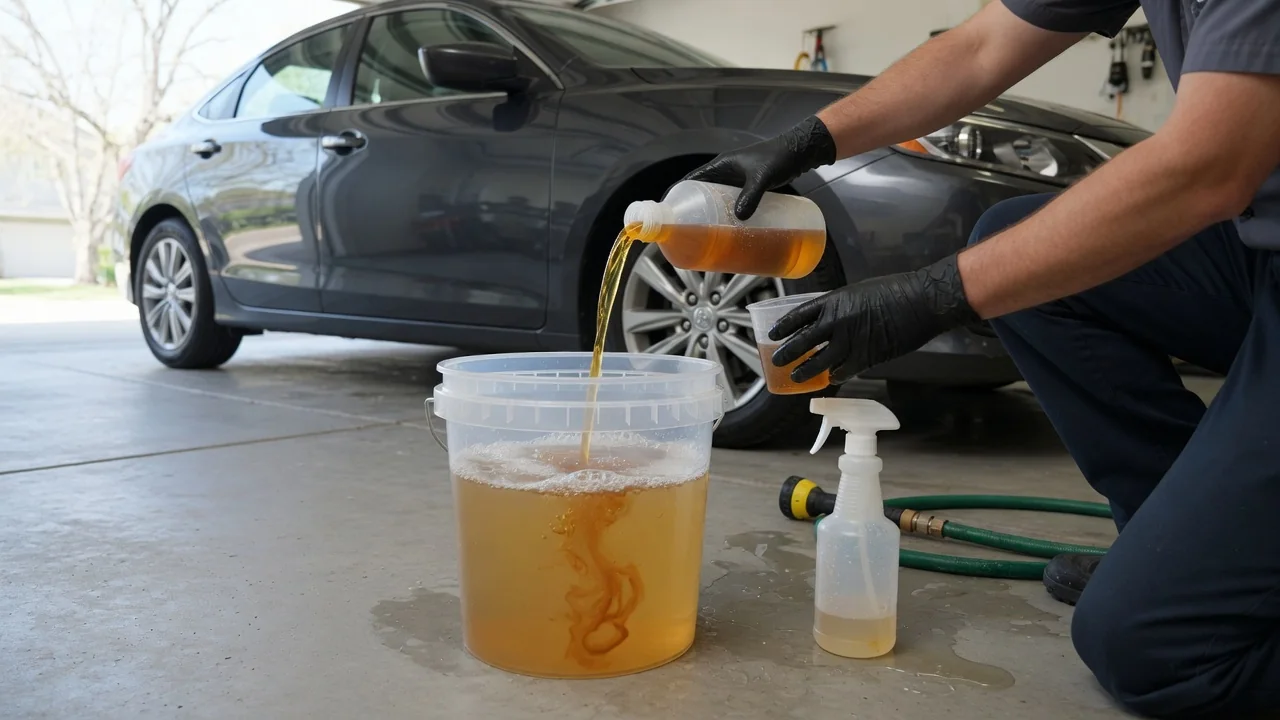
Most automotive degreasers are sold as concentrates, and the label usually lists several mixing ratios for different jobs. That flexibility is useful, but it also means the person mixing the product decides how aggressive it will be. Automotive degreaser dilution affects how well grime is lifted, how safely the solution treats paint, metal, rubber and plastic, and how completely it can be rinsed away. Those three effects explain why careful dilution matters more than reaching for a stronger mix.
Cleaning Strength Depends on the Right Concentration
A typical degreaser combines surfactants, which surround and lift oily soils, with alkaline builders or solvents that soften and break down grease. Adding water lowers the concentration of every active ingredient, which changes how aggressively the solution works, how it spreads across a surface and how much chemistry reaches each area. Manufacturers formulate their dilution ranges so that a light ratio handles road film and dust, while a stronger ratio targets baked-on oil, brake dust deposits or heavy engine grime.
The relationship between concentration and results does not keep improving without limit. Surfactants work once there is enough of them to form micelles around oily particles, and beyond a certain point extra concentrate adds little cleaning power while adding more chemical load to the surface. A mix that is too weak, on the other hand, may smear grease around instead of emulsifying it, tempting the user to scrub harder or repeat applications. Matching the dilution to the actual soil level is usually more effective than defaulting to the strongest ratio printed on the bottle.
Material Safety on Paint, Metal, Rubber and Plastic
The same chemistry that breaks down grease can also affect materials that were never meant to be stripped. Strongly alkaline solutions can dull or stain bare and polished aluminum, cause whitening on some uncoated metal surfaces and speed up oxidation where protective finishes are thin or damaged. On painted panels, a concentrated degreaser can remove wax, sealant or other protective layers much faster than a regular car shampoo, leaving the clear coat exposed until it is protected again.
Rubber seals, hoses, plastic trim and wiring insulation deserve similar caution. Some solvent-based or high-pH mixes can dry out or discolor these materials, especially with repeated exposure or long contact times. Because finishes and compounds differ between vehicles and even between parts on the same vehicle, there is no single safe concentration for every surface. That is why product labels often specify weaker ratios for delicate areas and why an owner's manual may include its own cautions about cleaning certain components, such as those in the engine bay.
Temperature adds another variable. A degreaser applied to a hot surface or in direct sun can evaporate quickly, and as the water leaves, the remaining film becomes more concentrated than the original mix. A dilution that would be gentle on a cool panel can therefore behave like a much stronger solution if it dries in place.
Rinsing and Residue Control
A degreaser has done only half its job once the grease is loosened; the emulsified soil and the cleaning chemicals both need to leave the surface. Stronger mixes contain more surfactant and builder, so they take more water and more time to rinse completely. Residue left behind can feel slick or tacky, attract fresh dust and road grime, and leave streaks or a hazy film on glass, paint and trim.
Rinsing also controls how long the chemistry stays in contact with the material. Working in manageable sections, keeping the surface wet during the dwell time the manufacturer recommends and rinsing before the solution can dry help prevent spotting and staining. Areas with crevices, such as wheel barrels, lug nut recesses, panel seams and engine bay brackets, tend to trap solution, so they benefit from a more thorough flush. A properly diluted product is generally easier to rinse fully, which reduces the chance of leftover chemicals continuing to act on sensitive surfaces.
Practical Implications and Limits
In everyday use, careful dilution starts with measuring rather than guessing. A marked bottle or measuring cup, plus a label on each spray bottle stating its contents and ratio, helps keep a light-duty mix from being confused with a heavy-duty one. Starting with the weakest ratio suggested for the job and increasing strength only if needed keeps any error on the side of protecting the material. Trying the mixed solution on a small, inconspicuous area is a sensible step before treating a large or unfamiliar surface.
Dilution has limits as a safety tool. It cannot make a product suitable for a surface the manufacturer says to avoid, and it does not replace agitation with a brush or microfiber towel when grime is heavily bonded. Some contaminants, such as tar, tree sap or embedded iron particles, are usually better handled by products designed for them than by an ever-stronger degreaser mix. After degreasing painted surfaces, reapplying wax or sealant may be necessary, since the cleaning step can reduce existing protection.
Personal protection and runoff matter as well. Concentrated and even diluted degreasers can irritate skin and eyes, so gloves and eye protection are reasonable precautions, and the product's safety information should guide handling. Where wash water ends up is regulated in many areas, which is another reason to use only as much chemistry as the job requires. Vehicle-specific guidance from the owner's manual or service documentation takes priority over general advice, particularly for engine bays, electrical components and specialty finishes.