Why Do Car Batteries Age Faster in Heat?
Car batteries rarely fail on the hottest day of summer, yet heat is one of the main reasons they wear out. Understanding why car batteries age faster in heat comes down to three things: the chemistry inside a lead-acid battery, how to test for heat-related wear, and where the battery sits in the vehicle. This guide explains those mechanisms in general terms, because exact behavior depends on battery type, vehicle design and climate.
Chemical Activity Inside a Hot Battery
Most conventional 12-volt car batteries are lead-acid designs, built from lead-based plates sitting in a sulfuric acid electrolyte. Like most chemical reactions, the reactions inside a battery speed up as temperature rises. In the short term this can seem helpful, since a warm battery often cranks an engine easily. The problem is that heat also accelerates unwanted side reactions that are not reversed by recharging. The most important of these is corrosion of the positive plate grid, the metal framework that holds the active material and carries current. As the grid corrodes, it loses strength and conductivity, internal resistance rises, and the battery can store and deliver less energy.
Heat also drives water loss. In flooded batteries, higher temperatures increase evaporation and the gassing that happens during charging, when water in the electrolyte splits into hydrogen and oxygen. As the electrolyte level drops, parts of the plates can become exposed and the remaining acid becomes more concentrated, which further speeds corrosion. Sealed and AGM batteries recombine most of these gases internally, but they are not immune. Sustained heat can gradually dry them out, and because they cannot be refilled, any water they lose is gone for good.
Self-discharge also runs faster in hot conditions, so a battery sitting in summer heat loses charge more quickly than one in mild weather. When a battery stays partially discharged, lead sulfate crystals on the plates can harden, a process called sulfation, and become harder to convert back during charging. If the charging system does not adjust its voltage for temperature, a hot battery can also be overcharged, adding to water loss. This damage accumulates quietly over one or more summers. It often becomes noticeable only in cold weather, when the engine needs more cranking effort and a weakened battery can no longer supply it. That is why heat damage is frequently blamed on winter.
Testing a Battery for Heat-Related Wear
Because heat damage builds gradually, checking the battery before it fails is more useful than waiting for a no-start. Begin with a visual inspection. Look for a swollen or bulging case, cracks, leaks, acid residue and heavy corrosion around the terminals. Case swelling can point to overheating or overcharging. On flooded batteries with removable caps, check the electrolyte level, because a low level is a sign of water loss. Top up only with distilled water and only if the battery maker permits it, and wear eye protection when working near battery acid.
A multimeter test is the next step. Measure the voltage with the engine off after the battery has rested long enough for any surface charge from recent driving or charging to dissipate. Compare the reading with the battery manufacturer's state-of-charge chart. Keep in mind that resting voltage shows how charged the battery is, not how healthy it is. A battery with significant grid corrosion can show an acceptable voltage and still lack the capacity to start the engine reliably.
To judge actual health, a load test or an electronic conductance test is more informative. These estimate how well the battery can deliver current, usually against its rated cold cranking amps, and many repair shops and parts retailers have the equipment. Results depend on state of charge and temperature, so follow the tester's instructions and recharge and retest if a result is borderline. It is also worth testing the charging system. A faulty voltage regulator or temperature sensor that keeps charging voltage too high in hot weather can shorten battery life, and replacing only the battery will not fix that underlying cause.
Battery Placement and Under-Hood Heat
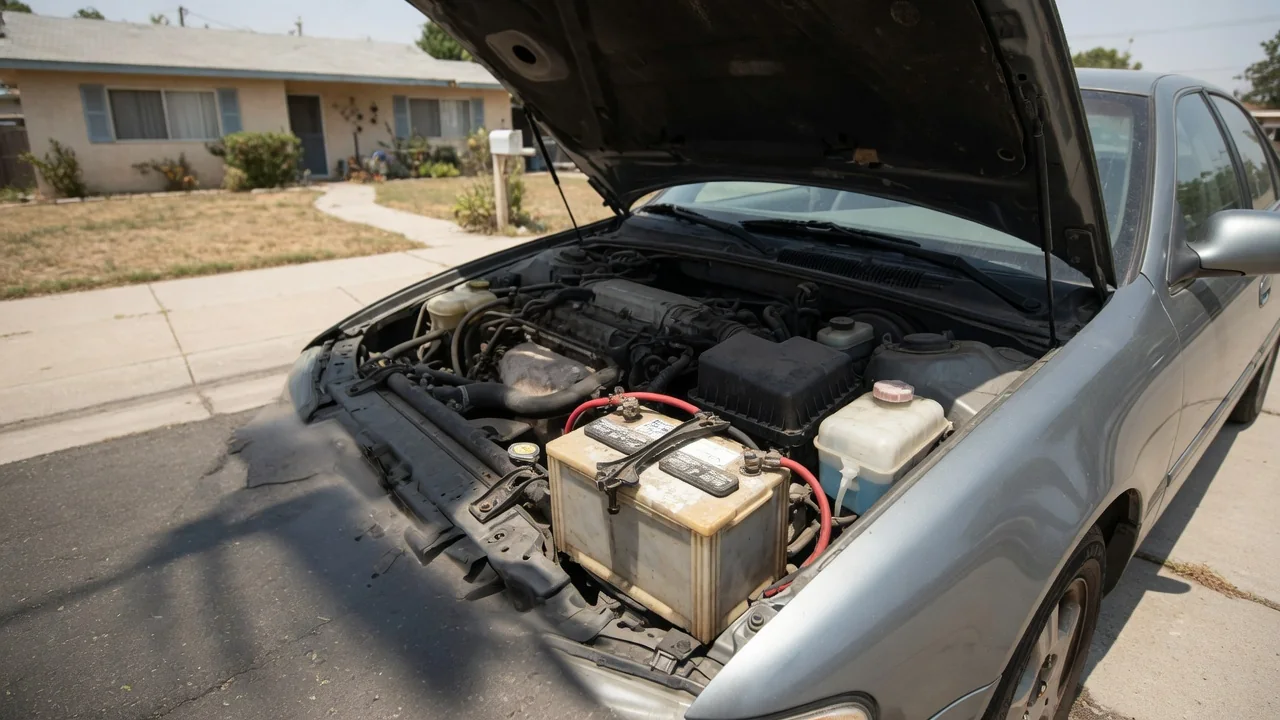
Most vehicles mount the battery in the engine compartment, where engine heat, nearby exhaust components and limited airflow at low speed push temperatures well above the outside air. Heat soak adds to this: after the engine is shut off, cooling airflow stops while the engine and exhaust continue releasing stored heat into the surrounding space. How hot a battery runs depends on its distance from these heat sources and how much airflow reaches it, which varies from one vehicle design to another.
Manufacturers often protect under-hood batteries with heat shields, insulating sleeves, covers or air ducts. These parts are easy to leave off or misplace during a battery replacement, so make sure they go back on in their original positions. Some vehicles place the battery in the trunk, under a seat or in the cargo area, away from engine heat. Those locations may call for a specific battery type and a venting arrangement, so the owner's manual should guide any replacement. For most owners, the battery's location is not something to change; the practical step is to keep the factory protection intact and install the battery type the vehicle specifies.
Parking also influences battery temperature. A car left in direct sun, especially over hot pavement, heats up throughout, including the engine bay and any interior battery compartment. Parking in shade or a garage when possible reduces the total amount of heat the battery is exposed to over time, even if it cannot eliminate the effect of driving in hot weather.
Practical Implications and Limits
For drivers in hot climates, the realistic expectation is a shorter battery life than in milder regions, although no single number applies to every car or battery. A sensible routine is to have the battery tested after a long, hot summer and again before cold weather arrives, and to consider replacement when tests show a clear decline rather than waiting for a failure. Keeping the battery fully charged also helps. Vehicles used mainly for short trips or parked for long periods can benefit from a maintenance charger designed for the battery's chemistry, since a battery that sits partially discharged in heat tends to degrade faster.
There are limits to what heat explains and what owners can control. Vibration from a loose hold-down, repeated deep discharges, parasitic electrical drains, charging faults and differences in manufacturing quality can all shorten battery life, so a failed battery cannot always be blamed on temperature alone. Some heat damage is permanent: charging cannot repair a corroded grid or replace water lost from a sealed battery. Good care slows the aging process but does not reverse it.
This explanation applies to conventional 12-volt lead-acid batteries, including the 12-volt auxiliary batteries used in many hybrids and electric vehicles. High-voltage traction batteries are also sensitive to heat, but they use different chemistry and dedicated thermal management systems, so their aging follows different rules. For any specific vehicle, the owner's manual and the battery manufacturer's guidance remain the best references for battery type, maintenance and replacement.