Why Do Car Audio Systems Use Time Alignment?
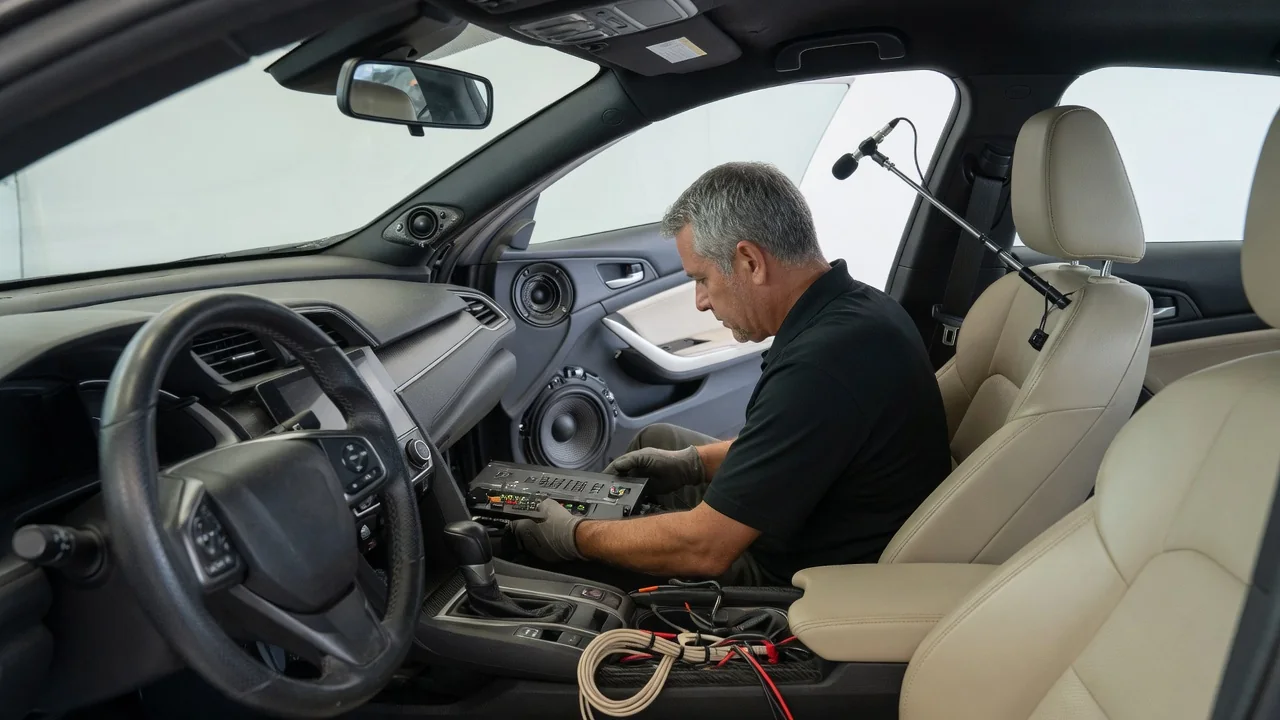
In most cars, the driver sits much closer to one set of speakers than the other, and that geometry shapes how the system sounds. Car audio time alignment is a digital signal processing technique that delays the signal to the nearer speakers so sound from every speaker reaches the listener at about the same moment. Car audio systems use time alignment because of three linked factors: speaker distances, arrival time, and where the listener actually sits.
Speaker distances
A home stereo is usually set up so the listener sits roughly the same distance from the left and right speakers. A car cabin rarely allows that. Seats are offset toward one side of the vehicle, so the driver's head is usually much closer to the speakers in the driver's door than to those in the passenger door. Speakers are also spread across very different locations. Tweeters may sit in the dashboard, A-pillars, or door sail panels. Midrange or midbass speakers are often low in the doors. A subwoofer may be in the trunk, under a seat, or on a rear deck. Each location is a different distance from the listener's ears.
These differences are not a sign of poor design. They come from fitting speakers into a vehicle around structure, airbags, wiring, windows, and trim. Installers and manufacturers generally choose speaker locations based on available space and how each speaker can be mounted, not on equal path lengths. The result can be a set of speakers that are well chosen and well powered, yet arranged so their sound travels unequal distances to any single seat. Time alignment exists largely to compensate for that unavoidable layout.
Arrival time
Sound travels through air at a finite speed, roughly 343 meters per second at room temperature, or about 1,125 feet per second. Put another way, sound covers a little over one foot per millisecond. If one speaker is a couple of feet farther away than another, its sound arrives a couple of milliseconds later. That interval is far too short to hear as an echo, but it is long enough to change how the brain interprets the sound.
Human hearing judges where a sound comes from using tiny differences in arrival time and loudness between the two ears. A well-documented effect, often called the precedence effect, causes listeners to locate a sound toward whichever source reaches them first, even when a later source is about as loud. In a car without correction, the nearest speakers tend to dominate. Vocals and instruments meant to appear centered can seem to come from the driver's door. Unequal arrivals can also cause certain frequencies to partly cancel or reinforce where the outputs of two speakers overlap, which can make the tonal balance uneven or hazy.
Time alignment addresses this by adding a small, adjustable delay to the closer speakers. A processor cannot make a distant speaker play earlier, so it holds back the nearer ones instead, and all of the sound arrives at the target location at about the same time. Many processors let the user enter the distance from each speaker to the listener and calculate the delays from those values. Others let the user set each delay directly in milliseconds.
Listening position
Time alignment is always calculated for a specific point in space. When the delays are set for the driver's seat, the sound from all the speakers lines up there. That is why a tuned system can create a centered stereo image in front of the driver, often described as a soundstage across the dashboard. The correction depends on the distance from each speaker to that point, so the chosen position matters as much as the delay values themselves.
The same correction that helps one seat can work against another. If the delays favor the driver, the front passenger sits closer to speakers that are being held back and farther from speakers that are not. Their arrival times can end up even more mismatched than with no correction at all. For this reason, many head units and processors offer selectable listening positions, such as driver, front passenger, front seats, or all seats, sometimes alongside manual settings. A setting aimed at several seats generally gives up some precision at each seat in exchange for a more even result across the cabin. The best choice depends on who usually listens and where they sit.
Practical implications and limits
For most owners, the practical value of time alignment is a clearer center image and more defined placement of voices and instruments, especially from the driver's seat. Whether it is available, and how adjustable it is, depends on the specific head unit, factory amplifier, or aftermarket processor. Some factory systems apply fixed delays set by the manufacturer. Others offer only a seat-position menu or no adjustment at all. The owner's manual or the processor's documentation is the reliable source for what a particular vehicle offers.
Time alignment also has limits. It cannot fix a speaker that is damaged, poorly mounted, or rattling. It does not replace crossover settings, level matching, or equalization, and these adjustments interact, so changing one may mean revisiting the others. Measured distances are a starting point rather than a guarantee. Reflections from glass and hard surfaces, the angle a speaker is mounted at, and the behavior of the crossover filters can all shift when the sound effectively arrives. At low frequencies, wavelengths are long compared with the cabin, so subwoofer delay is often set by ear or with measurement rather than by tape measure alone.
Finally, the benefit is tied to a sweet spot. Leaning forward, reclining, or a different driver with a different seat position moves the listener's ears away from the point the system was tuned for, and the effect becomes less precise. In a car that often carries passengers, a broader seat setting or a milder tune may be more satisfying than an aggressive driver-only alignment.