Why Do Camshafts Need Lubrication? Sliding Contact, Oil Supply and Wear
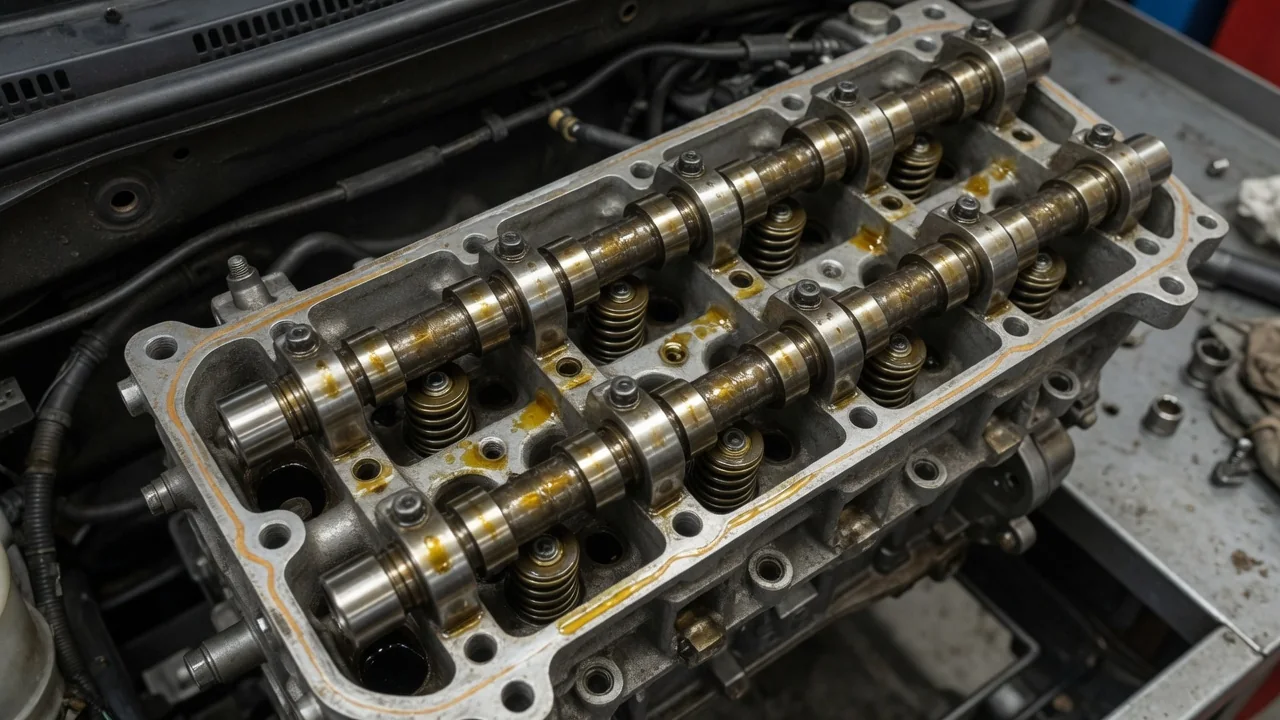
A camshaft opens and closes the engine's valves continuously while the engine runs, and each of those events presses metal against metal under heavy spring load. Without a thin, continuous oil film between the parts, that contact would generate heat and wear quickly. The answer to why camshafts need lubrication comes down to three linked ideas: how the parts slide against each other, how oil reaches them, and what happens to the surfaces when the oil film breaks down.
Sliding contact
Each cam lobe is an off-center profile. As the camshaft turns, the lobe pushes against a follower, which may be a flat tappet, a bucket tappet, the pad of a rocker arm or a roller. In flat-tappet and bucket designs, the lobe surface slides across the face of the follower while the valve spring pushes back. The load is concentrated on a very small contact area, and it peaks near the nose of the lobe, where valve lift and spring force are greatest. That small, heavily loaded zone is one of the most demanding contact points in the entire engine.
Roller followers replace much of that sliding with rolling motion, which lowers friction, but they do not remove the need for oil. The roller turns on its own pin or needle bearing, which must be lubricated, and some slip still occurs at the lobe. The camshaft journals add another sliding interface: they rotate inside bearing bores in the cylinder head or block, sometimes with separate bearing inserts. Once the shaft is turning, oil drawn into the narrow gap forms a pressurized wedge that lifts the journal away from the bearing surface.
The lubrication conditions at these two locations differ. Journals normally run on a full oil film, so the metal surfaces do not touch during steady operation. At the lobe and follower, the film is extremely thin and often operates in mixed or boundary conditions, especially at low engine speed and during startup. In those moments, oil viscosity alone cannot fully separate the parts, so anti-wear additives in the oil form protective layers on the metal surfaces. The oil also carries heat away from the contact zone and flushes away fine particles that would otherwise act as an abrasive.
Oil supply
In a typical pressure-lubricated engine, the oil pump draws oil from the sump, sends it through the filter and into a main gallery, and from there passages carry it up to the camshaft area. Cam journals are commonly fed directly through drilled passages in the bearing saddles or caps. Lobes may receive oil from passages in a hollow camshaft, from spray bars or nozzles, from oil escaping the journals and lifters, or from splash and oil mist inside the valve cover. The exact routing differs from one engine design to another, so the service manual for a specific engine is the reliable reference for how its camshaft is fed.
Location matters. In overhead camshaft engines, the camshaft sits at the top of the engine, at the far end of the oil's path. After shutdown, much of the oil drains back to the sump, and at a cold start there is a brief interval before full pressure and flow reach the cylinder head. During that interval, the parts depend on the residual film left on their surfaces. Any restriction along the way, such as sludge in a head passage, a partially blocked oil pickup screen or a clogged feed orifice, can starve the camshaft even when the rest of the engine is receiving oil.
In many engines, oil delivered to the valvetrain also does hydraulic work. Hydraulic lifters and lash adjusters use engine oil to take up clearance, and many modern engines with variable valve timing use oil pressure to move the cam phasers that shift camshaft timing. On those designs, low oil level, incorrect viscosity or contaminated oil can affect timing control as well as lubrication, and the engine management system may register a fault when the phasers do not respond as expected.
Wear
When the oil film becomes too thin, too hot or too contaminated, the microscopic high points of the lobe and follower surfaces start to touch directly. The result can be scuffing, in which material is smeared or torn from one surface to the other, and repeated contact stress can cause pitting or flaking of the hardened surface layer. Over time a lobe can lose height, a condition often described as a flattened or wiped lobe. Lower lobe height means the valve opens less and for a shorter time, so the affected cylinder breathes less effectively.
Camshaft wear tends to show up gradually. Possible signs include a ticking or tapping noise from the top of the engine, a rough idle, a persistent misfire on one cylinder and reduced power. Metallic particles may appear in the oil or on the drain plug. Scored cam journals can increase bearing clearance, which allows more oil to leak out at that point. Wear debris also circulates with the oil and can damage other components, and once the hardened surface of a lobe is breached, the softer metal underneath generally wears faster.
The break-in period of a new camshaft is a particularly sensitive time, especially with flat-tappet designs, because the lobes and lifters are still establishing their mating wear pattern. Builders typically coat the contact surfaces with assembly lubricant and follow the break-in procedure supplied by the engine or camshaft manufacturer. Because each flat-tappet lifter wears in against its own lobe, used lifters are generally not moved to a different lobe or installed on a new camshaft.
Practical implications and limits
For an owner, the importance of camshaft lubrication translates into a few routine habits: keeping the oil level within the marked range, using the viscosity grade and specification listed in the owner's manual, and changing oil and filter at the interval that matches how the vehicle is actually driven. Frequent short trips, extended idling and towing are often treated as severe service, because they can allow moisture and fuel to accumulate in the oil and encourage sludge that restricts flow to the cylinder head.
Good oil maintenance has clear limits. It slows wear but cannot restore a lobe that has already lost material, and aftermarket additives are not a repair for existing damage. A valvetrain noise does not automatically point to the camshaft, either: a lifter, lash adjuster, exhaust leak or fuel injector can produce a similar sound. Confirming cam wear usually requires inspection under the valve cover and measurement of lobe lift or journal clearance, following the procedure in the service manual for that engine.
Requirements also vary with engine design. Cam-in-block and overhead cam layouts, flat-tappet and roller followers, and engines with or without variable valve timing place different demands on the oil. Owners of older flat-tappet engines sometimes look for oils formulated with those engines in mind, and the right choice depends on the engine and the guidance of its manufacturer or rebuilder. When general explanations and vehicle-specific documentation disagree, the documentation for the specific engine should take priority.