Why Do Brakes Need Cooling Air? Heat, Airflow, and Design
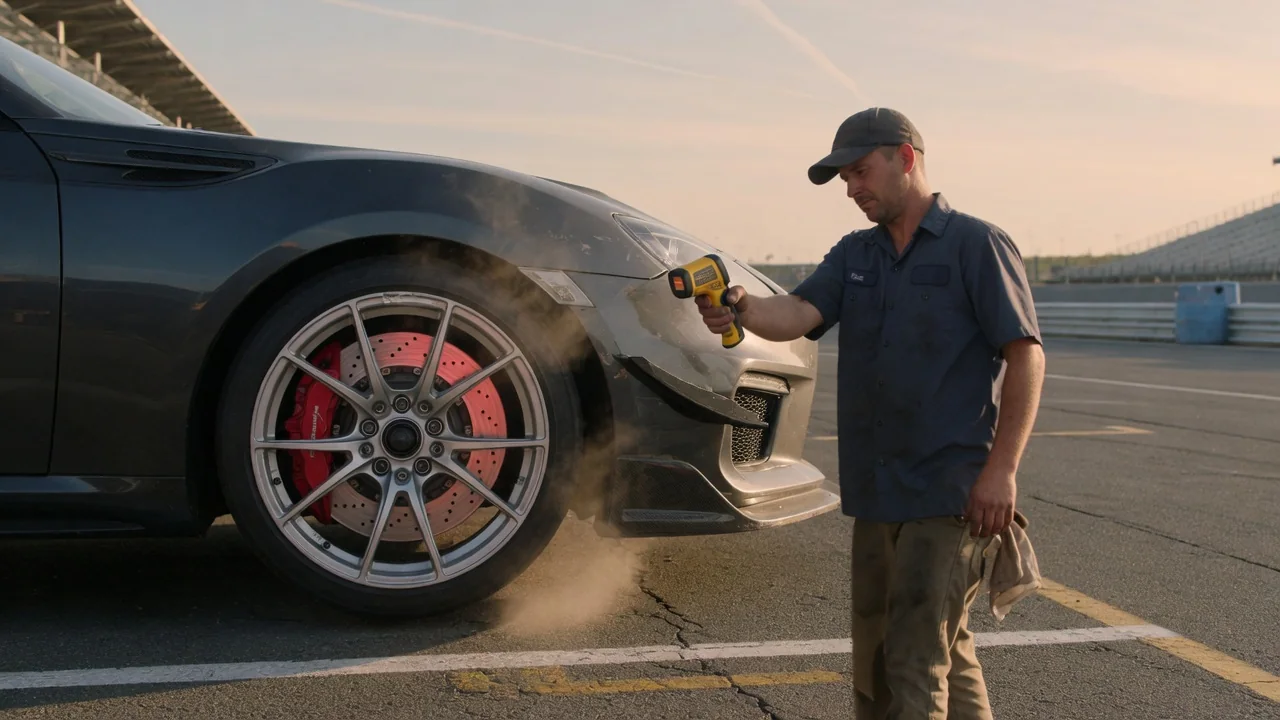
Every time you slow a car down, the brakes turn its motion into heat. That heat has to go somewhere, and most of it eventually leaves through the surrounding air. If it cannot escape fast enough, braking performance drops, parts wear faster, and the pedal can change feel. Knowing why brakes need cooling air explains a lot about how rotors, wheels, and body panels are shaped, and how driving habits affect brake life.
Heat buildup: where braking energy goes
Friction brakes are energy converters. A moving vehicle carries kinetic energy that depends on its mass and, even more strongly, on its speed, because energy rises with the square of velocity. To slow down, the pads clamp the rotors, or the shoes press against the drums, and friction turns that kinetic energy into thermal energy. Nearly all of it ends up as heat in the rotors or drums, the pads, and nearby hardware. These are relatively compact parts, so a hard stop from highway speed raises their temperature quickly.
The rotor works as a short-term heat sink. Its mass absorbs the burst of heat during a stop, and then it has to shed that heat before the next one. When stops come close together, or when the brakes are applied continuously on a long descent, heat arrives faster than it leaves and temperatures ratchet upward. A rotor that never gets a chance to cool starts each stop hotter than the last.
Excess heat causes several distinct problems. Pad friction material can lose grip when overheated, a condition known as brake fade, which means more pedal effort is needed for the same deceleration. Heat also travels from the pads into the caliper and the brake fluid. If the fluid reaches its boiling point, vapor bubbles form, and because vapor compresses, the pedal can feel soft or sink. Repeated overheating can also lead to uneven pad deposits on the rotor, surface cracking, and faster wear of pads, seals, and boots.
Air path: how airflow carries heat away
Heat leaves a brake in three ways: conduction into the hub, wheel, and suspension parts; radiation from hot surfaces; and convection into moving air. Conduction helps, but the parts receiving that heat have limited capacity of their own, and radiation becomes significant mainly at very high temperatures. Convection is the steady route that returns the whole assembly to a safe temperature, and it depends on how much air passes over the hot surfaces and how fast it moves. That is the core answer to why brakes need cooling air: air is the medium that finally carries the heat away from the vehicle.
Brake cooling airflow follows a path shaped by the car's motion and the parts around the brake. As the vehicle moves, air flows under and along the body, into the wheel wells, and out through openings in the wheel. A vented rotor has two friction faces separated by internal vanes. When it spins, the vanes act like a centrifugal pump, drawing air in near the center and pushing it out at the edge, which removes heat from inside the rotor rather than only from its faces. Splash shields protect the brake from water and debris and, depending on design, help guide air around the rotor.
Airflow is strongly tied to speed. At highway speed a great deal of air moves through the wheel area; in slow traffic or at a standstill there is very little. That is why brakes can run hot in stop-and-go driving on steep, winding roads, and why heat lingers after parking. Drum brakes enclose their friction surfaces, so they depend on heat passing to the drum's outer surface first, which generally makes them slower to cool than an exposed disc.
Vehicle design choices that manage brake heat
Engineers size brakes for the expected heat load, and that load is not shared evenly. During braking, weight shifts forward, so the front brakes do most of the work. For that reason, front rotors are commonly larger and vented, while rear brakes are often smaller, may use solid rotors, and on some vehicles are drums. Rotor size matters as well: a larger rotor offers more surface area to release heat and more mass to absorb a stop without an excessive temperature rise.
The surrounding vehicle determines how well that hardware can breathe. Wheel design affects how freely air and heat escape the brake area. Some performance-oriented vehicles add ducts that route air from the front of the car toward the brakes, and some rotors use directional vanes that must be installed on the correct side. Designers also balance cooling against other goals: smoother underbody panels and more closed wheel designs can reduce aerodynamic drag and noise, but they may also limit airflow to the brakes. The final layout is a compromise chosen by the manufacturer for that vehicle's intended use.
Vehicles with regenerative braking, such as hybrids and electric vehicles, recover part of the braking energy through the motor, which can reduce how often and how hard the friction brakes work in everyday driving. The friction brakes must still handle emergency stops, heavy loads, and situations where regeneration is limited, so they need adequate thermal capacity. How a particular vehicle blends the two systems depends on its own design.
Practical implications and limits
For drivers, the most useful approach is to reduce the heat put into the brakes rather than counting on airflow to keep up. On long downhill grades, a lower gear, engine braking, or a regenerative mode can carry part of the load, leaving the friction brakes cooler and ready for stops. Firmer, intermittent applications give the brakes short intervals to cool, unlike continuous light dragging. After hard use, clamping the brakes tightly while stopped for a long time concentrates heat in one area of the rotor, so where it is safe, avoid holding more pedal pressure than needed.
Maintenance and modifications also influence cooling. Bent or damaged splash shields, packed debris, or accessories that cover wheel openings can disturb the intended airflow. Brake fluid absorbs moisture over time, which lowers its boiling point, so following the replacement interval in the owner's manual helps preserve the margin against vapor formation. Towing, heavy loads, and mountain driving all raise the heat load and leave less reserve.
Cooling air has limits. It cannot prevent overheating when energy is fed into the brakes faster than any practical airflow can remove it, and thermal capacity differs widely between vehicles. Warning signs such as a burning smell, a softer or longer pedal, reduced stopping power, or vibration after hard use deserve inspection by a qualified technician. Specific hardware details, service intervals, and recommended techniques for towing or descents should come from the vehicle's own documentation.