Why Do Axle Shafts Twist Slightly Under Load?
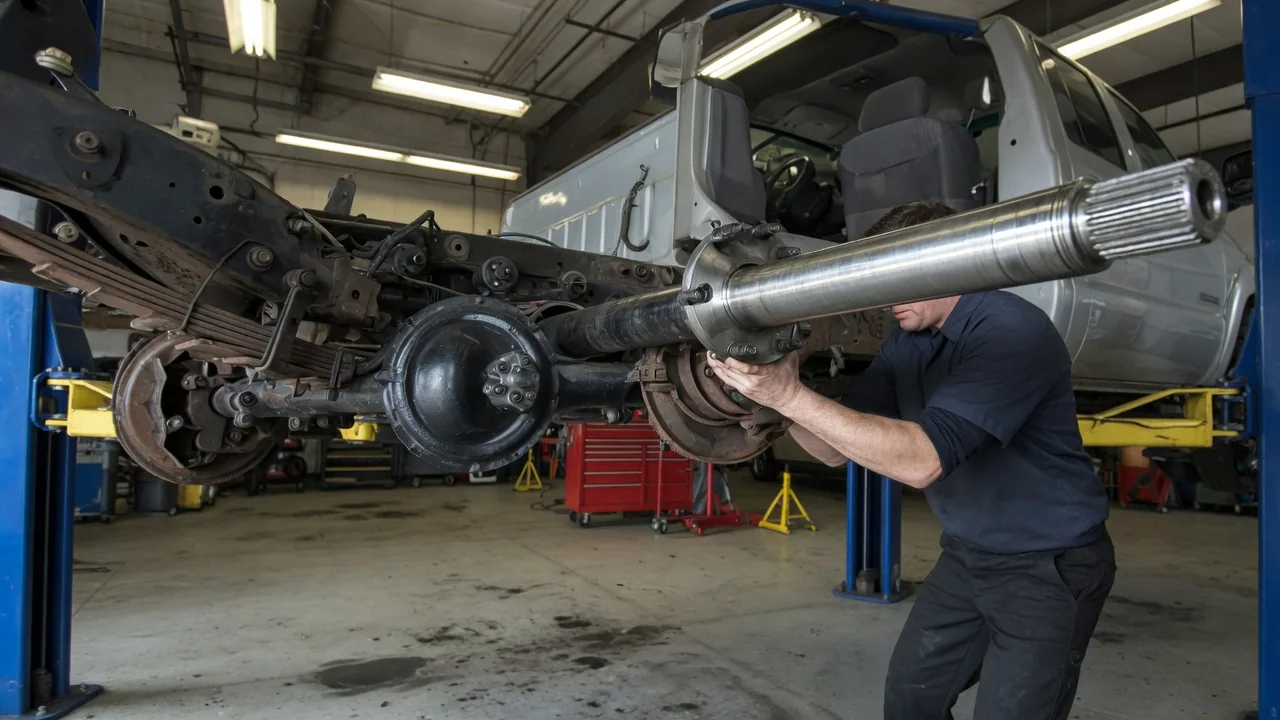
Every time a car accelerates, its axle shafts twist by a small amount along their length before the wheels turn. This axle shaft torsion is normal and expected, and it is accounted for in the design. It is not a sign of weakness but a basic consequence of pushing torque through a steel bar. Knowing why axle shafts twist slightly under load explains how they carry engine power, why they spring back afterward, and what separates healthy elastic flex from overload that eventually breaks a shaft.
Torque: The Twisting Load Every Axle Carries
An axle shaft has one main job: to transmit rotational force from the differential to the wheel hub. That force is torque, and torque is by definition a twisting load. One end of the shaft is driven by the differential, while the other end is held back by the wheel, the tire and the friction between the tire and the road. Whenever the driven end tries to turn faster than the resistance at the wheel allows, the material in between winds up like a very stiff spring until the shaft carries enough torque to move the vehicle.
The torque reaching an axle shaft is usually much greater than the torque the engine produces at its crankshaft. Transmission gearing and the final drive ratio multiply engine torque, so the shafts sit at the high-torque end of the drivetrain, turning slowly but under heavy load. The highest loads tend to occur in low gears during hard acceleration, when pulling a trailer from a standstill, when climbing a steep grade, or when a spinning tire suddenly regains grip. Grip itself sets a practical ceiling: a shaft cannot be loaded beyond the torque the tire can react against the road, which is why traction conditions matter as much as engine output.
How much a given shaft twists depends on more than torque. Engineering texts describe the angle of twist as rising with applied torque and shaft length, and falling as the material's shear stiffness and the shaft's cross-section increase. Diameter has an outsized effect, because the torsional stiffness of a solid round shaft grows with the fourth power of its diameter. A modest increase in thickness therefore reduces twist far more than its size suggests, while a longer shaft of the same diameter twists more than a shorter one under identical torque. That is one reason left and right shafts of different lengths, found on some front-wheel-drive layouts, do not wind up by exactly the same amount.
Elasticity: Why a Shaft Twists and Then Springs Back
Steel is not perfectly rigid. Under load, its crystal structure deforms very slightly, and this deformation appears as a measurable twist along the length of the shaft. In torsion the material experiences shear stress, which is lowest at the center of the shaft and highest at its outer surface. As long as that stress stays below the material's elastic limit, the deformation is temporary. Remove the torque and the shaft returns to its original shape, much like a torsion bar in a suspension system returns to its resting position.
Within the elastic range, twist is proportional to load: double the torque and the angle of twist roughly doubles. This predictable, spring-like behavior is useful. A shaft that winds up slightly acts as a small buffer, softening the sharp torque spikes that occur when a clutch engages abruptly, when a transmission shifts, or when a slipping tire hooks up. Without any compliance, those shocks would pass more directly into gears, splines, bearings and joints. The same stored energy is released as the shaft unwinds, and together with tire flex and drivetrain mounts it can contribute to surge or hop under some conditions, so engineers tune the stiffness of the whole driveline rather than the axle shaft alone.
Durability: Living With Countless Twist Cycles
Because an axle shaft twists every time the vehicle accelerates, decelerates or changes gear, it experiences an enormous number of load cycles over its life. Durability therefore depends less on surviving a single peak load and more on resisting fatigue, the gradual growth of microscopic cracks under repeated stress. A shaft that never exceeds its elastic limit can still fail eventually if its stress cycles are high and frequent enough, which is why design work aims to keep typical operating stresses comfortably below the level at which fatigue damage accumulates.
Fatigue cracks rarely start in a smooth, uniform section of shaft. They tend to begin where stress concentrates: at spline roots, at sharp changes in diameter, at grooves for retaining clips, or at surface scratches and corrosion pits. Because torsional stress peaks at the outer surface, the condition of that surface matters greatly. Manufacturers commonly use alloy steels and surface treatments such as induction hardening to strengthen the outer layer, and they shape transitions with generous radii to spread stress more evenly. Hollow designs can retain useful stiffness while reducing weight, since material near the center contributes relatively little to torsional strength.
Overload is a separate risk from fatigue. If torque pushes the surface stress past the yield point, the shaft does not fully spring back. The result can be a permanent twist, distorted splines or a shaft that no longer runs true. Repeated shock loads, such as violent launches on high-grip surfaces or wheel hop, can combine overload and fatigue, shortening service life even if no single event breaks the part.
Practical Implications and Limits
For most drivers, axle shaft twist is unnoticeable. The angle involved in normal driving is small, and the shaft returns to shape without lasting effect. Clunks or slack felt when switching between acceleration and deceleration usually come from elsewhere in the drivetrain, such as worn constant-velocity joints, universal joints, loose or worn splines, differential gear backlash or deteriorated mounts. Shaft wind-up contributes to the overall feel of the driveline, but it is rarely the cause of a distinct clunk on its own, so diagnosis should start with components whose clearances can wear.
Driving style and vehicle use change how much of a shaft's capacity is consumed. Towing, heavy payloads, repeated hard starts, off-road wheel spin followed by sudden traction, and added engine power all raise the loads the shafts see. Larger or stickier tires can also increase shaft loading, because more grip allows more torque to reach the shaft before the tire slips. Strengthening one part of the drivetrain tends to move the weak point rather than eliminate it, so stronger shafts may shift stress onto joints, differentials or mounting hardware.
General principles explain why shafts twist, but they cannot predict the limits of a particular vehicle. Allowable torque, shaft material, inspection procedures and replacement guidance vary between designs and are set by each manufacturer. For questions about a specific vehicle's axle shafts, the factory service manual or a qualified technician is the appropriate reference, especially after an impact, a suspected overload, or the discovery of a visible bend, crack or damaged boot.