Why Did SUVs Shift Toward Unibody Construction?
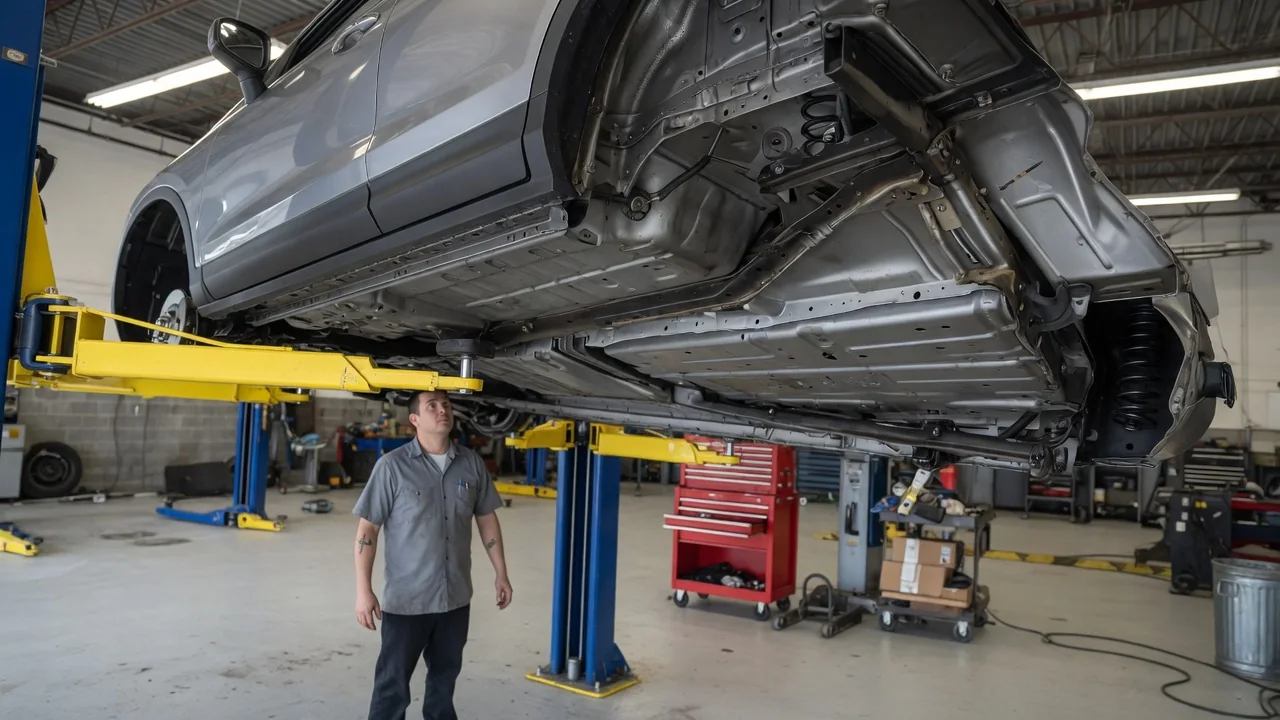
Anyone asking why did SUVs shift toward unibody construction is really asking how family buyers changed the vehicle. As sport utilities moved from work sites and trails to school runs and highway commutes, manufacturers favored a structure that rides more quietly, wastes less interior space, and weighs less. The older body-on-frame layout survives, but mainly where heavy-duty work still justifies it.
Construction choices
Traditional sport utilities were built like pickup trucks, with a separate body bolted onto a ladder frame of steel rails. The frame carries the engine, suspension, and driveline, while the body simply sits on rubber mounts above it. A unibody design merges those jobs into one welded shell, so the floor, pillars, roof, and rocker panels all share the loads. Because every panel contributes to strength, engineers can reach the stiffness they need with less total metal than a frame and a body built separately.
The change also followed manufacturing logic. Many modern crossovers share their underlying architecture with passenger cars, which lets a manufacturer build sedans, hatchbacks, and utility vehicles from related components on common assembly lines. That link is often visible from underneath: a unibody vehicle shows a stamped floor with subframes attached, while a framed truck shows two thick rails running front to rear with a visible gap between frame and body. Marketing labels are less reliable than a look under the vehicle or a check of the manufacturer's description.
Passenger use
Packaging is where passengers feel the difference first. With no frame rails sitting beneath the cabin, the floor can be set lower without reducing ground clearance by the same amount. A lower floor means an easier step in for children and older riders, a more natural seating position with knees less raised, and more headroom under the same roofline. Third-row seats and cargo floors benefit as well, because components can be tucked into the structure rather than stacked on top of a frame.
Ride quality was the other major motivation. A stiff one-piece shell gives the suspension a stable base, so springs and dampers can be tuned for comfort instead of compensating for a flexing chassis. Framed vehicles sometimes produce a faint shudder over broken pavement as body and frame move slightly against their mounts, which many drivers notice as a quiver through the seat or steering column. Unibody designs, often paired with fully independent suspension, usually feel calmer and more car-like, though tuning varies widely between models.
Capability tradeoffs
The move away from frames was not free. A separate ladder frame handles concentrated loads well, which is why it remains common under vehicles intended for heavy trailers, large payloads, or repeated hard off-road use. Twisting forces from uneven terrain and tongue weight from a trailer can be fed into thick rails rather than spread through sheet metal. Frames also pair easily with solid axles and low-range transfer cases, and they tolerate lift kits and other modifications that would compromise a welded shell.
Those advantages are tendencies rather than rules, and the exceptions matter. Some unibody sport utilities are engineered with reinforced structures, low-range gearing, and generous underbody protection, and they perform capably on demanding trails. Some framed models, meanwhile, are tuned mainly for comfort and carry modest tow ratings. Construction type alone does not reveal what a given vehicle can pull or carry. The ratings printed on the door jamb label and listed in the owner's manual are the only dependable figures for that specific configuration.
Everyday Use and Observations
In daily driving, the lower mass of a unibody shell usually helps fuel economy, braking, and responsiveness, since the engine and brakes manage less weight. A lower center of gravity tends to reduce body lean in corners and makes emergency maneuvers feel more settled. Drivers switching from an older truck-based model often remark on the quieter cabin and lighter steering before anything else. These impressions depend on tires, wheel size, and suspension choices, so two vehicles with the same basic construction can still feel quite different.
Crash behavior influenced the shift as well. A unified structure lets engineers design crumple zones and load paths as one system, directing impact energy around the passenger compartment. Framed vehicles can also protect occupants well, but coordinating a body and a separate frame adds complexity. Owners may also notice ownership differences over time: structural corrosion on a unibody affects the shell itself, while a framed truck can suffer rusted rails beneath a sound-looking body. Either condition deserves professional inspection, particularly in regions that use road salt.
Limits and Next Steps
Unibody construction has real limits that buyers should weigh honestly. Structural collision damage can be harder to correct, because the shell must be measured and straightened as a whole rather than a bent frame being repaired or replaced beneath an intact body. Heavy towing over many years, frequent rock crawling, or significant suspension modification all favor a separate frame. Electric utility vehicles add another variation, since many integrate the battery enclosure into the floor structure, blurring the old categories and making general assumptions even less reliable.
The practical next step is to match the structure to the job instead of the image. Someone who mostly carries passengers on pavement and occasionally pulls a small trailer will likely appreciate the space, comfort, and efficiency that drove the industry toward unibody designs. Someone hauling heavy equipment or traveling rough backcountry routes should look closely at framed alternatives. In both cases, confirm the construction, tow rating, and payload for the exact model year and trim, and test drive over rough pavement to judge ride and noise firsthand.