Why Did Older Cars Use Drum Brakes More Often?
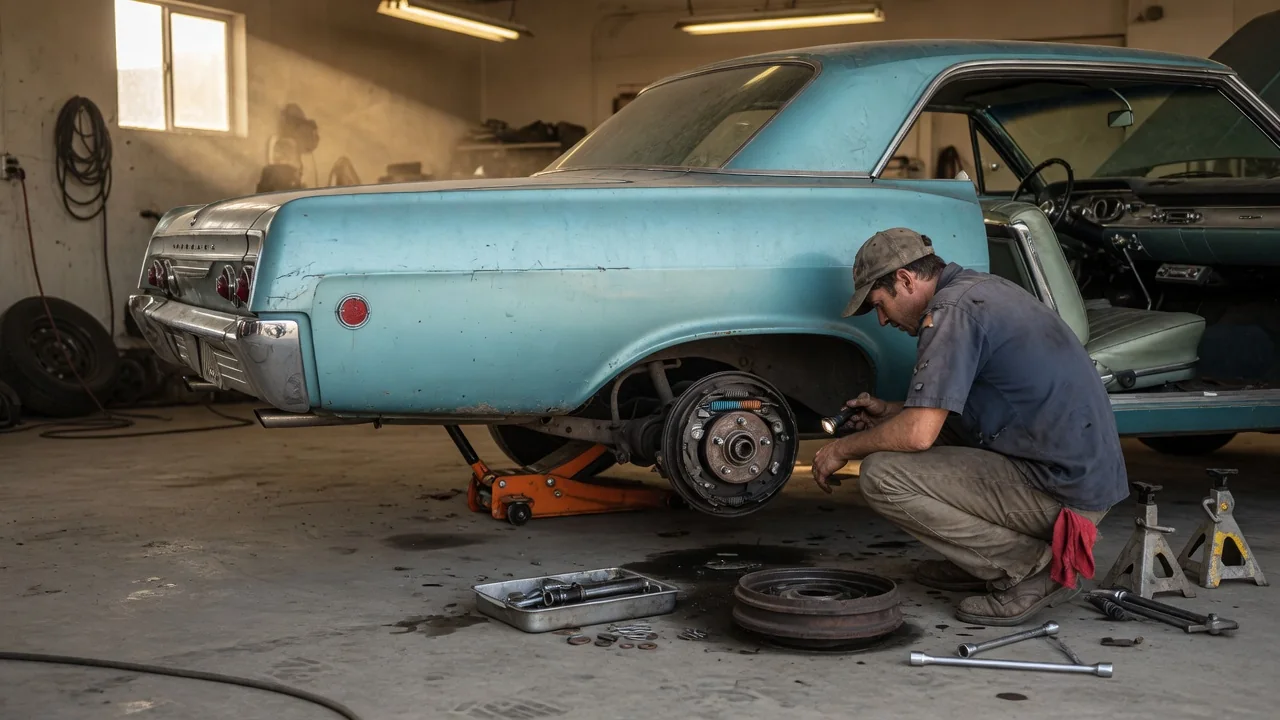
Anyone who has pulled a wheel off a classic sedan has probably wondered why older cars used drum brakes more often than the disc setups common today. The answer has less to do with one design being better and more to do with how cars were built, what materials and tooling were available, and what drivers expected from their vehicles at the time.
Brake construction
A drum brake places its working parts inside a cast iron or steel drum that rotates with the wheel. Two curved shoes lined with friction material sit against a fixed backing plate, and a hydraulic wheel cylinder pushes them outward against the inner surface of the drum when the pedal is pressed. Return springs pull the shoes back afterward. This layout grew out of earlier mechanical brakes operated by rods and cables, so engineers and factories were already familiar with the basic arrangement when hydraulics arrived.
Many drum designs also have a self-energizing effect, where the rotation of the drum helps wedge a shoe more firmly into contact. That meant a useful amount of braking force could be produced from modest pedal effort, which mattered in an era when power assistance was uncommon or optional. A disc brake, by contrast, clamps pads against a flat rotor and generally relies on higher hydraulic pressure. The exact shoe arrangement, adjuster type, and drum size differed between manufacturers and model years, so details vary from car to car.
Cost and packaging
Manufacturing economics played a large role. Drums, shoes, springs, and backing plates could be made with casting and stamping methods that carmakers had refined over decades, and the supply chain for those parts was mature. Disc systems required calipers machined to tighter tolerances, seals able to cope with higher pressures and temperatures, and often a brake booster to keep pedal effort comfortable. Adding those components to a mass-market car raised complexity at a time when buyers were not yet asking for them.
Packaging mattered as well. A drum brake easily incorporates a parking brake, because a simple cable and lever can spread the same shoes used for normal stopping. The enclosed design also tucked neatly inside the steel wheels of the period and kept the friction surfaces shielded from road grime. Once tooling, assembly lines, and service training were all organized around this layout, changing it meant significant investment, so manufacturers tended to move gradually, often fitting discs to the front axle first while retaining drums at the rear.
Current uses
Drum brakes have not disappeared. Many economy cars, compact pickups, and light commercial vehicles still use them on the rear axle, where the braking load is lower because weight shifts forward during a stop. In that position a drum can do its job for a long time while keeping the built-in parking brake function. Heavy trucks and trailers with air brake systems also commonly use drum assemblies, though the design and actuation differ considerably from those on a passenger car.
Some electric and hybrid vehicles have returned to rear drums as well. Because regenerative braking handles much of the routine slowing, the friction brakes may see lighter use, and an enclosed mechanism is less exposed to moisture and corrosion during long idle periods. Certain vehicles with rear discs even hide a small drum inside the rotor hub solely for the parking brake. Whether a given model uses drums, discs, or a combination depends on the manufacturer, trim level, and market, so the equipment should be confirmed for the specific vehicle.
Everyday Use and Observations
On a car with drums, the most visible clue is a smooth, closed metal cylinder behind the wheel rather than an exposed rotor and caliper. Owners of older vehicles often notice characteristics tied to the design. Because the drum encloses its friction surfaces, heat leaves more slowly, and repeated hard stops or a long downhill grade can lead to a longer, softer pedal as the brakes fade. After driving through deep water, the first few applications may feel weaker until the linings dry out.
Adjustment is another everyday consideration. As the linings wear, the shoes must travel farther to reach the drum, so many older cars needed periodic manual adjustment, while later designs added self-adjusting mechanisms. A parking brake lever that travels higher than it used to, or a pedal that sits lower, can hint that the shoes need attention. Brake dust also collects inside the drum instead of on the wheel face, which keeps wheels cleaner but means wear is not visible without removing the drum.
Limits and Next Steps
The same traits that made drums practical also defined their limits as cars became heavier, faster, and more often driven on highways. Heat buildup during sustained braking, sensitivity to water, and the need for adjustment pushed manufacturers toward front discs, which shed heat into open air and behave more consistently from stop to stop. This shift happened at different times for different makers and markets, so the year or model alone does not reliably indicate what a particular classic car has fitted.
For anyone owning or shopping for an older vehicle, the sensible next step is to identify the actual brake equipment and its condition instead of assuming. Symptoms such as pulling to one side, grabbing, squealing, or a spongy pedal can stem from several causes, including contaminated linings, leaking wheel cylinders, or worn hardware, and each calls for proper inspection. Brakes are a safety-critical system, so the factory service information for the specific car and a qualified technician are the right resources for diagnosis and any repair work.