Why Did Older Cars Need Choke Adjustment?
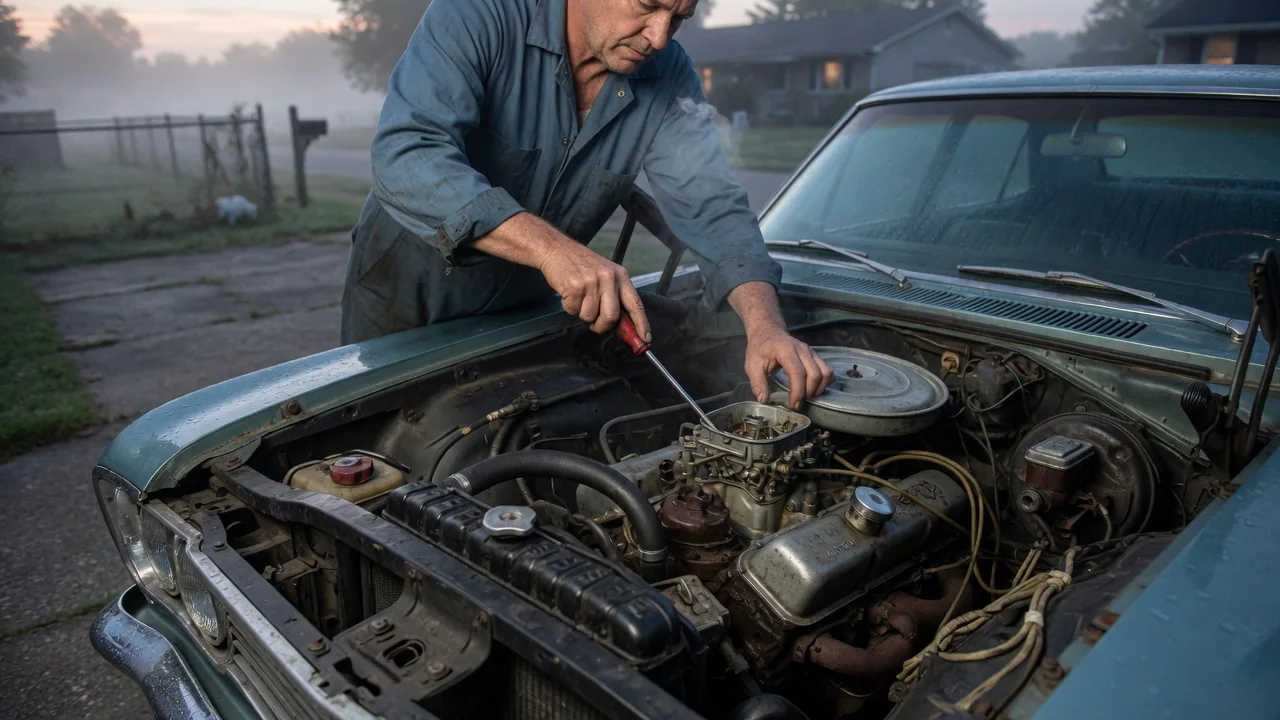
Before fuel injection became common, most gasoline engines relied on a carburetor to mix fuel and air, and a carburetor cannot sense engine temperature by itself. The choke filled that gap. Drivers of older cars pulled a knob or depended on an automatic mechanism that still needed periodic setting. The reasons come down to how fuel behaves in a cold engine, what changes during warmup, and how the driver fit into the process.
Cold mixture
Gasoline burns well only as a vapor mixed with air. In a warm engine, heat in the intake manifold and cylinder head helps fuel droplets evaporate on their way to the combustion chamber. In a cold engine that help is missing. Much of the fuel leaving the carburetor condenses on cold manifold walls or stays in droplets too large to burn completely. The mixture the carburetor meters may be reasonable, but the vapor that actually reaches the spark plug is too lean to ignite reliably. Slow cranking on a cold morning adds to the problem, because weaker airflow through the carburetor breaks fuel up less effectively.
The choke compensates by deliberately oversupplying fuel. It is a flat valve, usually called a choke plate or butterfly, mounted in the carburetor's air horn above the venturi. When it closes, it restricts incoming air, and the engine's intake strokes create a stronger vacuum beneath it. That stronger vacuum draws more fuel from the carburetor's circuits relative to the air passing through. The result is a much richer mixture, so that even when a large share of the fuel fails to vaporize, enough does to support combustion. In effect, the choke trades efficiency for the ability to start and keep running.
This is the root of the need for adjustment. Too much choke sends excess fuel into the engine, while too little leaves the mixture too lean to start. Because the right amount of enrichment depends on temperature, no single fixed choke position suits every start.
Warmup
Enrichment that is necessary at the first turn of the key quickly becomes excessive. As combustion heat builds, the manifold and cylinders warm, fuel vaporizes more readily, and the engine needs progressively less extra fuel. The choke therefore has to open in stages, from nearly closed at a cold start to fully open once the engine reaches operating temperature. Managing that progression is the central task of any choke system, whether a person or a mechanism controls it.
Many carbureted cars used an automatic choke to handle this transition. A common design uses a bimetallic coil spring that holds the choke plate closed when cold and relaxes as it is heated, whether by exhaust heat, warm air routed from near the exhaust manifold, or an electric element, depending on the design. A vacuum-operated device, often called a choke pull-off or vacuum break, opens the plate slightly as soon as the engine starts so the first seconds of running do not flood the cylinders. A stepped fast idle cam linked to the choke holds the throttle slightly open during warmup, raising idle speed so the cold engine does not stall, then releases as the choke opens.
These parts explain why automatic chokes still needed adjustment. On many designs the coil housing could be rotated against index marks to change how firmly the spring held the plate, and the pull-off and fast idle settings had their own specifications. With age, springs could lose tension, linkages could stick with varnish and dirt, and vacuum diaphragms could leak. Each change shifted when and how far the choke opened, so a setting that suited the engine when new might no longer match it. Correct values and procedures are vehicle-specific and belong to the relevant service manual.
Driver use
On cars with a manual choke, the driver was the control system. A knob or lever, often on the dashboard, moved the choke plate through a cable. A typical cold-start routine was to pull the choke out before cranking, then push it back in gradually as the engine smoothed out and warmed. The skill lay in timing: too much choke for too long made the engine run rich and rough, while returning it too early could cause stalling or stumbling when pulling away. Conditions mattered as well, since a mild morning generally called for less choke, for a shorter time, than a freezing one.
Automatic chokes reduced that workload without removing the driver entirely. Owner's manuals for many carbureted cars told drivers to press the accelerator before a cold start, which on many designs allowed the choke to close and set the fast idle cam. Some carburetors also had an unloader feature that opened the choke when the accelerator was held to the floor during cranking, to help clear a flooded engine. Because these routines differed between carburetors and manufacturers, the procedure in the vehicle's own owner's manual was the reliable guide.
Using the choke on a warm engine was a common mistake. A hot engine already vaporizes fuel readily, so added enrichment can flood it and make a restart harder rather than easier.
Practical implications and limits
For owners of carbureted classics, choke behavior is one of the clearer indicators of fuel system health. A choke that stays closed or opens too slowly tends to bring black exhaust smoke, a strong fuel smell, rough running, sooty spark plugs and higher fuel consumption. A choke that opens too early or never closes fully tends to show up as hard cold starts, stalling soon after starting, or stumbling until the engine is warm. Confirming that the plate moves freely through its full travel is a sensible first observation before deeper work.
Over-choking also has costs beyond the tailpipe. Excess liquid fuel can wash lubricating oil from cylinder walls and dilute the engine oil, which is one reason to avoid leaving a manual choke out longer than needed. Seasonal shifts in temperature and in gasoline blends can also make a choke that behaved well in one season need attention in another. That helps explain why carburetor choke adjustment was treated as part of routine tune-up work rather than a one-time setting.
Choke adjustment also has clear limits. It governs only cold-start and warmup enrichment, so it cannot correct vacuum leaks, an incorrect float level, worn ignition parts or a dirty idle circuit, and those faults can imitate choke trouble. Settings, adjustment points and test methods vary by carburetor and should come from the service information for the specific vehicle rather than general rules of thumb. Fuel-injected engines largely removed the task, because the engine control unit uses temperature sensor input to add fuel during cold operation, which is why most modern drivers never encounter a choke.