Why Did Cars Move From Carburetors to Fuel Injection?
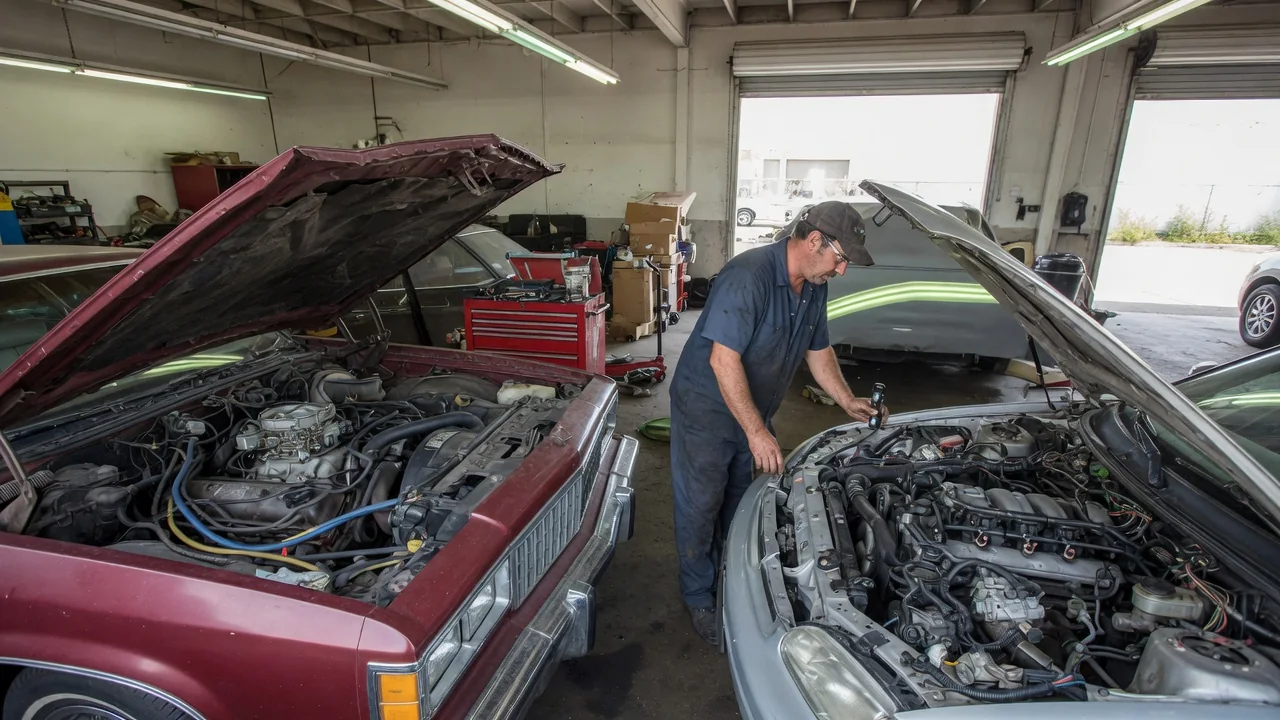
Anyone asking why did cars move from carburetors to fuel injection is really asking how engines learned to measure fuel more precisely. A carburetor relies on airflow and vacuum to draw gasoline into the intake, while injection delivers it under pressure in controlled amounts. That difference shaped emissions, drivability, fuel economy, and the way engines are serviced.
Fuel metering
A carburetor meters fuel mechanically. Air rushing through a narrowed passage called a venturi creates a pressure drop that pulls gasoline from a small reservoir through calibrated jets. The mixture depends on fixed passages, float level, and the strength of the vacuum signal, so it is tuned for a range of conditions rather than each individual moment. When air density changes with altitude or temperature, or when the engine is cold, the carburetor can only approximate the ideal air-fuel ratio using chokes, accelerator pumps, and supplementary circuits.
Fuel injection replaces that passive draw with active delivery. A pump pressurizes the fuel, and injectors spray it in measured pulses near the intake valves or directly into the combustion chamber, depending on the design. Because the amount is determined by how long each injector stays open, the system can adjust delivery continuously. Finer atomization also helps fuel mix evenly with air, which supports more complete combustion. The exact arrangement varies by vehicle, from a single injector feeding the whole intake to one injector per cylinder.
Control and emissions
The decisive advantage of injection is that it can be governed by an electronic control unit reading sensors. Signals for airflow or manifold pressure, throttle position, coolant temperature, engine speed, and exhaust oxygen content let the computer calculate fuel delivery many times per second. An oxygen sensor in the exhaust reports whether the mixture is running rich or lean, and the controller corrects it. This feedback arrangement, often called closed-loop control, is something a purely mechanical carburetor cannot match with comparable accuracy or speed.
That precision mattered because of exhaust emissions. A catalytic converter works efficiently only when the mixture stays within a narrow band around the chemically balanced ratio. Too rich, and unburned hydrocarbons and carbon monoxide rise; too lean, and nitrogen oxides increase and misfires may occur. Carburetors struggled to hold that band across cold starts, hard acceleration, and changing weather. As tailpipe standards tightened, keeping the mixture consistently on target became an engineering necessity, and electronically controlled injection offered a practical way to do so while also reducing wasted fuel.
Service differences
Servicing a carburetor is largely a mechanical task. Jets can clog with varnish from stale fuel, floats can stick or sink, gaskets and diaphragms age, and idle mixture and speed screws drift from their settings. Adjustment often involves listening to the engine, watching a vacuum gauge, and making small corrections by hand. Many owners appreciated that accessibility, since a rebuild required modest tools. The trade-off is that carburetors generally need periodic attention to keep running well, and their condition is judged mostly by symptoms rather than stored data.
Injection systems shift diagnosis toward electronics. The control unit monitors its sensors and can store a fault code when a reading falls outside expected limits. A code points to a circuit or condition worth investigating; it does not prove a specific part has failed, and many codes are manufacturer-dependent, so vehicle-specific service information is needed to interpret them. Typical concerns include restricted injectors, weak fuel pressure, vacuum leaks, and aging sensors. Because the fuel system operates under pressure, work on it is best left to trained technicians with proper equipment.
Everyday Use and Observations
The change is easiest to notice at startup. A carbureted engine on a cold morning may need a choke, a few pumps of the accelerator pedal, and a warm-up period before it idles smoothly. It can hesitate or stumble if driven off too soon. An injected engine usually starts with a turn of the key or press of a button, because the controller enriches the mixture automatically based on coolant temperature and then leans it out as the engine warms. Drivers experience this as consistency rather than as anything they must manage.
Other differences appear on the road. Carbureted vehicles can run noticeably differently at high altitude, on very hot days, or during hard cornering and steep grades, when fuel sloshes in the float bowl. Injection compensates for air density and is far less sensitive to vehicle attitude. Throttle response tends to be smoother, fuel consumption steadier, and the smell of raw gasoline at idle less common. How pronounced these traits are depends on the particular engine, its state of tune, and the generation of injection hardware fitted.
Limits and Next Steps
Fuel injection is not without drawbacks. It adds pumps, wiring, sensors, and a control unit, so there are more components that can age, and faults are sometimes harder to trace without scan tools and reference data. Injectors are sensitive to contaminated fuel, and electrical problems can mimic fuel problems. Carburetors remain in use on many small engines and are valued on classic vehicles for their simplicity and period correctness. The move to injection reflected priorities around emissions, efficiency, and consistency, not a verdict that carburetors could never work well.
For owners, the practical step is knowing which system a vehicle has and maintaining it accordingly. The owner's manual and factory service information describe the fuel system layout, recommended fuel, and maintenance schedule for that specific model. Hard starting, rough idle, hesitation, a fuel odor, or a warning light all justify a proper inspection rather than guesswork, since several different causes produce similar symptoms. Anyone considering converting a carbureted vehicle to injection should confirm parts compatibility and local emissions rules with a qualified specialist first.