Why Did Cars Adopt Wraparound Windshields?
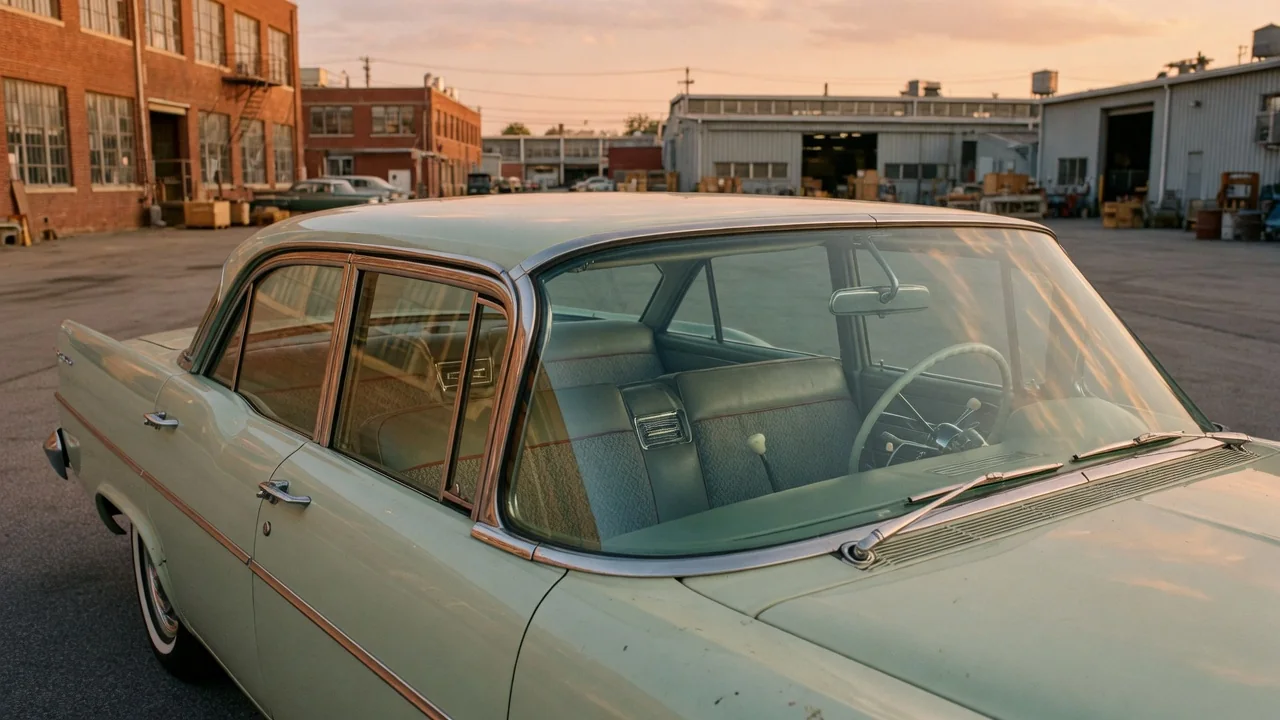
Wraparound windshields curve around the front corners of the cabin and sweep the glass back toward the doors. They became one of the defining features of postwar car design, especially in the 1950s. Why did cars adopt wraparound windshields? Three forces came together. Designers promised drivers a wider view. Stylists wanted a look that celebrated speed and modern technology. And improvements in glass forming made deeply curved panes practical to produce in volume.
Visibility
Earlier windshields were usually flat panels, or two flat panes joined at a center divider. Relatively thick pillars framed them on each side. Those pillars sat close to the driver's line of sight and created blind zones toward the front corners, which matter when turning, merging, or watching for pedestrians at intersections. Bending the glass around the corners moved the side pillars rearward and replaced part of that blocked zone with clear glass. The pitch to buyers was easy to grasp: more glass in front of the occupants meant a more open, panoramic view of the road.
The visibility gain was real but conditional. Moving the pillar back did not eliminate it. It relocated the obstruction and, in many designs, angled it into a shape that could still sit in the driver's peripheral vision. The tightly curved corners of the glass could also bend light and distort the view near the edges, so the added area was not always as optically clean as the center of the windshield. Designers were trading one visibility compromise for another. How well that trade worked depended on the geometry of each body, not on the wraparound concept itself.
Styling
Styling was arguably the stronger driver. The postwar public was fascinated by aviation, jet aircraft, and futuristic design, and automotive stylists borrowed freely from that imagery. A curved, canopy-like windshield made a car look lower, sleeker, and more modern than a flat upright pane. It also visually connected the windshield to the side windows, which suited the long, horizontal look many designers wanted. And it made a new car look clearly different from the previous generation.
Once wraparound glass appeared on show cars and higher-priced vehicles, it quickly became a marker of up-to-date design. Automakers changed appearance every year to help sell cars, so a feature buyers could recognize from across the street had obvious appeal. That competitive pressure helps explain why the wraparound windshield spread widely, particularly among American manufacturers, instead of staying a niche feature. In the history of wraparound windshield design, fashion and perceived modernity mattered at least as much as any measured functional advantage.
Manufacturing
None of this would have been possible without progress in glass production. A wraparound windshield needs compound curvature, meaning the glass bends in more than one direction. It also has to work as laminated safety glass: two layers of glass bonded to a plastic interlayer so the pane holds together when broken. Glassmakers developed ways to heat flat glass until it softened, let it sag or be pressed onto shaped molds, and then laminate matched pairs of curved sheets. The two layers had to match closely enough to bond without trapped air, built-in stress, or excessive distortion, which made the process demanding.
The body structure had to change as well. Because the glass wrapped around the corners, the front pillars could no longer be simple vertical posts beside the windshield. Many designs used a pillar that leaned backward or doubled back at its lower end, a shape often called a dogleg. That pillar had to support the roof, work with the door opening and seals, and frame the curved glass. All of this made stamping, welding, and sealing more complicated than with a flat windshield opening.
These requirements added tooling and production complexity. Each new windshield shape needed its own forming molds and matching body dies. The large curved pane was also more costly to make and needed more careful handling than a flat one. Manufacturers accepted those costs because the feature helped sell cars. Even so, the expense was one of the factors that pushed later designs toward more moderate curvature.
Practical implications and limits
In everyday use, the most commonly cited drawback was the dogleg pillar. Its lower section could project into the door opening, so people getting in or out of the front seat had to watch their knees and shins. This trade-off shows up in daily driving rather than in a styling sketch. It is one reason later designs moved toward pillars that sweep forward and upward instead of doubling back at the base.
Structural and safety priorities also shifted over time. Automakers and regulators placed more emphasis on roof strength, occupant protection, and stiffer body shells. That favored a gently curved windshield set into a strong, continuous pillar. Modern windshields are still curved and often steeply raked, and they are frequently bonded to the body so the glass adds to structural stiffness. They rarely wrap sharply around the corners in the classic sense, though. The visibility goal survived, but the extreme geometry largely did not.
Owners of older vehicles with wraparound glass face different practical concerns. Replacement windshields in these shapes may be harder to find than modern glass, and the fit depends on the condition of the surrounding pillars, channels, and seals. Some distortion near the curved corners is part of the design, so it is not automatically a defect. Anyone restoring or repairing such a car should check that vehicle's documentation and use installers who know the shape, since general principles cannot replace model-specific guidance.