Why Did Cars Adopt Anti-Lock Brakes?
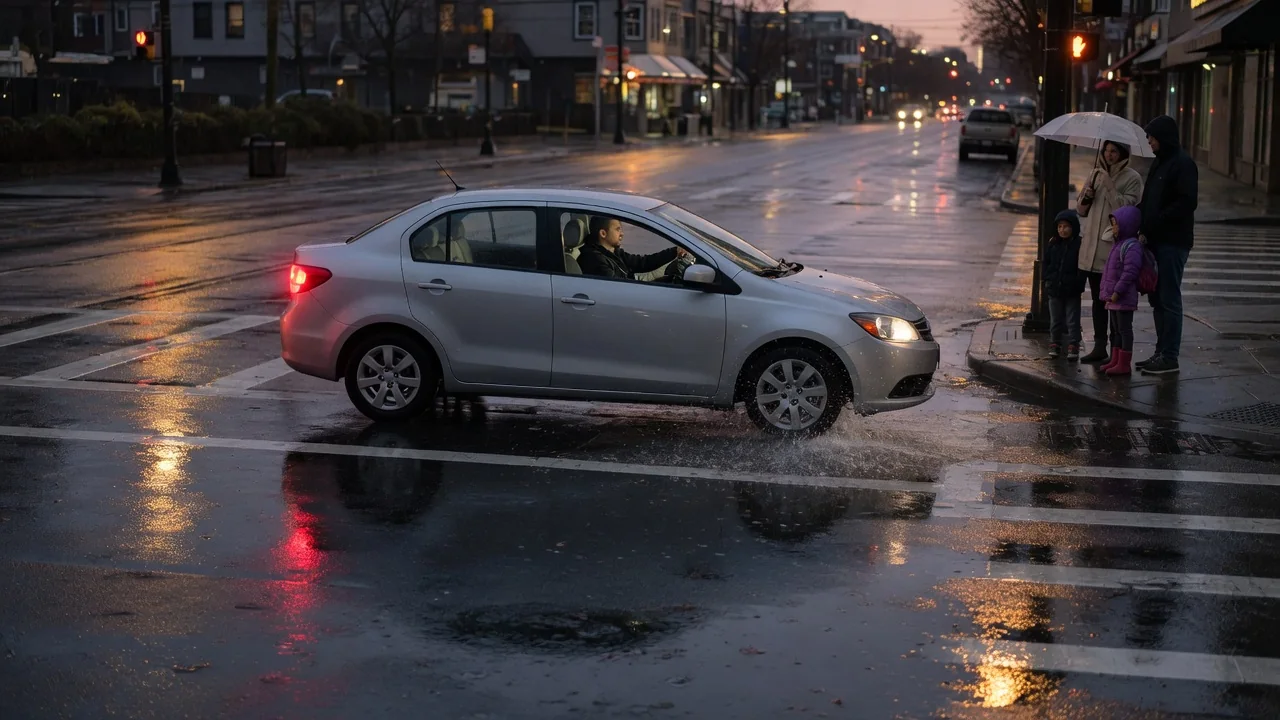
Anyone asking why did cars adopt anti lock brakes is really asking about control. A tire that stops rotating while the car is still moving can no longer steer, and panic stops used to end that way often. Anti-lock systems were developed to keep the wheels turning just enough to preserve grip and direction while the driver brakes as hard as the road allows.
Wheel lock issue
A tire generates its strongest braking force when it is still rolling but slipping slightly against the pavement. Push past that point and the wheel stops turning altogether, leaving a patch of rubber sliding across the surface. A sliding tire usually grips less than a rolling one, and more importantly it cannot produce the sideways force needed to change direction. Turning the steering wheel with the front tires locked does almost nothing, so the car continues straight toward whatever the driver was trying to avoid.
Locked rear wheels create a different hazard, because the back of the vehicle loses its lateral stability and can swing around into a spin. Before anti-lock systems, drivers were taught to pump the pedal or ease off at the first hint of a skid, a skill that is difficult to perform in a genuine emergency. Wet leaves, painted lines, ice and loose gravel made lockup arrive at surprisingly light pedal pressure, and a road with different grip under the left and right wheels could pull the car sideways.
Electronic sensing
Early attempts to prevent lockup relied on mechanical and hydraulic devices, with the idea first proving itself in aircraft landing gear, where a skidding tire could be destroyed in moments. Those systems were too bulky and slow for mainstream passenger cars. The practical breakthrough came when compact electronics could monitor wheel rotation many times each second and react faster than any human foot. Once microprocessors became affordable and reliable, anti-lock braking moved from an expensive option on luxury models toward ordinary family vehicles.
A typical system uses a speed sensor at each wheel, reading a toothed or magnetic ring that turns with the hub. The control unit compares those signals, and when one wheel slows far more sharply than the vehicle possibly could, it treats that as impending lock. A hydraulic modulator then holds, releases and reapplies pressure to that brake in rapid cycles. Layouts vary by vehicle and era, with some older designs controlling the rear wheels as a pair rather than individually, so vehicle-specific documentation matters.
Driver experience
From the driver's seat, the most noticeable sign of intervention is a rapid pulsing or vibration through the brake pedal, often accompanied by a buzzing or grinding noise from the hydraulic unit. This sensation alarms people who have never felt it, and some instinctively lift off the pedal, which is exactly the wrong response. The pulsing means the system is working. The intended technique is to press firmly, keep the pressure on, and steer where the car needs to go.
That ability to steer under full braking is the main reason the technology spread. A driver facing a stopped vehicle or a pedestrian can brake hard and still move around the obstacle, rather than choosing between slowing and turning. Pedal feel differs between models, with some producing a strong kickback and newer designs feeling smoother and quieter. The steering response also depends on tire condition and speed, since the system can only use the grip that actually exists between the rubber and the road.
Everyday Use and Observations
In ordinary driving the system stays in the background, and many drivers go months without feeling it activate. A warning lamp on the instrument panel normally illuminates briefly at startup as the control unit checks itself, then goes out. Some vehicles also make a brief click or hum shortly after setting off while the pump and valves are tested. Activation is most likely on rain-slicked intersections, icy mornings, gravel shoulders and steel plates or painted markings, where one or more tires momentarily lose traction.
The same wheel speed information later became the foundation for other functions, which is another reason manufacturers embraced the hardware. Traction control uses it to detect a spinning drive wheel under acceleration, and stability control uses it alongside steering and yaw sensing to brake individual wheels and correct a slide. Electronic brake force distribution adjusts front-to-rear balance as load changes. Which of these features a given car has, and how they behave, depends on the manufacturer, the model year and the equipment level.
Limits and Next Steps
Anti-lock brakes do not repeal physics. They help the tires use available grip, but they cannot create more of it, so worn tread, excessive speed and short following distances still lead to collisions. On loose gravel or deep snow, a locked wheel can build a wedge of material in front of it that helps slow the car, so stopping distances with anti-lock control may be longer there even though steering is retained. Its purpose has always been control first, with shorter stops on many surfaces as a frequent benefit.
If the warning lamp stays lit while driving, the anti-lock function is usually disabled while normal braking generally remains, though a simultaneous red brake warning deserves prompt attention and cautious driving. Stored fault codes point a technician toward a circuit or condition, not a confirmed failed part; a wheel speed code can stem from a damaged sensor, a corroded tone ring, wiring faults or a worn bearing. Code meanings can be manufacturer-specific, so proper diagnosis with vehicle-specific information is the sensible next step before replacing anything.