Why Car Interior Lights Stop Working: Causes and Safe Checks
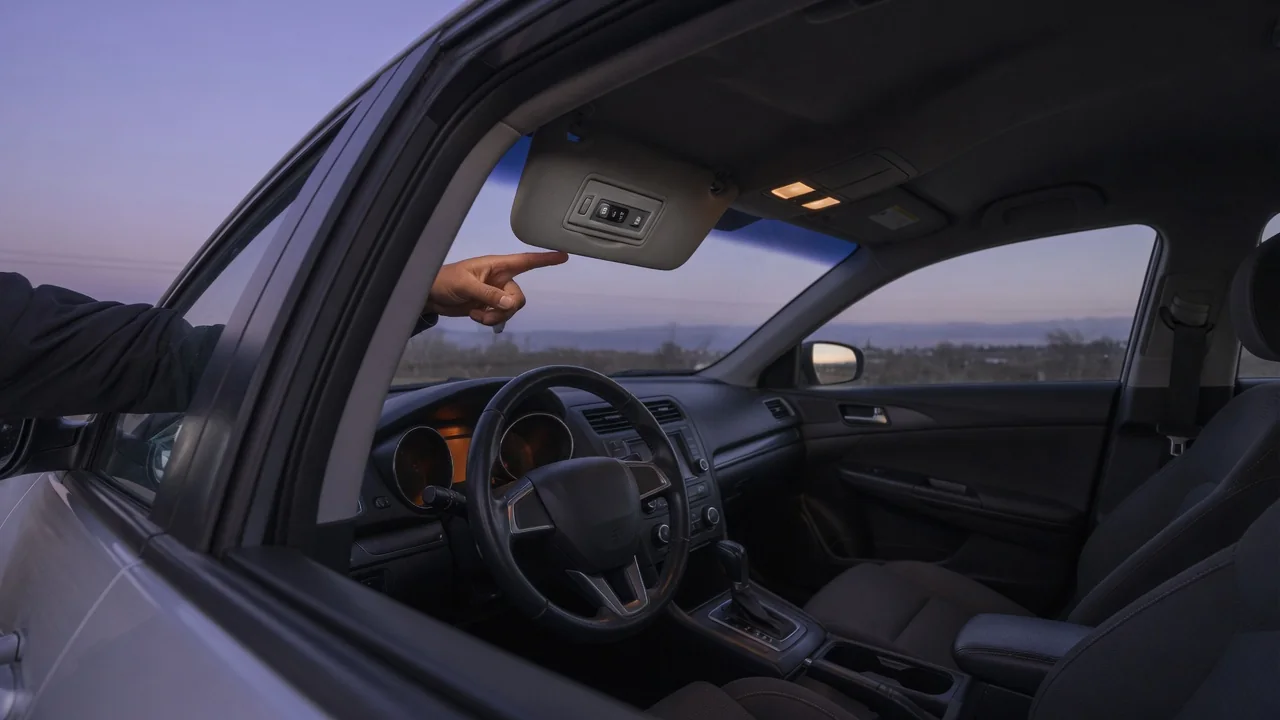
When car interior lights are not working, the cause is often simpler than it first appears: a switch setting, a dimmer, a fuse or a door signal that never arrives. This guide explains why interior lights stop working in cars, trucks and trailers, which checks are safe to make yourself, and when the problem belongs with a professional.
Start With the Simple Settings Before Assuming a Fault
Most dome lights have a three-position switch: on, off and door. In the door position the lamp waits for a signal that a door has opened; in off, it ignores the doors completely. A bump from luggage or a hand reaching for the map light can leave the dome light switch in off, which looks exactly like a failure. Many vehicles also set interior lighting brightness through the dash dimmer switch, so a dimmer rolled all the way down can make healthy lamps seem dead.
Counting the dark lamps narrows things quickly. If one map light or courtesy light is out while the others work, the bulb, its contacts or that lamp assembly is the likely culprit, because power clearly reaches the rest of the cabin. When several lamps go dark together, look for something they share, such as a switch setting, a fuse or a control module. Controls differ between manufacturers, so read the lighting section of the owner's manual rather than assuming every car works the same way.
When All Interior Lights Go Out at Once
When all interior lights are not working at the same moment, a blown interior light fuse is a sensible first suspect, since one fuse commonly protects the whole circuit. The fuse box diagram on the panel cover or in the owner's manual shows which fuse serves the interior lamps. Replace a blown fuse only with one of the same rating. If the new fuse fails again, a short or other fault is drawing excess current, and a higher-rated fuse simply moves the weak point to the wiring.
On many modern vehicles the lamps are not wired straight to the doors. A body control module reads the door signals and decides when to light the cabin, and a battery saver timer switches everything off after a set period. A setting, a module fault or a lost door signal can therefore darken every lamp while the fuse stays intact. A weak battery, or one that was recently disconnected, can also cause odd lighting behavior or reset stored settings, so check battery condition early.
Radio and Interior Lights Not Working Together
If your radio and interior lights are not working together, treat the pairing as a clue. On many vehicles the audio unit and the cabin lamps draw from the same fuse or power feed, so one fault can silence both. Note what else quit at the same moment: the clock, the power outlets or keyless entry. A cluster of dead accessories points to a common supply problem, while a lone failure points toward the component itself.
Which accessories share a fuse varies by make, model and year, so the layout has to come from vehicle-specific information rather than a general rule. Resist the temptation to borrow a fuse from another circuit or to bypass the fuse as a test; both remove the protection that keeps a wiring fault from overheating. If the correct fuse is intact yet the shared circuit stays dead, or the fuse fails repeatedly, the fault needs professional electrical testing.
Model-Specific Interior Light Problems: Check Vehicle Details First
Drivers of a 4Runner, Tacoma or Tundra, a Crown Vic, a Defender, an E36, an F250, a G35, a Pontiac G6 or a PT Cruiser are usually chasing the same handful of causes. The same applies to a Golf Mk4, Mk5 or Mk6, a Jetta, a Passat B5, a Skoda, a Sprinter van, a W124 or W204, and the Jaguar XE, XF and F-Pace. Fuse locations, switch types and lighting control logic differ by vehicle, so confirm them in the owner's manual or official service information.
In general terms, the door signal can be lost in several ways. Some designs use a plunger-style door jamb switch that can corrode or stick, while others rely on a sensor inside the door latch. Wiring flexes each time a door opens, so conductors in the hinge area can wear. None of this means a particular model has a known defect. Some vehicles also let owners change interior light behavior in the infotainment or settings menu, and a dealer can check for official service bulletins more reliably than forum claims.
Interior Cab Lights in Freightliner and Kenworth Trucks
Heavy trucks add layers that passenger cars lack. A Freightliner Cascadia or Kenworth T680 may have separate cab and sleeper lighting circuits, each with its own switches, control panel or power management. Begin with the obvious: check every light switch position, compare the sleeper controls with those in the cab, and use the fuse panel diagram in the operator's manual to identify the circuits serving the cab lights. Note whether one zone is dark or the whole interior.
Some trucks have a battery disconnect switch or a low-voltage cutoff that shuts off interior loads when battery voltage falls, preserving enough charge to start the engine. After a long stop with accessories running, dark interior lights may be that protection doing its job rather than a wiring fault. Modern Freightliner and Kenworth trucks also use multiplexed electrical systems, in which switches send data messages instead of switching current directly. Diagnosing those networks takes a qualified truck technician with the proper tools.
Trailer, Camper and Pop-Up Interior Lights Not Working
When trailer interior lights are not working, first establish where their power comes from. Depending on how it is wired, an enclosed trailer, cargo trailer or horse trailer may feed its interior lamps from the tow vehicle connector, a trailer battery, or both. Check that the trailer battery is charged, that any battery disconnect switch is on, and that the connector is fully seated and clean. A bad ground connection is a common general cause of dim or dead trailer lights, because current has no reliable return path.
Campers work a little differently. In a Jayco or Forest River unit, a pop up or a tent trailer, the interior lamps typically run on a 12-volt system supplied by the house battery, with a converter supporting that system when the unit is plugged in. Whether the lights fail on battery, on shore power or on both helps show where the fault sits. Check the 12-volt fuse panel using your own unit's manual, and leave shore power, converter and 120-volt problems to a qualified RV technician.
Safety Limits and When to Get Professional Help
Observation is the safest diagnostic tool an owner has. Note which lamps fail, whether the failure comes and goes, and whether other accessories are affected at the same time; those details shorten a technician's work considerably. Keep hands and tools away from wiring near airbags, seat sensors and the curtain airbags mounted along the headliner, close to where dome light wiring often runs. Never use improvised jumper wires to feed a lamp, since an unfused connection can overheat quickly.
Certain signs call for professional electrical testing rather than further checks: fuses that blow repeatedly, a burning smell, melted connectors, an unexplained battery drain, or lights that stay on after the doors are closed. Finally, this guide covers vehicles and trailers only. If a KitchenAid or Whirlpool refrigerator has interior lights not working, that is a different kind of system altogether, and the appliance maker's documentation or an appliance technician is the right resource.