Why Can Wet Roads Change Regenerative Braking?
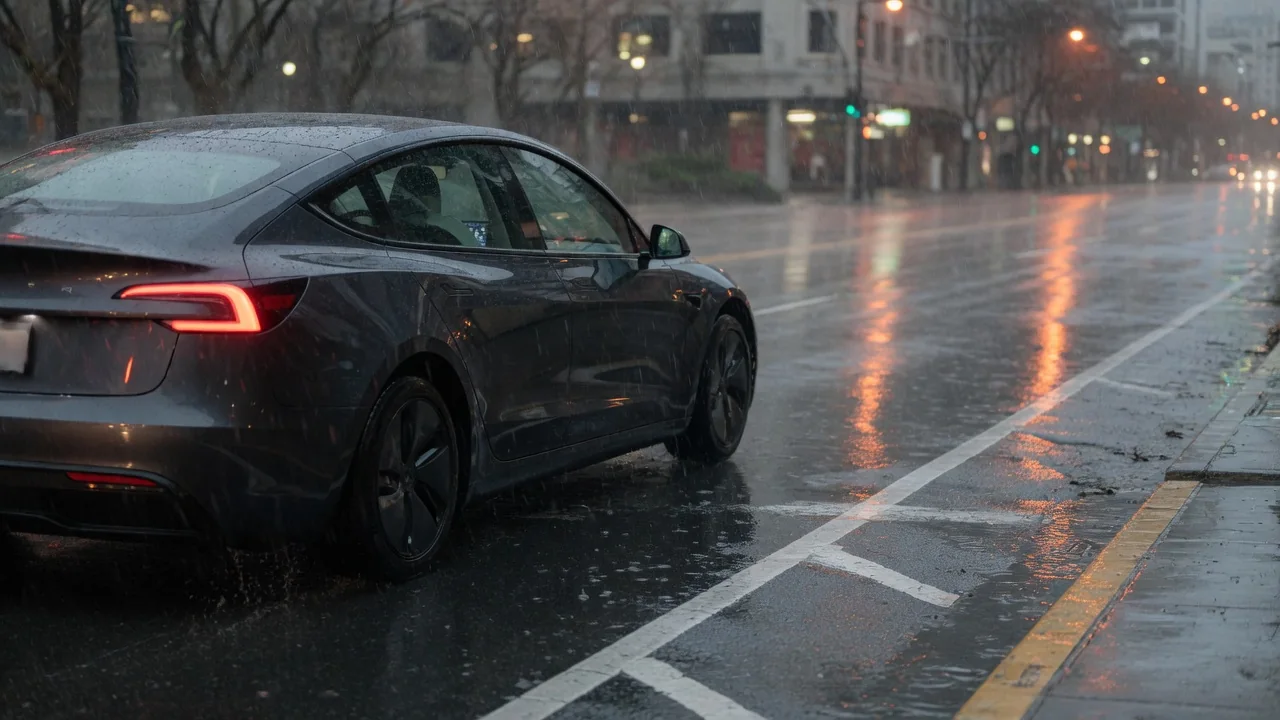
Regenerative braking slows a vehicle by running its electric motor as a generator and sending the recovered energy back to the battery. On dry pavement it usually feels smooth and predictable, but rain can change how much regen the car applies and how it feels from the driver's seat. The deciding factor is not the electrical system but the tires, because regen still has to work through the grip between rubber and road. This article looks at wheel grip, stability control, and driver feel.
Wheel grip: why regen depends on tire traction
Every braking force a car produces, whether from friction brakes or from a motor in regenerative mode, has to pass through the tire contact patches to slow the vehicle. The road can only push back on the tires up to a certain limit, set largely by the friction between rubber and pavement. A film of water lowers that limit. Deeper standing water can go further and lift part of the tread off the surface, which is the beginning of hydroplaning. When the requested braking force exceeds the available grip, the wheel slows faster than the car is actually traveling and starts to slip. A slipping tire transmits less braking force and also loses much of its ability to hold the car on its intended path.
Regen adds a particular twist to this problem. Conventional friction brakes act on all four wheels, with the balance usually biased toward the front, where weight shifts under braking. Regenerative braking, by contrast, acts only on the wheels connected to an electric motor. In a vehicle with a single drive motor, one axle carries all of the regenerative deceleration, so that axle can reach its grip limit sooner on a wet road than it would if the same deceleration were spread across four tires. Vehicles with motors on both axles can share regen between them, but how they divide it is a software decision that differs from one design to another. Regen is also commonly applied the moment the driver lifts off the accelerator, which can happen over slick spots such as painted lane markings, metal covers, or wet leaves.
Stability control: how the car manages regen on slippery surfaces
Electrified vehicles use the same wheel-speed sensors that serve the anti-lock braking and stability control systems. By comparing the speeds of individual wheels, the control software can detect when a driven wheel is decelerating out of proportion to the others, which is a sign of slip under regen. The usual response is to reduce motor braking torque very quickly so the tire can regain traction. If the driver is pressing the brake pedal, the system can blend in friction braking to make up for the regen it removed. When the anti-lock braking system becomes active, many vehicles scale back or suspend regenerative braking so that ABS can modulate the friction brakes at each wheel with the precision it needs.
Stability is a separate concern from stopping distance. Heavy regen on the rear axle of a slippery road can reduce the rear tires' sideways grip and encourage the back of the car to step out, which is oversteer. Heavy regen on the front axle can instead reduce steering response, which is understeer. Stability control watches signals such as steering angle, yaw rate, and lateral acceleration, and it can cut regen and brake individual wheels to keep the car pointed where the driver is steering. The thresholds and strategies behind these interventions are calibrated by each manufacturer and are not universal. In general the controls react to measured wheel and vehicle behavior; whether a particular vehicle also reduces regen in advance based on other inputs is vehicle-specific and is best confirmed in its owner's manual.
Driver feel: what changes behind the wheel
The most noticeable change on a wet road usually involves lift-off deceleration. Drivers who rely on strong regen or one-pedal driving may find that the car slows less firmly than expected, or that deceleration briefly fades and then returns when the system detects slip and backs off motor torque. The sensation can resemble a short moment of coasting. A traction or stability warning light may flicker on the dashboard at the same time. These responses are generally the control system doing its job rather than a sign of a fault, although a warning that stays on is worth having checked.
Brake pedal feel can change as well. In many hybrids and electric vehicles, the pedal is partly decoupled from the friction brakes so the software can decide how much stopping force comes from regen and how much from the pads and rotors. The controller aims to deliver consistent deceleration for a given pedal input, but when grip is limited and regen hands off to friction braking, the transition can sometimes be felt as a small shift in pedal response or in how the car slows. Because friction brakes see less routine use in electrified vehicles, the first firm stop after driving through rain may also feel slightly different while water clears from the rotors.
Practical implications and limits
For everyday driving, the practical lesson about regen and wet road traction is to make inputs gradual. Easing off the accelerator smoothly rather than lifting abruptly gives the tires a better chance of handling the deceleration request. Where a vehicle offers selectable regen levels, a lower setting can make lift-off behavior gentler on slick pavement; what settings exist, and what they do, depends on the vehicle. Allowing more following distance helps because the deceleration a driver is used to from one-pedal driving may not be fully available at the moment it is needed. Keeping a foot ready to cover the brake pedal is sensible in heavy rain. Tire condition matters more than any regen setting: adequate tread depth and correct inflation help channel water away from the contact patch.
There are also limits to what drivers should read into changes on rainy days. If the system frequently trims regen, a little less energy may be recovered on that trip, but the amount varies widely and cannot be predicted in general terms. Cold rain often coincides with a cool battery, and a nearly full battery can also restrict regen, so not every reduction in regen on a wet day is caused by water on the road. Over the long term, infrequent friction brake use in damp or salted conditions can contribute to rotor corrosion, which makes following the manufacturer's brake inspection schedule worthwhile. Finally, regenerative braking does not create extra grip. It operates within the same physical limits as any other braking, and the owner's manual remains the authority on how a specific vehicle manages regen when the road is wet.