Why Can Two Fill-Ups Show Different Fuel Economy?
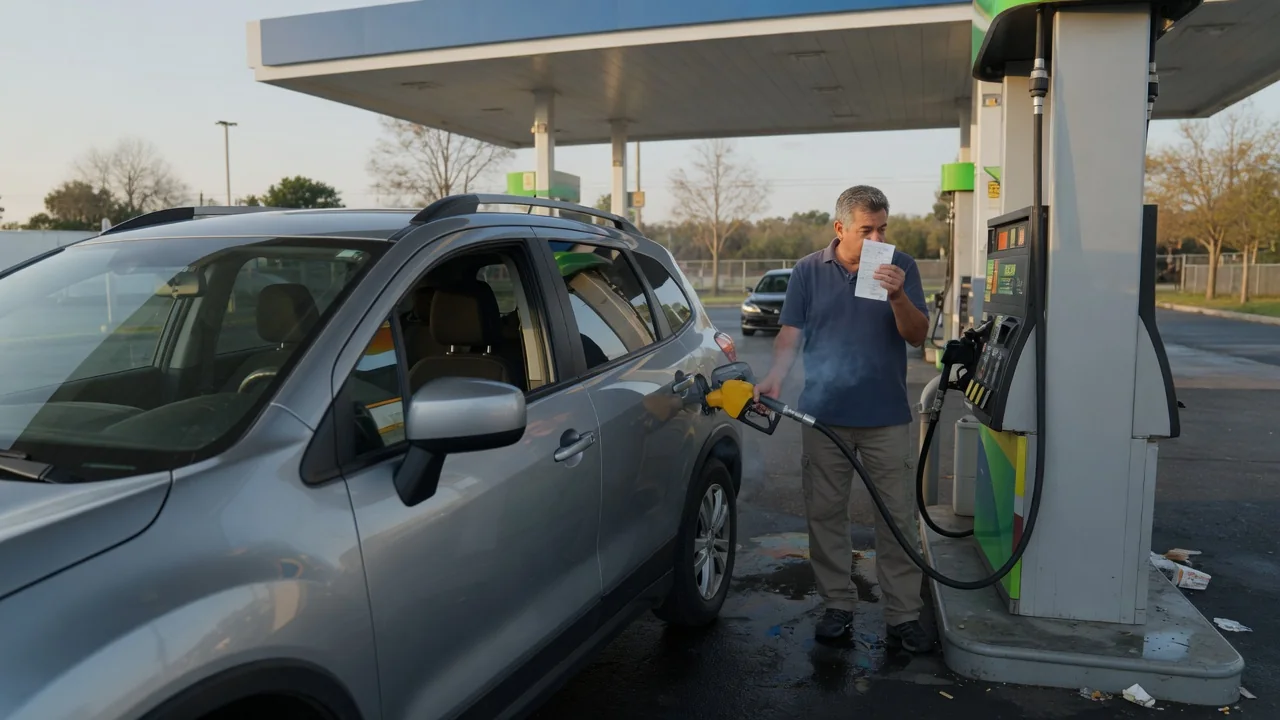
Drivers who track mileage at the pump often wonder why can two fill ups show different fuel economy when the car, the driver, and the commute seem unchanged. The answer usually lies in two places: small errors in how much fuel actually went into the tank, and real differences in how each tank was burned. Neither necessarily signals a problem.
Pump shutoff
A tank-to-tank calculation assumes the tank was filled to exactly the same level both times, and the pump nozzle rarely cooperates. The automatic shutoff trips when fuel or foam rises far enough to cover a small sensing port near the nozzle tip. How quickly that happens depends on flow rate, how deep the nozzle sits in the filler neck, and how the fuel surges inside the neck. A fast setting may click off early, while a slow trickle can leave the tank noticeably fuller.
Because the difference lands entirely in one tank's math, even a modest shortfall matters. If one fill stops a little early, that tank appears to have used less fuel and the calculated mileage looks generous; the next fill then makes up the missing fuel and looks worse. A car parked on a sloped forecourt, a different station's nozzle, or warm fuel that foams more can all shift the stopping point. Filler neck shape and tank design vary between vehicles, so some models are more sensitive than others.
Driving conditions
Even with perfect fills, no two tanks are burned the same way. A week of short trips keeps the engine in its cold, fuel-rich warm-up phase for a larger share of the miles, while a single highway run lets it settle at efficient operating temperature. Stop-and-go traffic wastes energy in braking, and long idling periods consume fuel while adding no distance at all. Higher cruising speeds raise aerodynamic drag sharply, so a tank spent at brisk interstate speeds can trail one spent on moderate two-lane roads.
Weather and load add another layer. Cold air is denser, tires lose pressure as temperatures drop, and winter-blend gasoline typically carries a little less energy than summer fuel. Headwinds, rain-soaked pavement, air conditioning use, a roof box, or a trunk full of cargo each nudge consumption upward. Hybrids and turbocharged engines can react more strongly to temperature and driving style than a simple naturally aspirated engine, so the size of the swing depends on the vehicle as well as the route.
Multi-tank averages
The fill-level error has a useful property: it does not accumulate. Fuel missed at one stop is added at the next, so the mistakes largely cancel when several tanks are combined. Adding total miles across three, five, or more consecutive fills and dividing by total gallons purchased gives a figure far steadier than any single tank. The only uncertainty left is the difference between the first and last fill levels, which shrinks in importance as the distance covered grows.
A running average also smooths the real variation in driving. One tank dominated by a road trip and another by errands blend into a number that reflects how the car is actually used across a month or a season. Comparing averages from similar periods, such as this autumn against last autumn, is more meaningful than comparing back-to-back tanks. The calculation only works if every fill is recorded, since a skipped receipt or a partial fill left out of the log distorts the total.
Everyday Use and Observations
Consistent habits reduce the noise. Using the same station and even the same pump, choosing the same flow setting, and stopping at the first automatic click make each fill more comparable. Topping off beyond that click is not a good way to gain precision, because excess fuel can reach the evaporative emissions system on many vehicles. Recording the odometer reading rather than relying on a trip meter that may have been reset by accident also keeps the distance side of the equation honest.
Many drivers notice that the dashboard display and the hand calculation disagree. The trip computer estimates consumption from fuel injector data and other engine signals, while the pump method measures what was dispensed, so each has its own error and a steady offset between them is common. Odometer readings can also drift slightly with tire wear or non-original tire sizes. A short note beside each entry, such as mostly highway, heavy traffic, or cold snap, makes later swings much easier to explain.
Limits and Next Steps
Hand calculation cannot isolate a single cause. A lower tank might reflect an early shutoff last time, a week of short trips, a fuel blend change, or all three together, and the arithmetic alone cannot separate them. For that reason one disappointing tank is weak evidence of a mechanical fault. What deserves attention is a sustained downward trend across several tanks under similar driving and weather, especially when the multi-tank average falls well below the car's own established baseline.
When that pattern appears, start with simple observations: tire pressures against the door-jamb placard, any dragging sensation or unusual heat at one wheel, fuel odor, a rough idle, or a warning light. A stored fault code can point a technician toward a system worth testing, but it is evidence to interpret rather than proof that a particular part has failed, and some codes are manufacturer-specific. Bringing a fuel log to the shop gives the technician a documented history instead of an impression.