Why Can Cleaning a Hot Car Panel Cause Streaks?
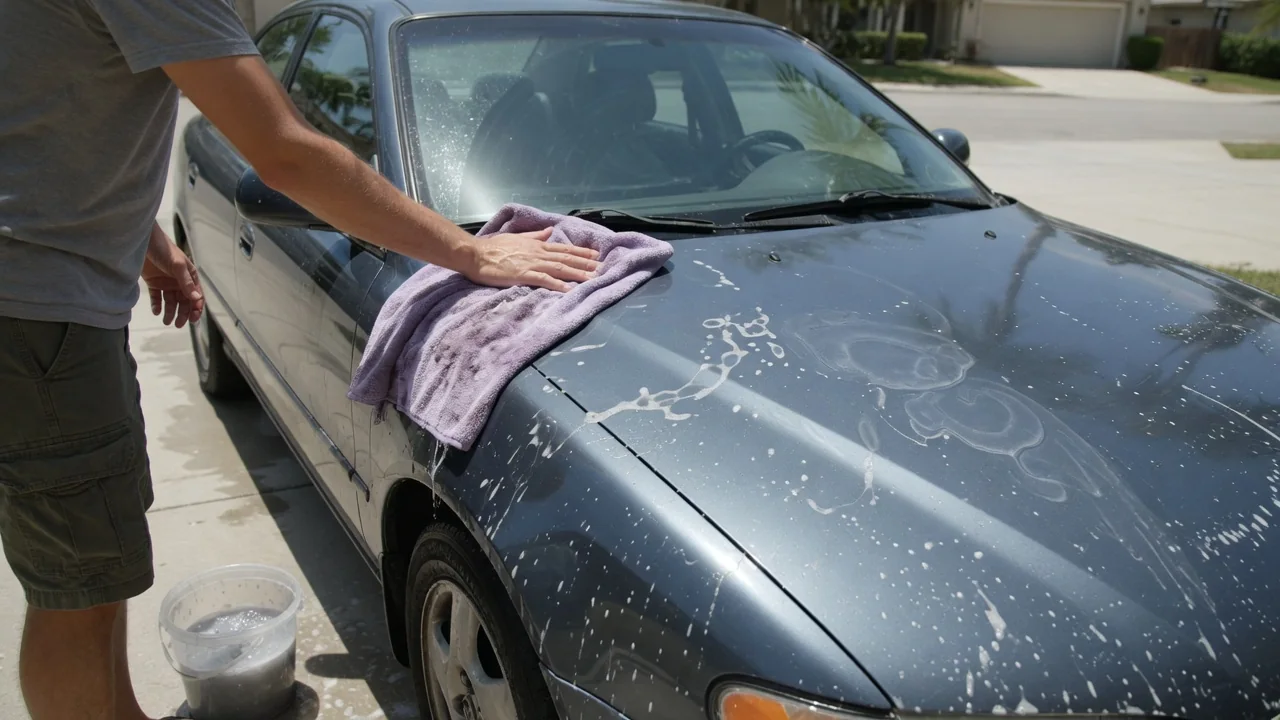
Washing or wiping a car that has been sitting in the sun often leaves streaks, spots, or a hazy film that was not there before you started. The product alone is rarely the cause. Heat changes how water and cleaning chemistry behave on paint, glass, and trim, and it shortens the time you have to work. Knowing why cleaning a hot car panel can cause streaks makes it easier to choose the right moment and method.
Fast Evaporation Shrinks Your Working Time
Every cleaning product depends on liquid to do its job. Water, solvents, and surfactants loosen dirt, hold it in suspension, and carry it away when you rinse or wipe. That process needs time. A panel that has absorbed sunlight or engine heat warms the thin film of liquid on it, and a thin film on a warm surface evaporates much faster than the same liquid in a bucket or on a cool panel. Moving air and dry conditions speed it up further. As a result, the product can start drying before you have finished spreading, agitating, or removing it.
Evaporation is not uniform. The edges of a spray pattern, thinner areas, and spots in direct sun dry first, while puddles and shaded recesses stay wet longer. Uneven drying creates boundaries where concentrated material collects as the liquid retreats. That is part of why streaks on a hot panel often appear as lines, rings, or tide marks rather than an even haze. Dark paint and glass in direct sunlight tend to get warmer than lighter or shaded surfaces, so the effect can vary across a single vehicle, but the underlying mechanism is the same on any car.
Heat also changes how a product behaves while it is still wet. Many cleaners are designed with a dwell time, a short period for the chemistry to work before it is wiped or rinsed away. On a hot surface that window can effectively disappear, so the product either does not work as intended or dries in place. Rinse water faces the same problem: it can evaporate before it sheets off the panel, leaving behind whatever it was carrying.
Residue: What a Streak Is Made Of
A streak is usually a deposit of material that was dissolved or suspended in the liquid and stayed behind when the liquid disappeared. On a hot panel, several kinds of material can end up in that deposit. The first is the cleaner itself: surfactants, slower-evaporating solvents, gloss enhancers, lubricants, and any polymers or waxes added for protection. These ingredients are meant to be diluted, spread thin, and wiped or rinsed away. When they dry in a concentrated band, they can show up as smears, oily rainbow patterns on glass, or cloudy patches on paint.
The second source is minerals in the water. Tap and well water contain dissolved minerals, and as droplets evaporate, those minerals remain as white or gray spots and outlines, commonly called water spots. Hot panels encourage this because droplets shrink quickly and leave their contents behind instead of running off. The third source is loosened dirt. If a cleaner lifts road film or dust but dries before that grime is wiped up, the dirt is redeposited across the surface as a thin, streaky layer.
Some residue is purely cosmetic and comes off with a fresh, correct cleaning. Other deposits can be more stubborn. Mineral spots that are left to bake in the sun repeatedly may become harder to remove, and concentrated chemicals drying on a surface can, depending on the product and the material, affect coatings, plastic trim, or rubber. The product label is the most reliable guide to which surfaces a specific cleaner is safe on and how long it may remain on them.
Technique That Prevents Streaks
The most effective step is to start with a cooler surface. Working in shade, early in the morning, or later in the day, and letting the vehicle sit for a while after driving, gives the panels time to lose heat. A simple check is to touch the panel with the back of your hand; if it feels hot rather than merely warm, it is likely to dry products too quickly. When shade is not available, a gentle water rinse can cool the surface before you apply a cleaner, as long as you keep the panel wet and do not let that rinse water dry into spots.
Working in smaller sections also matters. Treating one panel, or part of a panel, at a time keeps the product wet from application to removal. Spraying cleaner onto a microfiber towel instead of directly onto a warm surface reduces overspray drying on nearby areas, which is especially helpful on glass and interior surfaces. Use the amount and dilution the label calls for rather than mixing stronger to compensate for heat, since more product usually means more material left behind.
Removal technique completes the process. Rinse rinse-off products thoroughly and promptly, then dry the panel instead of letting it air dry. A clean, absorbent microfiber towel used with light pressure picks up water before minerals settle. For wipe-off products, a final pass with a second dry towel removes the thin film that causes haze. Towels that are dirty, saturated, or contaminated with wax or fabric softener can smear residue on their own, so switching to a fresh towel often fixes streaks that careful timing alone does not.
Practical Implications and Limits
In everyday terms, hot panel cleaner streaks are a problem of timing and conditions more than a product failure. The same cleaner that streaks at midday in full sun may perform well on the same car in the evening. That helps when deciding what to change: before buying a different product, change when and where you work. If streaks persist on a cool panel with clean towels, the cause is more likely the product, its dilution, the water quality, or an existing film on the surface. Interior glass, for example, can build up a film over time that keeps causing smears until it is fully removed.
General advice also has limits. Products are formulated differently, and some, such as waterless or rinseless washes, come with their own directions for use; the label remains the authority for those. Clear coat, ceramic coatings, matte finishes, and plastic or rubber trim can respond differently to the same chemistry, and the owner's manual may include care guidance for specific finishes. When a streak or spot does not come off with a normal, correct cleaning, testing a remedy on a small, inconspicuous area is safer than repeatedly applying stronger chemicals to a hot or sensitive surface.