Why Can Brake Fluid Level Drop Slowly?
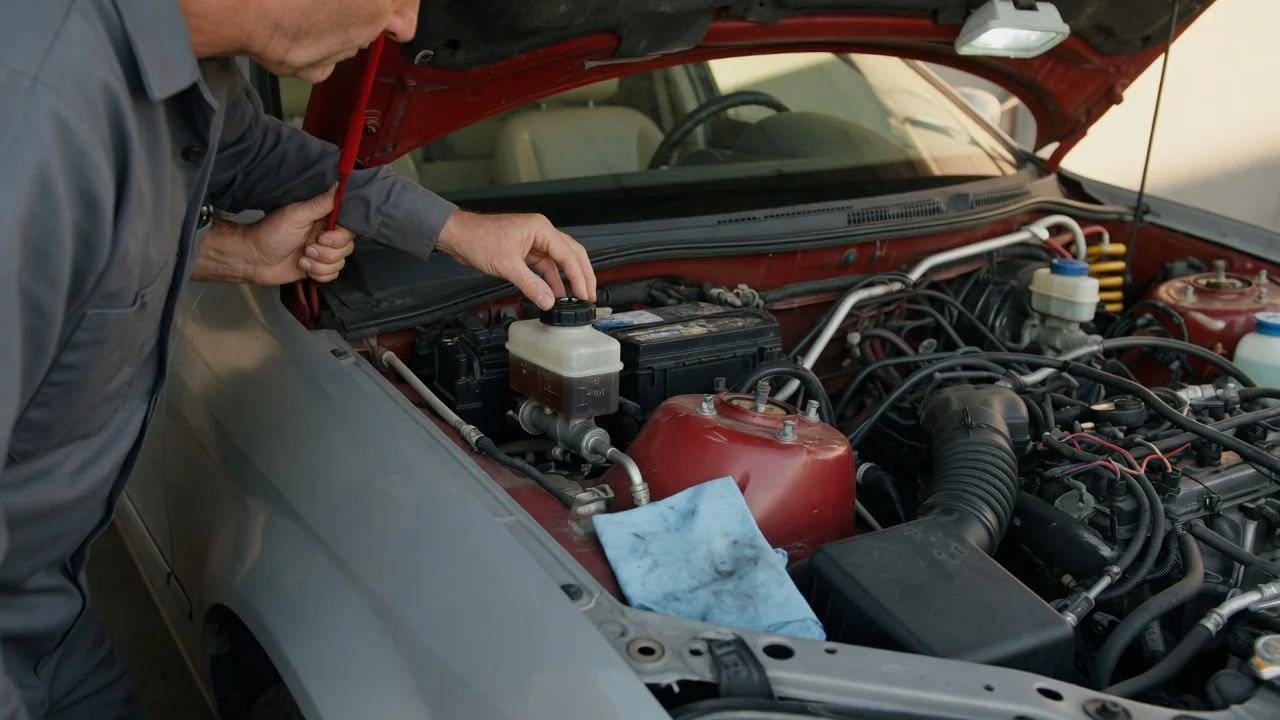
Drivers often ask why can brake fluid level drop slowly when nothing seems wrong with the pedal. The hydraulic system is sealed, so fluid is not consumed the way engine oil or washer fluid can be. A gradual decline usually points to one of two things: normal pad wear drawing fluid into the calipers, or a small leak that deserves prompt attention.
Reservoir marks
Most brake fluid reservoirs are translucent plastic with molded minimum and maximum lines, often labeled MIN and MAX, on the side. The level is meant to sit between those marks when the vehicle is parked on level ground. A reading near the upper line with fresh pads and a reading closer to the lower line with worn pads can both be normal, which is why the marks describe a working range rather than a single correct point.
Reservoir location and design differ by vehicle. Some sit in plain view on the master cylinder near the firewall, while others hide beneath a cowl cover or share fluid with a hydraulic clutch, which adds another place where fluid could go. Aged plastic can yellow and make the level hard to read, so a flashlight held behind the reservoir helps. The owner's manual shows the exact marks and specifies the fluid type, which is often printed on the cap as well.
Brake wear
Disc brake calipers self-adjust for wear. As pad friction material thins, each caliper piston rests farther out of its bore to keep the pad close to the rotor, and the space behind the piston fills with fluid drawn from the reservoir. Spread across several pistons over many months of driving, that displaced volume shows up as a slow, steady decline at the reservoir even though no fluid has left the system.
This explains why a level near the minimum line often coincides with pads that are close to needing replacement. When new pads are installed and the pistons are pushed back, the fluid returns and the level rises again. That is also why topping up to maximum on worn pads can cause an overflow at the next brake service. Vehicles with rear drum brakes or larger multi-piston calipers will show different amounts of change, so the drop varies by design.
Leak urgency
A leak is different because fluid actually leaves the system, and the hydraulic circuit depends on that fluid to transmit pedal force. Common seepage points include flexible hoses, corroded steel lines, caliper piston seals, drum brake wheel cylinders, and bleeder screws. On many vehicles the master cylinder can also leak past its rear seal into the brake booster, lowering the reservoir without leaving a drop on the ground, which makes that fault easy to miss.
Any suspected leak should be treated as urgent rather than watched for weeks. A level that falls below the minimum mark can allow air into the system, producing a soft or sinking pedal and longer stopping distances. Most modern vehicles split the hydraulics into two circuits so one failure does not remove all braking, but that is a backup, not a reason to keep driving. A pedal that feels spongy or travels farther than usual warrants a tow, not a test drive.
Everyday Use and Observations
A few simple observations help separate wear from leakage. Checking the reservoir at regular moments, such as during fuel stops or monthly under-hood checks, builds a sense of how quickly the level moves. A decline that takes many months and tracks with pad thickness fits normal wear. A drop that is noticeable over days or a couple of weeks, or one that returns soon after a top-up, does not fit wear and suggests fluid is escaping.
Visual clues matter too. Brake fluid is usually clear to amber and feels slick, and it tends to appear as wet streaks on the inside of a wheel or tire, damp spots along a brake line, or a small puddle near a wheel. It can also damage paint, so a blistered finish beneath the master cylinder is a sign. A red brake warning light may come on from a level sensor in the reservoir, though sensor arrangements and warning messages vary by manufacturer.
Limits and Next Steps
A reservoir check has limits. It cannot show pad thickness at each wheel, the condition of lines hidden above the fuel tank or subframe, or a seal that weeps only under pressure. A warning light or stored fault code related to the brake system is evidence to interpret, not proof that a specific part has failed, and manufacturer-specific codes need to be confirmed against information for that particular vehicle before parts are replaced.
The sensible next step is a brake inspection that measures pads and checks hoses, lines, calipers, wheel cylinders, and the master cylinder for dampness. If fluid must be added to reach the minimum mark, only the type specified on the cap or in the manual should be used, since fluid types are not all interchangeable, and the addition should be mentioned to the technician. Adding fluid restores the level but does not address the reason it fell, so the cause still needs to be found.