Why Can a Small Dent Cause a Large Panel Reflection Change?
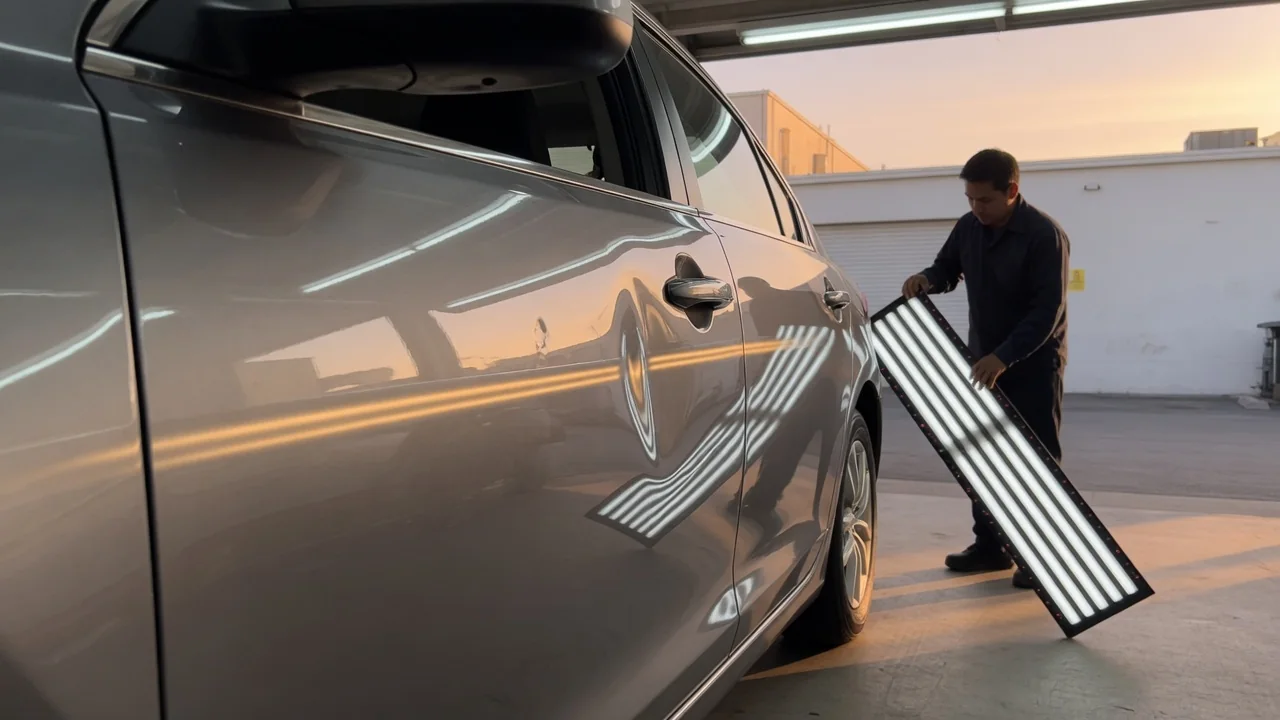
A dent you can barely feel with a fingertip can still bend the reflection of a window frame, a tree line, or a shop light across a large part of a door or fender. Many owners find this confusing, because the visible distortion looks far bigger than the damage itself. The answer lies in three things: glossy paint acts like a curved mirror, reflected lines show changes in surface angle rather than depth, and those same factors shape the repair choice.
Curved surface: why slope matters more than depth
A glossy car panel behaves like a large curved mirror. What you see in it depends on the angle of the surface at each point, not on how far that point sits in or out. When a dent forms, the metal at its walls tilts away from the original contour. Under the basic law of reflection, tilting a mirror by a small angle turns the reflected ray by twice that angle. The farther away the reflected object is, the more that change in angle moves its image across the panel. A very shallow depression can therefore shift the reflection of a distant roofline or light fixture by a visibly large amount.
The dent is also usually larger than the spot that was struck. Sheet metal is a continuous, stressed surface, so an impact pulls the surrounding area with it. The low spot is often ringed by a raised shoulder or crown where metal was displaced, and the transition zone between them extends well beyond the visible mark. Each of these areas has its own change in slope, so the reflection is disturbed across a band much wider than the center of the dent. On flatter panels with little curvature, an impact can also leave a broad, soft distortion that shifts the whole area rather than forming a crisp crater.
Panel shape affects how noticeable all of this becomes. Large, gently curved areas such as hoods, roofs, and the middle of doors produce smooth, predictable reflections, so any local deviation stands out. Tightly shaped areas, sharp body lines, and complex compound curves already bend reflections heavily. That can partly hide a small dent, but it also makes the dent harder to judge and repair. These are general tendencies. How a particular panel responds depends on its design, material, thickness, and internal bracing.
Light lines: how reflections reveal the damage
Body technicians and careful inspectors rely on straight reflected lines because they turn a subtle surface error into an obvious visual one. On undamaged paint, a fluorescent tube, a striped reflector board, a straight building edge, or the line where a garage door meets the ceiling reflects as a smooth line or a smoothly curving one. Over a low spot, the line bends, pinches, or appears to break apart. Over a high spot, the lines tend to bunch together. Reading how the lines distort shows where the surface slopes inward or outward, much like reading a contour map.
Viewing conditions change how large the effect looks. Looking along the panel at a shallow, glancing angle magnifies distortion, while looking straight at it can make the same dent nearly disappear. Moving your head or moving the light makes the distorted region seem to travel, which helps you find its edges. Paint matters too. Dark, high-gloss finishes produce sharp reflections that reveal small irregularities. Lighter colors, heavy metallic content, and matte or textured finishes scatter light and soften the image.
Not every wavy line means there is a dent. Factory paint has some orange peel texture, panels are built to normal manufacturing tolerances, and earlier repairs with filler or refinishing may reflect differently from original surfaces. Part of reading light lines is separating these background patterns from the localized, sharply defined distortion that a recent dent creates. People generally notice a break in an otherwise continuous line quickly. That is why a dent seen in reflected light can feel far more prominent than its physical size suggests.
Repair choice: matching the method to the distortion
Because reflection depends on slope, a good repair restores the original contour rather than just raising the lowest point. Paintless dent repair is often considered when the paint is intact, the metal is not severely stretched or creased, and the damage can be reached from behind or worked with glue-pull tools from the outside. Technicians typically watch a reflector board while they work. They make many small pushes to lift the low areas and tap down the raised crown around them. The repair is judged by whether the reflected lines run straight and continuous again.
Conventional body repair becomes more likely in several cases: the paint is cracked or chipped, the metal is sharply creased or stretched, or the dent sits on an edge, seam, or double-walled section without workable access. This process generally starts with straightening the metal as close to its original shape as practical and addressing any stretched areas. A thin layer of body filler is applied where needed, followed by priming, block sanding, and refinishing. A guide coat and long sanding blocks help expose highs and lows that would otherwise only become visible once the panel is glossy again.
Panel material also affects the decision. Aluminum and some high-strength steels respond differently from conventional mild steel. They may tolerate less reshaping and can require specific tools, techniques, or replacement procedures. The manufacturer's repair information defines what is acceptable for a given vehicle, so the right choice for one panel cannot be assumed for another.
Practical implications and limits
For owners, the main takeaway is to inspect damage under more than one kind of light. A dent that seems trivial in shade or on an overcast day may look much worse under a straight overhead fixture, and the reverse can also happen. To check whether a reflection change comes from damage or from paint texture, view the panel from several angles and run a flat hand lightly over the area. The same technique is useful when looking at a used vehicle, since uneven reflections can point to past bodywork that deserves a closer look.
Reflection-based judgment has limits. It shows that the surface shape has changed, but not why, how deep the damage goes, or whether hidden structure behind the panel is affected. A repair that looks flawless in daylight may still show slight waviness under a reflector board. Panels that have been stretched or previously repaired may never return to a perfectly undisturbed reflection. How much remaining distortion is acceptable depends on the vehicle, the panel, and the owner's expectations. A qualified technician working from the applicable repair information is best placed to assess a specific case.