Why Can a Fully Charged Battery Still Fail to Start a Car?
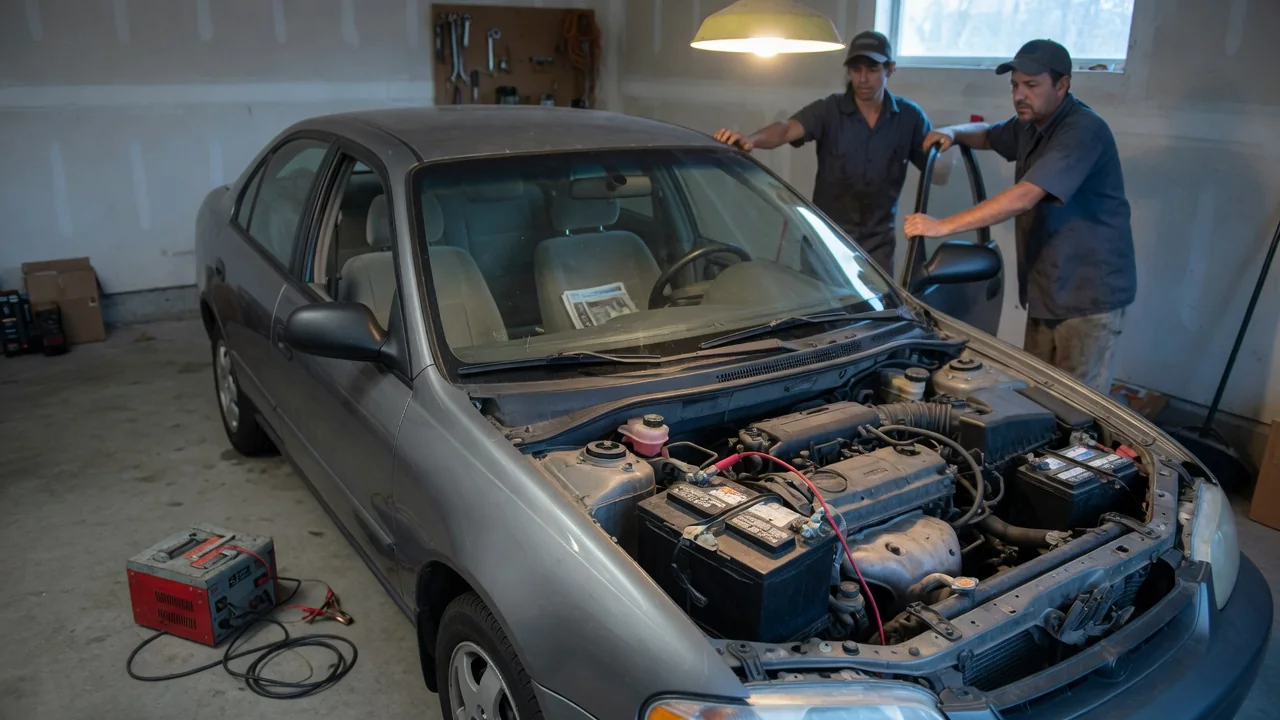
The charger says the battery is full and a voltmeter shows a healthy reading, yet the engine barely turns over or does nothing at all. The cause is usually the gap between stored charge and the ability to deliver very heavy current on demand. Everything that current passes through on its way to the starter also matters. Understanding both explains a battery no-start despite charge and points to the right checks.
Current delivery: charge is not the same as cranking power
A voltage reading taken with nothing switched on mainly reflects the battery's state of charge. Starting an engine is a different demand. The starter motor draws a very large current for a few seconds, far more than any other load in a typical car. Whether the battery can supply that current depends heavily on its internal resistance. In a lead-acid battery, power comes from chemical reactions at the surfaces of the lead plates in contact with the electrolyte. When those surfaces are degraded, internal resistance rises. The battery may still hold charge and show normal voltage at rest, but under a heavy load its voltage sags sharply. If the voltage falls too far, the starter turns slowly or not at all, and the vehicle's electronics may drop out.
Several aging mechanisms raise internal resistance. Sulfation is one of the most common. Hard lead sulfate crystals build up when a battery sits partly discharged or is repeatedly undercharged, and they reduce the active plate area. Active material can also shed from the plates over time, grids can corrode, and an internal connection can weaken or break. A single failing cell can drag down the whole battery while the total resting voltage still looks close to normal. Right after charging, a temporary surface charge can also inflate the voltage reading. This makes a tired battery look healthier than it really is.
Temperature makes these weaknesses visible. Cold slows the battery's chemical reactions and reduces the current it can deliver. At the same time, thickened engine oil makes the engine harder to turn. A battery that cranks acceptably on a mild afternoon can fail on a cold morning even when it is fully charged. This is why cranking capability is rated separately from capacity: storing energy and releasing it quickly are related but distinct abilities, and both decline with age.
Connections: where good current gets lost
Even a healthy battery's output must travel through terminals, clamps, cables, ground connections and the starter circuit before it does any work. Voltage lost across a connection equals the current multiplied by that connection's resistance. Because starting current is so high, a resistance too small to affect a dome light can waste enough voltage to stop the starter from turning the engine. Corroded terminals, a loose clamp or an oxidized contact surface between post and clamp are classic causes. These problems are not always visible, because the outside of a clamp can look clean while the contact face underneath is not.
The return path matters as much as the positive side. Current flows from the negative terminal through ground cables or straps to the body and engine. Since engines generally sit on rubber mounts, they rely on a dedicated ground connection. A corroded, loose or broken ground strap, or one bolted to a painted or rusty surface, can produce the same symptoms as a weak battery. Cables can also corrode inside their insulation, especially near the terminal ends, where the damage is hidden. Typical signs include rapid clicking, dash lights that dim heavily when the key is turned, slow cranking, or a connection that becomes warm after a start attempt.
Beyond the cables, the starter solenoid has its own heavy contacts that close to power the motor. Worn contacts can produce a single click with no cranking even when the battery is fine. The control side of the circuit can also prevent the starter from engaging at all. That side may include the ignition switch, a starter relay, a neutral safety or clutch switch, and on many vehicles electronic or security systems. Such faults look like a battery problem but are not one. Circuit layouts vary by vehicle, so the specific components and their locations should come from that vehicle's service information.
Testing: measuring what the battery can actually deliver
A resting voltage check is a useful first step, but it only indicates state of charge, not cranking ability. To get a meaningful reading after charging, remove the surface charge first. You can let the battery rest for several hours or follow the tester's procedure for applying a brief load. A fully charged conventional lead-acid battery is commonly cited at roughly 12.6 volts at rest. Exact values differ by battery type and design, so the battery manufacturer's guidance should take precedence.
Two methods assess the ability to deliver current. A load tester applies a heavy load for a set period while monitoring how far the voltage drops. An electronic conductance tester estimates cranking capability and compares it with the battery's rating. Both give reliable results only when the battery is charged first, because a discharged battery can test poorly for reasons unrelated to its health. A simple multimeter connected across the battery while someone cranks the engine adds another clue. A steep voltage sag points to a weak battery or to an abnormally high draw from the starter. Results should be judged against the tester's or manufacturer's criteria, not a generic number.
Connections are checked with voltage drop testing during cranking. The meter is placed across one segment of the circuit at a time. Typical segments run from the battery positive post to the starter's main terminal, and from the battery negative post to the engine block. A healthy segment shows only a small voltage difference, while a larger one isolates the faulty section. Measuring from post to clamp shows whether the problem lies at that contact surface. Allowable limits vary, so consult service information. Keep hands and leads clear of moving parts. Disable the engine from starting if the procedure calls for it, wear eye protection, and remember that batteries can release explosive gas.
Practical implications and limits
For an owner, a charger's "full" indicator is not a certificate of battery health. A charger reports when the battery accepts no more charge, and a battery with internal damage can still reach that point. Degradation is usually gradual, so a sudden no-start is often preceded by weeks of slightly slower cranking. That slower cranking is worth taking seriously as an early warning. The two main causes also call for different fixes. Replacing a battery will not cure a corroded ground strap, and cleaning terminals will not restore a sulfated battery. Diagnosing first avoids spending money on the wrong part.
Some symptoms overlap, which limits what quick checks can prove. A click with no crank can come from the battery, a connection, the solenoid or the control circuit. An engine that cranks at normal speed but will not run usually has a fuel, ignition or sensor problem rather than a battery one. A successful jump start suggests the trouble is electrical supply. However, it cannot separate a weak battery from a poor connection, and jumper clamps placed on corroded terminals may fail for the same reason. Some vehicles, including many with start-stop systems, use battery types or monitoring systems with specific charging or replacement requirements. When home measurements are inconclusive, professional testing of the battery and starting circuit is the more reliable path.