Why Are Windshield Glass Edges Carefully Finished?
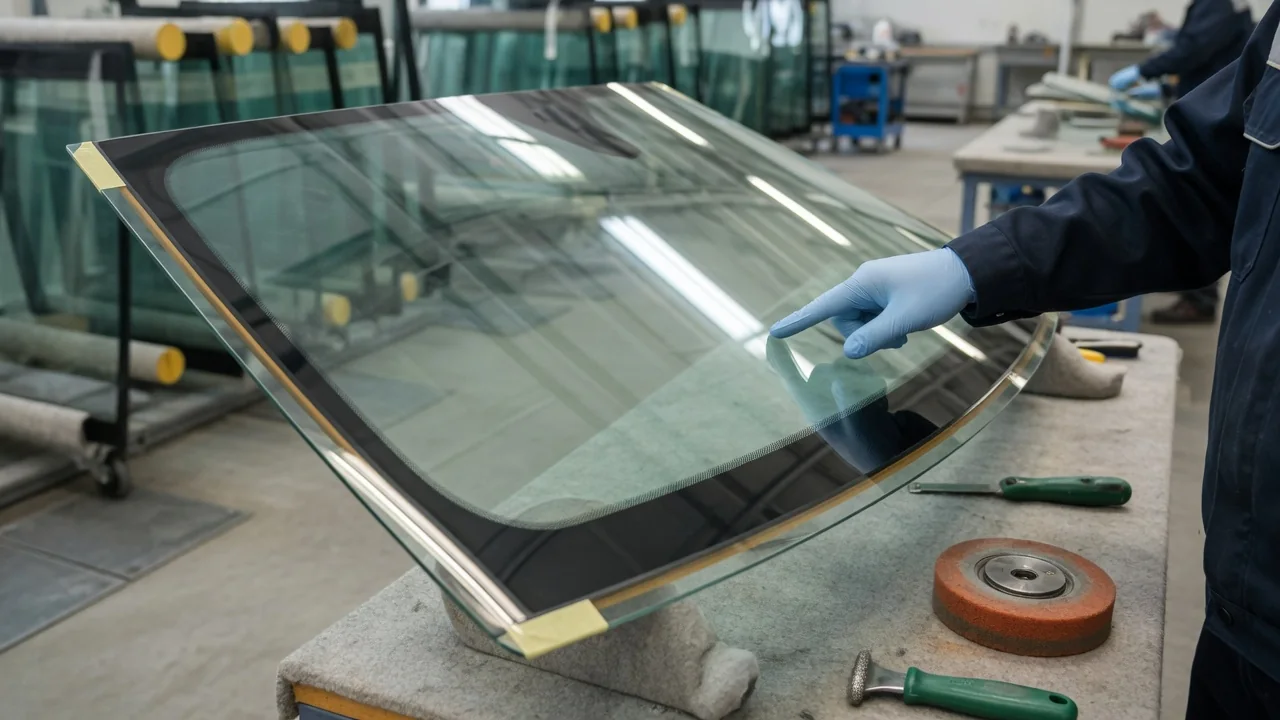
A windshield looks like a simple curved sheet, but its perimeter gets a surprising amount of attention during production. After each glass ply is cut to shape, the raw edge is typically ground or seamed before bending and lamination. Windshield edge finishing is not cosmetic. It addresses three practical problems. Edges are where glass is most vulnerable to cracking. The finished part has to fit a body opening precisely. And the glass must be handled safely from the factory to installation.
Edge strength
Glass is very strong in compression but breaks in tension, and fractures almost always begin at a surface flaw. Cutting glass by scoring and snapping can leave tiny chips, microcracks and sharp corners along the edge. These small defects concentrate stress. When the glass flexes, warms unevenly or is pressed against a mounting surface, the load gathers at the tip of the flaw. A crack can then start at a stress level the surrounding glass would otherwise tolerate.
Grinding or seaming the edge removes the sharpest corners and the most damaged material, leaving a smoother, more uniform profile. This does not make the edge unbreakable. It does reduce the size and severity of the flaws a crack would need in order to begin. Edge quality matters especially on a windshield because the perimeter carries several kinds of load in service. These include body flex transmitted through the adhesive bond, thermal stress when a cold windshield meets defroster air or hot sun, and vibration over rough roads.
Most windshields are laminated, with two glass plies bonded to a plastic interlayer, and each ply has its own edge to finish. Manufacturers also control how the glass cools after bending, because uneven cooling can leave unwanted tension near the perimeter. A well-finished edge and controlled cooling work together. They give the edge zone a better chance of resisting cracks that would otherwise start at the outside and run inward.
Fit
A windshield is not simply dropped into a frame. On most modern vehicles it is bonded into the body opening with a bead of urethane adhesive, often with moldings or trim around the edge. For that system to work, the glass outline has to match the opening closely. Edge finishing helps bring the cut plies to consistent final dimensions and removes irregularities left by cutting. The result is a perimeter that follows the intended shape instead of wandering by small amounts along its length.
Consistent edges matter for several fitting tasks. The gap between the glass and the body needs to be even, so the adhesive bead has a uniform contact width and the trim seats properly. The edges of the two laminated plies should line up, because a stepped profile can interfere with moldings or press unevenly on the urethane. A clean edge also makes it easier to position the glass accurately during installation, which affects appearance, wind noise and water sealing. Exact tolerances and molding designs vary by vehicle, so these points describe the general purpose rather than any specific model's requirements.
Handling
Freshly cut glass edges can be razor sharp. Between cutting and final installation, a windshield passes through many hands and machines: bending, lamination, inspection, packing, shipping, storage and finally fitting by an installer. Seamed or ground edges reduce the risk of cuts to workers. They also make the part safer to lift, carry and position, whether by hand or with suction cups and handling equipment.
Finishing also protects the glass itself. A rough edge chips more easily when it touches a rack, a conveyor guide, another sheet or the metal flange of a vehicle body. Each new chip is a fresh flaw from which a crack can grow, sometimes long after the contact that caused it. Smoother edges are less prone to this kind of incidental damage, which helps the windshield reach the vehicle in the condition production intended. Edges still need protective packaging and careful handling, because finishing reduces vulnerability rather than eliminating it.
Practical implications and limits
For car owners, the main takeaway is that the edge of a windshield deserves respect. A chip at or near the perimeter is generally treated as more serious than a similar chip in the middle of the glass, because it sits in a zone that already carries mounting and thermal loads. Many repair shops are cautious about edge damage for that reason. Whether a particular chip can be repaired or calls for replacement is a judgment for a qualified technician who can inspect it.
During replacement, edge condition is one of the things a careful installer checks before setting new glass. A replacement windshield with an edge chip from shipping may develop a crack that has nothing to do with road debris. So may glass that ends up touching bare metal in the opening. Following the vehicle maker's and adhesive maker's installation procedures helps keep edge loads within what the glass was designed for. That is a general mechanism. How much margin a particular windshield has depends on its design, the body opening and the quality of the installation.
Edge finishing also has limits. It improves resistance to cracks that start at the perimeter, but it does not protect against a heavy stone impact, severe body damage or a poorly prepared bonding surface. Most owners also cannot judge it by eye: a smooth-looking edge does not prove the glass is free of hidden flaws or built-in stress. Edge finishing is best understood as one part of a larger system that includes glass quality, lamination, correct fit and proper installation.