Why Are Tires Matched to Wheels at Assembly?
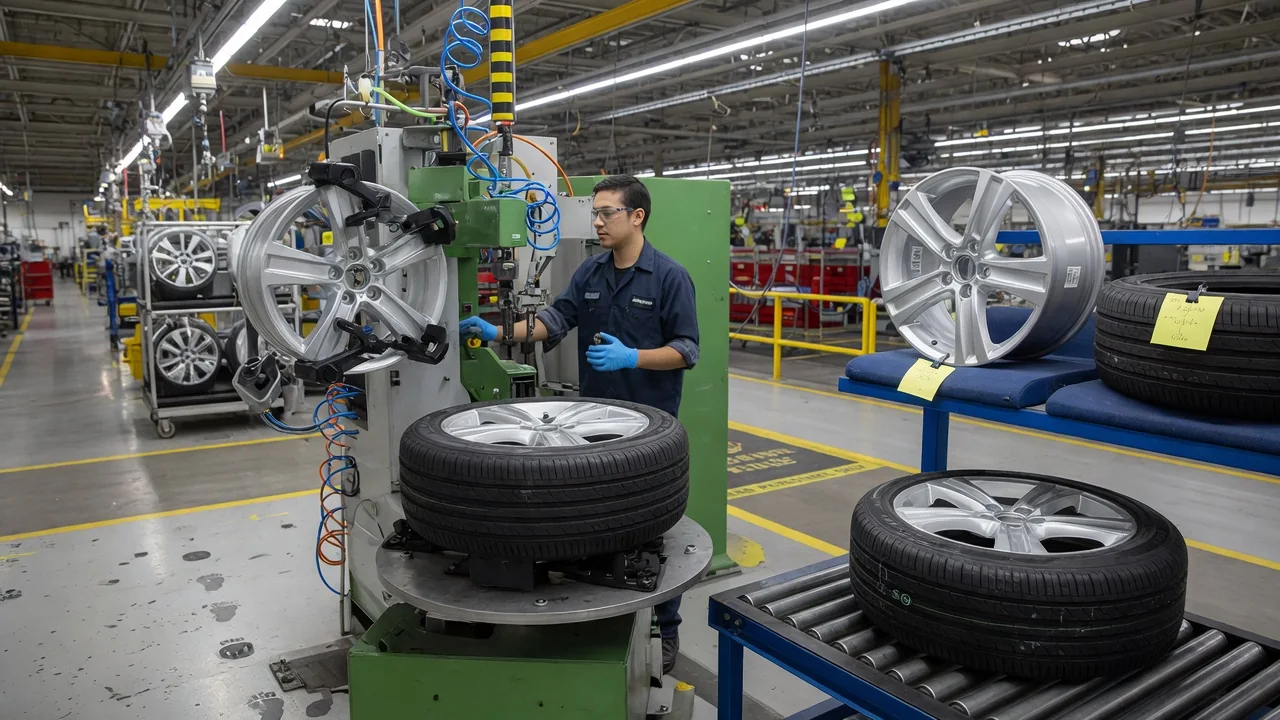
Tires and wheels are made in separate plants, often by different suppliers, and neither is perfectly round or perfectly uniform. During vehicle assembly, the two are usually joined on a dedicated tire-and-wheel line. There they are mounted, oriented, inflated, balanced and checked before they reach the car. Factory tire wheel matching exists because small, normal variations in each part can add up to vibration, uneven wear or air loss if the parts are combined at random.
Fit and balance
The first reason is physical fit. A tire must suit the wheel's rim diameter and width. Its beads must also seat evenly against the bead seats so the assembly holds air and runs true. On a production line, mounting equipment applies a lubricant to the beads and rim, works the tire over the flange, and inflates it so the beads move outward and lock into position. If a bead seats unevenly, the tire can sit slightly off center. That shows up as runout, a hop or wobble that added weight cannot fully correct.
The second reason is uniformity. Every tire has small variations in stiffness, construction and mass around its circumference. Every wheel has some radial runout, meaning parts of the rim sit slightly farther from the center than others. Tire makers may identify a high point of force variation, and wheel makers may identify a low point of runout. Mounting the tire so its high point lines up with the wheel's low point lets the two variations partly cancel. This practice is commonly called match mounting or phase matching. It reduces vibration at its source rather than masking it.
Balance is the third piece. Even a well-matched assembly can be slightly heavier in one area. Static imbalance makes the wheel hop, while dynamic imbalance makes it shimmy from side to side. Balancing machines spin the assembly, measure where mass is uneven, and show where weights should go on the inner and outer sides of the rim. Good matching usually reduces how much weight is needed, which matters for three reasons. Large weights can look untidy, they can be knocked off, and they correct uneven mass but not variation in tire stiffness.
Valve setup
The valve is a small part, but it affects how the assembly is matched. A valve stem adds concentrated mass at one point on the rim, and a valve that carries a tire pressure monitoring sensor adds more. Some tires carry a mark that indicates their lightest point. Placing that mark near the valve is a common way to offset the valve's weight before any balance weights are added. Marking conventions differ between manufacturers, so the meaning of a particular dot or color should come from that manufacturer's information rather than be assumed.
Installing the valve is itself a quality step. Rubber snap-in valves must be pulled fully through the rim hole. Clamp-in metal valves use a nut and seal that must be tightened as specified for that part. Where a pressure sensor is attached to the valve, it must sit correctly against the inside of the rim, and the mounting equipment must avoid striking it as the beads pass over. On vehicles with direct pressure monitoring, the sensors also need to be registered to the vehicle so the system recognizes them, and this is usually done before the vehicle leaves the plant.
Inflating through the valve completes the setup. The core and cap must be in place and free of leaks. The assembly is filled to the pressure the vehicle maker specifies, which appears on the vehicle's placard, not the maximum pressure molded on the tire sidewall. A correct valve setup at assembly means the first pressure readings the driver sees are accurate and no slow leak is built in from the start.
Inspection
Because matching is a process rather than a single action, checks follow it. Depending on the plant and the product, these can include confirming that the correct tire and wheel are paired for the vehicle being built, verifying that the beads are fully seated, measuring the final balance after weights are fitted, and testing the inflation pressure. Some lines also measure runout or force variation on the finished assembly. Units outside the manufacturer's tolerance are flagged for rework, such as rotating the tire on the rim and rebalancing it.
Leak and sensor checks come next. Leaks can be detected in different ways, from monitoring pressure over time to visual inspection. The goal is to catch a poorly seated bead, a damaged valve or a porous rim before the car ships. Pressure sensors are generally checked to confirm they transmit and report a plausible reading. Traceability also matters: tires carry identifying codes, and plants commonly record which assemblies went onto which vehicle so a supplier problem can be traced later. Exact methods, tolerances and equipment vary, and they are not usually published in owner materials.
Practical implications and limits
For owners, the main takeaway is that a new vehicle's wheels start out as tuned assemblies, and that tuning is easy to undo. Removing a tire for a repair, switching to seasonal tires or replacing a single tire breaks the original alignment of marks and weights. A shop that rebalances without considering matching may need more weight to reach an acceptable reading. If vibration continues after balancing, a road force balancer can help. It presses a roller against the tire to measure variation under load, which helps a technician decide whether rotating the tire on the rim would improve the result.
Matching also has limits. It reduces the combined effect of tire and wheel variation but does not eliminate it. It cannot fix a bent rim, internal tire damage, worn suspension parts or flat spots from long storage. Tires also change as they wear, so an assembly that starts out smooth may need rebalancing later. Paint dots on a tire are not defects, and a replacement tire without them is not necessarily of lower quality, because marking practices differ. For vehicle-specific procedures, including sensor relearn steps and pressure values, consult the owner's manual and service information for that model.