Why Are Tires Balanced After Mounting?
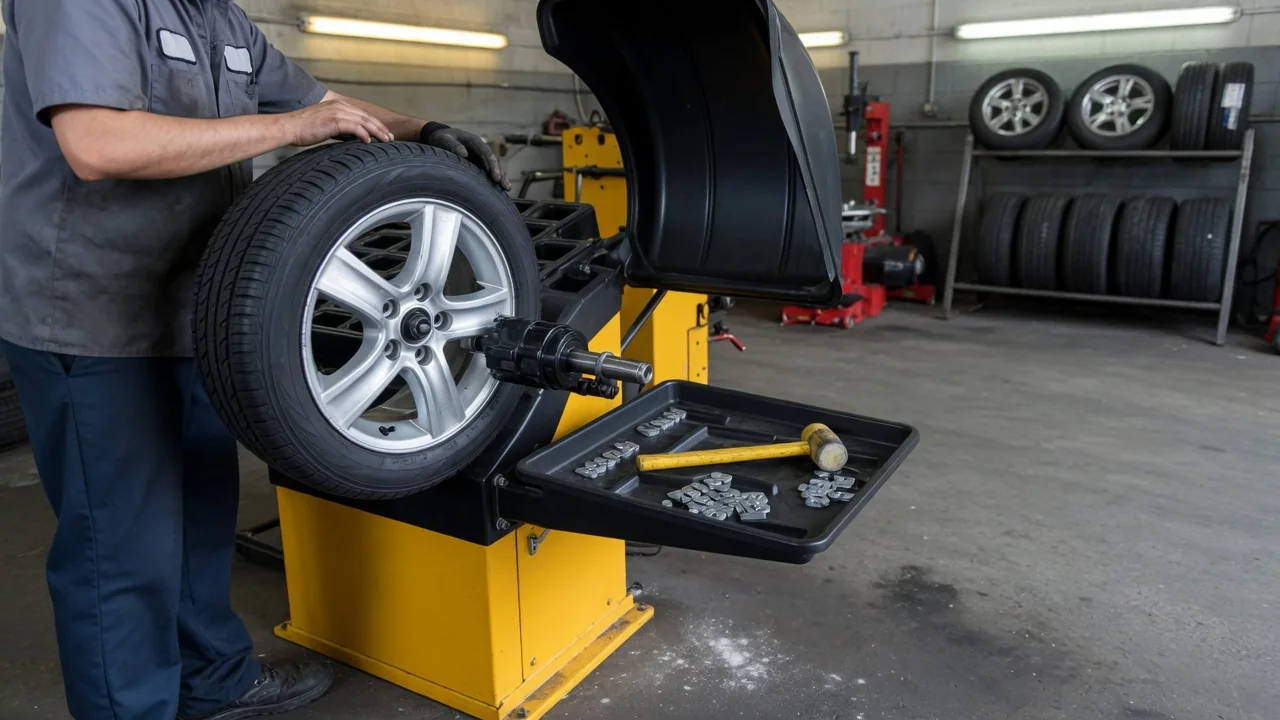
Every time a tire is mounted on a wheel, the shop finishes the job by spinning the assembly on a balancing machine and clipping or sticking small weights to the rim. That step can look like an optional extra, but it addresses a real physical problem. The purpose of tire and wheel balancing is to make the combined assembly rotate smoothly. The reasons come down to three linked ideas: how mass is distributed, how fast the wheel turns, and how the car rides as a result.
Mass variation: why no tire and wheel is perfectly even
No tire comes out of the mold with its mass spread perfectly evenly around its circumference. A tire is built from many layers, including rubber compounds, body plies, steel belts and beads. Where those materials overlap or are spliced together, they add a little extra weight in one area. Small variations in rubber thickness have the same effect. Wheels have their own irregularities too. The valve stem hole, casting or stamping tolerances and the spoke pattern can all leave one part of the rim slightly heavier than another. Individually these differences are small, but they are never zero.
The key point is that the tire and the wheel only become a single rotating unit once the tire is mounted. Before that moment, nobody can know how the heavy spot of the tire will line up with the heavy spot of the wheel. If they happen to sit on the same side, their effects add together. If they sit on opposite sides, they partly cancel. Some technicians rotate the tire on the rim to place a known light spot against a known heavy spot, a practice often called match mounting. Even then, the final result has to be measured on the assembled wheel. That is why balancing is done after mounting rather than on the tire or wheel alone.
Imbalance takes two basic forms. Static imbalance is a heavy spot that makes the wheel want to settle in one position, so it tends to cause an up-and-down hop as the wheel rotates. Dynamic imbalance involves mass that is uneven across the width of the wheel. In that case the assembly tends to wobble side to side, even if it would sit still on a level shaft. A modern balancing machine spins the assembly and senses the forces at both the inner and outer edges of the rim. It then indicates how much weight to add, and where on each edge, to counter both kinds.
Wheel speed: why small weight differences become large forces
A heavy spot that weighs very little would not matter if the wheel never moved. The problem appears when the wheel spins. As it rotates, any off-center mass tries to fly outward, producing a force that pulls the wheel toward the heavy spot as it passes around. Because that spot travels in a circle, the direction of the pull keeps changing. The hub and suspension feel it as a repeating push in every revolution.
The size of that force does not rise in simple proportion to road speed. It grows with the square of the rotational speed, so doubling the speed roughly quadruples the force produced by the same out-of-balance mass. The frequency of the disturbance also rises with speed, because the wheel completes more revolutions every second. This is why a wheel that feels acceptable in a parking lot or on a slow city street can produce a noticeable vibration on the highway. Many drivers notice that imbalance seems to come and go within a particular speed band. A common explanation is resonance. The suspension, tires and steering parts have natural frequencies at which they respond most strongly. When the wheel's rotation frequency approaches one of them, the shaking is amplified. Where that band falls depends on the specific vehicle, its suspension design and its tire and wheel size, so it cannot be stated as a single universal figure.
Ride: how imbalance reaches the driver and the car
An unbalanced wheel turns its repeating force into vibration that travels through the suspension and into the body. Where the driver feels it often hints at which end of the car is affected. Imbalance in a front wheel is commonly felt as a shimmy or buzz in the steering wheel, because the front wheels are linked to the steering system. Imbalance at the rear is more often felt through the seat, the floor or the center console. These are general patterns rather than firm rules, since vehicle design influences how vibration is transmitted.
Beyond comfort, the repeated hop or wobble affects how the tire meets the road. The tire is pressed down harder and then lightened in a regular cycle, so the contact patch does not stay as steady as it should. Over time this can contribute to uneven tread wear, such as scalloped or cupped patches. It also adds extra cyclic load to wheel bearings, shock absorbers, steering linkages and other suspension parts. A balanced assembly lets the tire roll with a more consistent contact force. That supports predictable grip, quieter running and less fatigue on long drives.
Practical implications and limits
Because balance depends on how a particular tire sits on a particular wheel, it needs to be checked again whenever that relationship changes. That includes mounting new tires, remounting an existing tire after it has been removed from the rim, and puncture repairs that involve dismounting. A wheel weight that falls off, for example after a hard pothole strike or curb contact, also changes the result. Tires lose rubber as they wear, and that loss is not always perfectly even. A balance that was correct when the tires were new may therefore drift with mileage. Many owners have balance checked when tires are rotated or when a new vibration appears.
Balancing also has clear limits. It corrects uneven mass. It cannot fix a bent wheel, a tire that is out of round, or a tire whose internal stiffness varies around its circumference. Those conditions can cause vibration even when the assembly spins perfectly on a balancer. Some shops use road force balancing machines, which press a roller against the tire to look for this kind of variation. Balancing is also separate from wheel alignment. Alignment sets the angles of the wheels relative to the car and the road. Balancing deals only with how mass is distributed in the rotating assembly.
When a vibration persists after balancing, the cause may lie elsewhere, such as worn suspension or driveline parts, loose components or a damaged tire. The vehicle's owner's manual and a qualified tire technician are the right references for how a specific car should be inspected and what tolerances apply to it. Across all vehicles, the general principle stays the same: a well-balanced tire and wheel assembly is the foundation for a comfortable, controlled ride.