Why Are Some Car Paint Colors Harder to Repair?
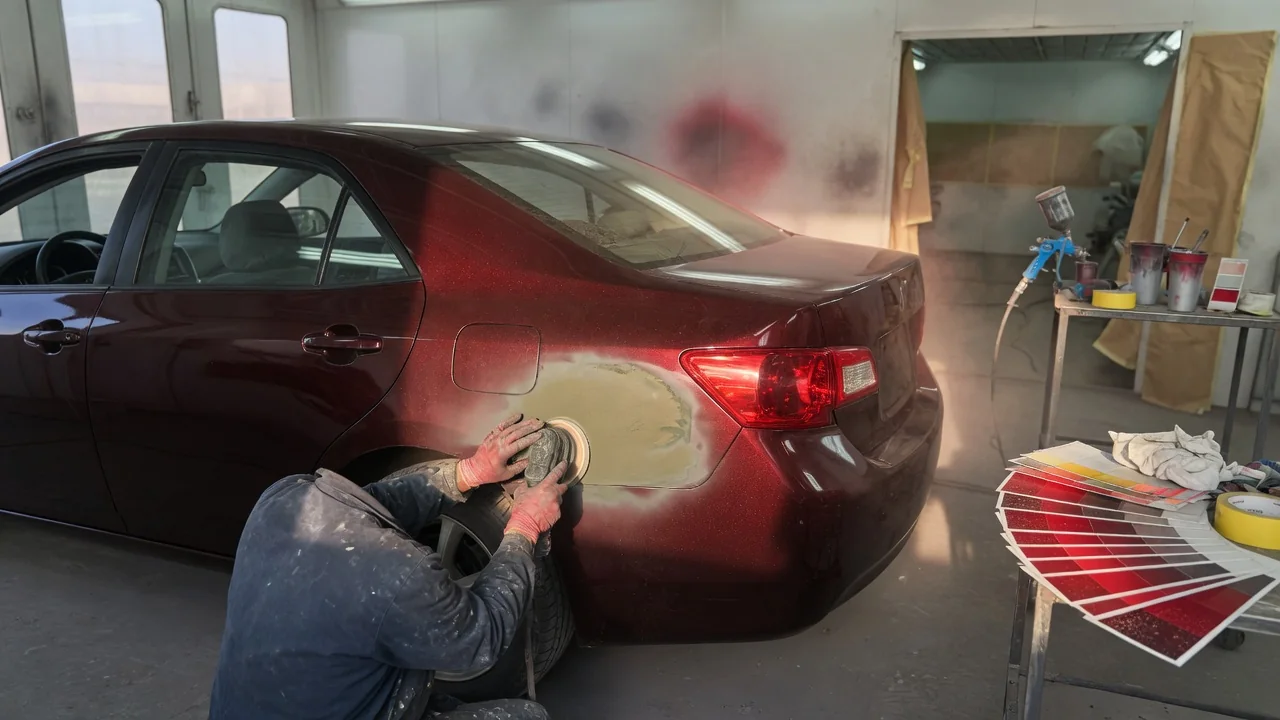
Most car paint damage can be repaired, but some colors need more time, material and skill to make the repair invisible. The hue itself is rarely the cause. The difficulty comes from how the finish is built, how reflective particles inside it behave, and how much planning a shop must do before spraying. Those three factors explain why some colors are hard to match and why repair estimates for similar damage can vary so much.
Layer complexity
Modern factory finishes are usually built from several layers. Over the primer, a typical finish has a basecoat that carries the color and a clearcoat that provides gloss and protection. A solid color in a basecoat/clearcoat system is the simplest case. The color lives in one layer, and the refinisher mainly needs the base to reach full hiding, so the primer or old color underneath no longer shows through. Once the basecoat is opaque, small differences in the number of coats have relatively little effect on the final appearance.
Tri-coat finishes add another layer and are often used for pearl whites and some deep reds. A ground coat sets the base color, a translucent mid-coat containing pearl or tinted pigment goes over it, and clear goes on top. Because the mid-coat is semi-transparent, the color you see depends on how many mid-coat passes were applied. One pass too few or too many can shift the shade, so the painter must reproduce the factory build, not just the formula. Some finishes also use tinted clearcoats, where the clear itself contributes to the color. With those, film thickness matters even more.
Other finishes bring their own layer problems. Matte and satin topcoats usually cannot be polished or feathered the way gloss clear can, because polishing changes the sheen. Faded or weathered original paint is also a challenge. The color on the car may no longer match what the formula was designed to produce, so the repair has to match the current aged surface rather than the original standard.
Flake effects
Metallic paints contain small aluminum flakes. Pearl paints contain coated mica or similar effect pigments. These particles reflect light in particular directions, which gives the finish its depth and sparkle. They are also the biggest practical obstacle in matching color. How an effect color looks depends not only on which pigments are in the paint but on how the flakes are arranged within the film.
Application technique largely determines how the flakes lie. Gun distance, air pressure, fluid flow, overlap, how wet each coat goes on, and flash time between coats all affect whether flakes lie flat or sit at varied angles. Flatter flakes tend to make a color look brighter head-on and darker at an angle. More randomly oriented flakes can do the opposite. Painters call this the difference between face and flop, or face and side tone. Two panels sprayed with identical paint can match when viewed straight on and mismatch from the side if the technique differed. Booth conditions such as temperature and airflow change drying speed, which also affects how the flakes settle.
Effect colors are also more prone to metamerism, where two surfaces match under one light source but not under another. A repair that looks right under shop lighting may look different in direct sun or under streetlights. Pearl particles can also shift hue with viewing angle, which gives the refinisher one more property to reproduce. Solid colors without effect pigments are much less sensitive to these variables, which is a large part of why they are usually easier to repair.
Shop planning
Difficult colors leave little room for correction after spraying, so much of the work happens before the gun is loaded. The paint code on the vehicle identifies the intended color, but one code can have several production variants because factory paint can differ slightly between batches. Refinish shops commonly compare the car against variant chips, read the existing finish with a spectrophotometer, or both. They then select or adjust the formula. Mixing is only the first step, because the result still has to be verified.
Verification usually means spraying test cards, called spray-outs or let-down panels, with the same technique planned for the car. For tri-coats, a let-down panel shows the color with different numbers of mid-coat passes, so the painter can choose the build that matches. The cards are compared with the vehicle at several angles and under different light sources before any work on the car begins.
Planning also decides where the repair will end. A panel painted edge to edge in a slightly different shade shows a sharp boundary. To avoid that, refinishers often blend the new color into the adjacent panels. That means preparing extra panels, masking a larger area, and sometimes removing trim or handles. On tri-coats, the blend may have to be handled separately for the ground coat and the mid-coat. Each step adds labor and material, which is why estimates for effect colors often list operations a solid-color repair may not need.
Practical implications and limits
For owners, the main consequence is that the cost and appearance of a repair depend heavily on the finish type, not only on the size of the damage. A small scrape on a solid color may stay within one panel. Similar damage on a pearl or tri-coat finish may require work on neighboring panels to get an acceptable result. Before approving an estimate, ask the shop whether the plan includes blending, how the color will be verified, and whether the finish will be checked under different lighting.
Even a well-planned repair has limits. An exact match from every angle and under every light source is not always possible, especially when the original paint has aged unevenly or has been refinished before. Touch-up pens and aerosol products can protect bare metal, but they generally cannot reproduce flake orientation or tri-coat depth. On effect colors, treat them as protection rather than an invisible repair. Results also vary by vehicle, paint system and repair history. These general mechanisms explain why some car paint colors are harder to repair, but they cannot predict the exact outcome of any one job.