Why Are Some Car Clips Designed to Break During Removal?
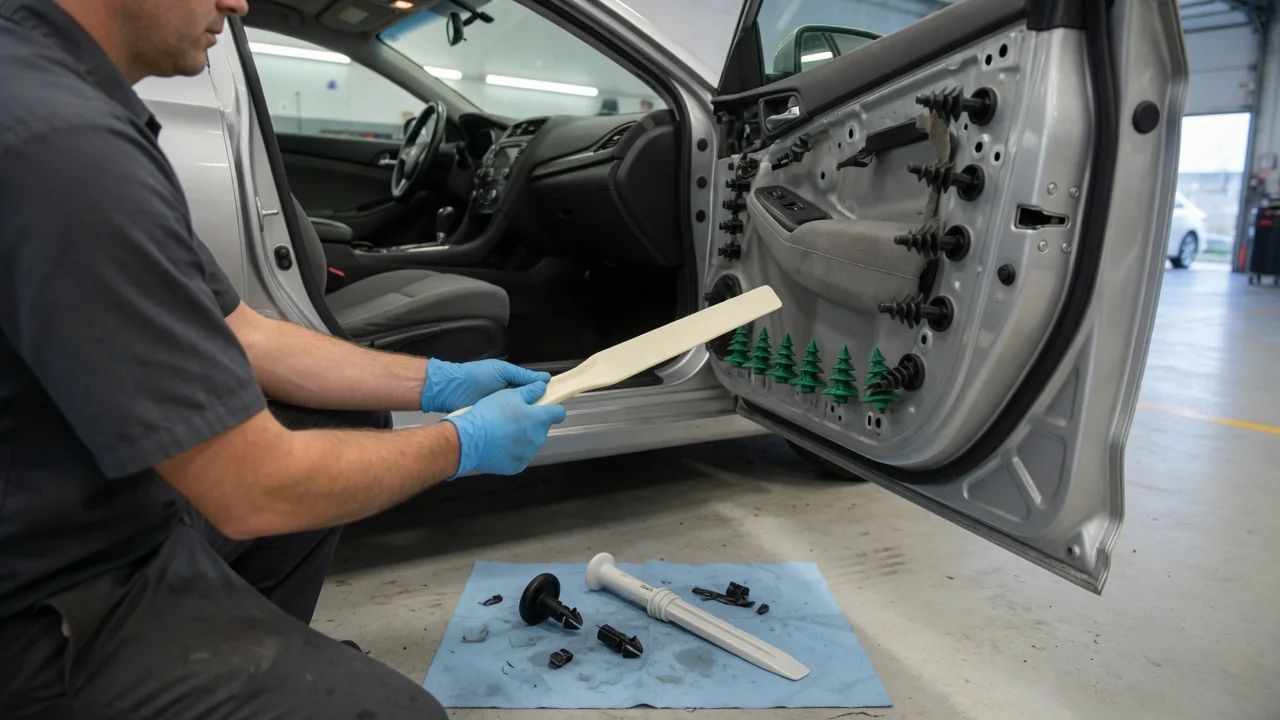
Anyone who has removed a door panel, bumper cover, or wheel well liner knows the sound: a sharp snap, followed by a piece of plastic left behind in the hole. That outcome is often not a mistake. Many automotive trim clips are intended as single-use or sacrificial fasteners. Understanding why some car clips are designed to break during removal comes down to three things: how clips hold panels in place, how service access is planned, and how replacement is expected to work.
Assembly retention
Plastic clips exist largely because they are fast to install. On an assembly line, a clipped panel can be aligned and pushed into place without threads or tools. Retention comes from flexible features such as barbs, ribbed fir-tree fins, or spring legs. As the clip enters a hole, these features fold inward; once they pass through, they spring back and bear against the back side of the panel or body sheet metal. The geometry is usually asymmetric on purpose: the angle that guides the clip in is shallow, while the face that resists pulling out is steep. The result is a fastener that goes in with modest force but resists extraction strongly, which is what keeps trim from loosening under vibration, temperature swings, airflow, and repeated door slams.
That asymmetry is the core of the issue. A clip built to resist coming out cannot tell the difference between road vibration and a technician pulling on the panel. To free the panel, something has to yield. Either the clip's legs bend or shear, the head separates from the shank, or the mounting point on the panel or body is damaged. Automotive trim clip design commonly treats the clip as the intended weak link. A clip is small, inexpensive, and easy to replace, while a cracked mounting boss, a torn tab on a molded panel, or an enlarged hole in sheet metal is much harder to fix. Letting the clip fail first protects the more valuable part.
Material aging adds another reason. Clips are commonly molded from engineering thermoplastics chosen for a balance of stiffness and flexibility. Over years in service, they are held under constant load and exposed to heat cycles, cold, moisture, and, in exterior locations, sunlight. Thermoplastics under sustained stress can slowly relax, and aging can reduce their flexibility. A clip that has been seated for a long time may no longer flex the way it did when new, so it is more likely to crack on removal, and even one that survives may not grip as firmly afterward.
Service access
Not every clip is meant to be destroyed. Some retainer designs are made for repeated removal. Push-type retainers with a center pin release their legs when the pin is pried up or pushed through. Screw-type plastic rivets back out with a screwdriver. Some clips have a release tab that a tool can reach. Designs like these tend to appear where a panel is expected to come off more often, while one-way clips are more typical where removal is expected to be rare and retention and cost take priority. Which approach is used at a given location is a decision made by each manufacturer, so it varies from vehicle to vehicle.
Many clips are also blind fasteners. They sit behind the panel they hold, where no tool can reach the locking features from the front. The only practical way to separate the parts is to pull, and the design accepts that the clip may break in the process. Trim removal tools help by spreading force close to the clip and reducing the chance of cracking or marking the panel, but they cannot guarantee that the clip itself survives. Service procedures written for this kind of construction often anticipate the loss by listing the clips as parts to be replaced rather than reused.
Some locations carry extra weight. Trim around curtain airbags, seat belt anchors, or components that seal against water and air may use specific retainers whose correct engagement matters for more than appearance. On some vehicles, service information calls for particular clips in these areas to be replaced whenever the trim is removed. Because those requirements are model-specific, the vehicle's own repair information is the authority for such panels.
Replacement
If clips are treated as consumables, reassembly with the old ones can cause problems even when they appear intact. A weakened or partly broken clip may let the panel buzz or rattle, leave a visible gap, or allow wind noise. Some clips include a foam or rubber seal under the head that closes the hole in the body; once compressed and removed, that seal may not seal properly again, which can let water or dust pass. Installing new clips restores the retention and sealing the assembly was designed around.
Matching the replacement matters. Clips that look similar can differ in hole diameter, head size, shank length, and the range of panel thickness they are designed to grip. A clip that is too small may pull out easily, while one that is too large can be hard to seat or may stress the panel. General-purpose clip assortments can be useful for noncritical trim, but the parts catalog or service information for the specific vehicle is the reliable way to identify the correct part, especially for exterior panels.
Before installing new clips, it helps to clear out any fragments left in holes or still lodged on the panel, since a broken base can prevent a new clip from seating. The mounting points deserve a look as well. If a slot on the panel is cracked or a hole in the body has become enlarged or deformed, a new clip alone may not restore proper retention.
Practical implications and limits
In practical terms, the safest assumption before any trim job is that some clips will not be reusable. Having the correct replacements on hand before starting avoids reinstalling a panel with too few fasteners or leaving the vehicle apart while parts are sourced. Temperature can also play a role: many plastics become more brittle in the cold, so working on trim in a moderately warm environment generally gives clips and panels a better chance of flexing instead of cracking.
There are limits to the idea that clips are designed to break. It is a useful simplification, not a universal rule. Some clips break simply because they are old, because the wrong tool was used, or because they were pulled at an angle, and that breakage was not part of anyone's plan. The reverse is also true: a clip that comes out in one piece is not automatically safe to reuse. Clip types, locations, and service requirements differ between manufacturers and even between models from the same brand, so the general principles here explain the reasoning behind sacrificial clips without describing how any particular vehicle is built.