Why Are Rubber Seals Tested in Cold Weather?
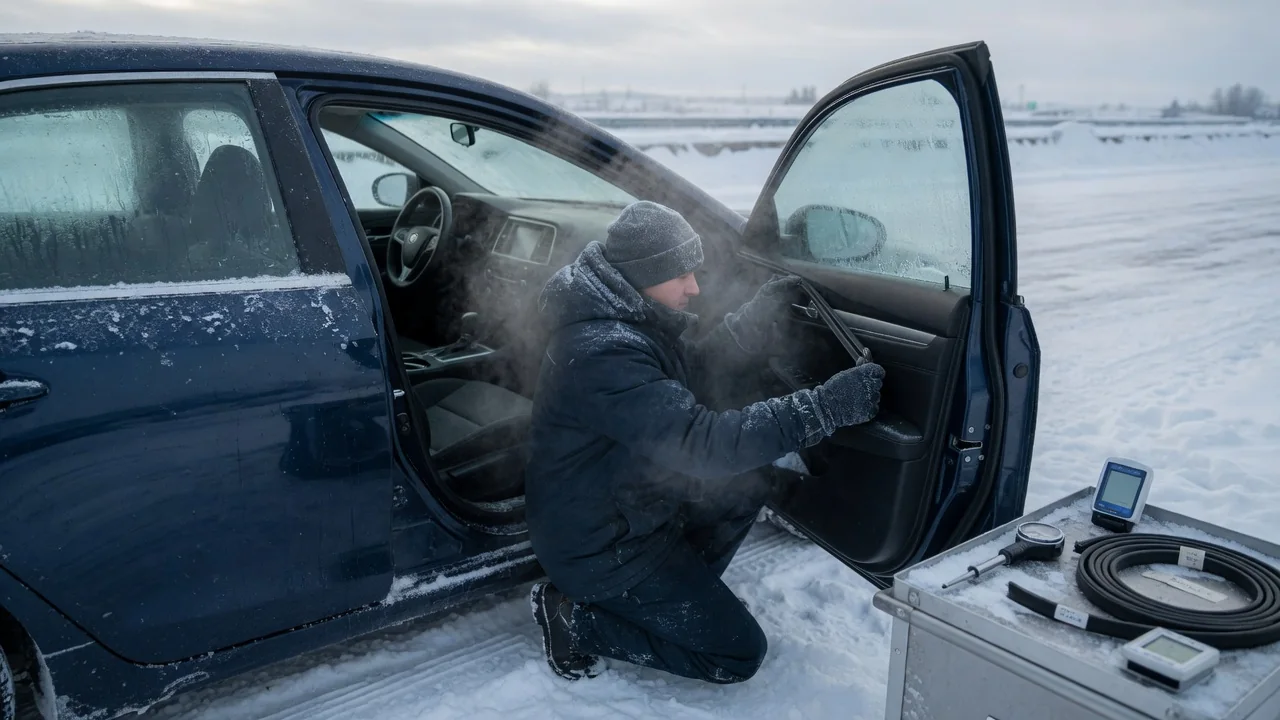
Rubber seals around doors, windows, trunks, and hoods have to work in every season, and cold weather is where their limits show most clearly. As the temperature drops, rubber compounds stiffen, recover more slowly, and press against painted metal and glass with a different force than on a mild day. That is why an automotive seal cold test is a routine part of seal development and validation. It checks whether a seal still flexes, lets doors close properly, and keeps water and air out in the cold.
Stiffness: How Cold Changes the Way Rubber Behaves
Rubber is elastic because its long polymer chains can move, stretch, and coil back into place. Heat gives those chains mobility, and cold takes it away. As the temperature falls, the chains move less freely and the material gets harder and less flexible. Every elastomer also has a glass transition range. Near or below that range, rubber stops acting like a soft, springy solid and starts acting more like a rigid plastic. Different compounds reach this point at very different temperatures. EPDM is widely used for automotive weatherstrips, partly because it resists weathering and keeps its flexibility in the cold. Even so, the exact behavior depends on the specific formulation, including its fillers, plasticizers, and cure system. Two seals made from the same rubber family can therefore perform differently in the same cold conditions.
Stiffness matters because a weatherstrip works like a spring. Hollow bulb and lip profiles are designed to compress when a door or lid closes and then push back against the opposing surface to hold a seal. In the cold, two things change. Compressing the profile takes more force, and the profile springs back more slowly once the load is released. A seal that is held compressed in the cold may also take a temporary set, recovering only partly until it warms up. Cold testing typically looks at how much force the profile needs to deflect, how well and how quickly it recovers, and whether the material cracks or splits when flexed at low temperature. These properties cannot be predicted reliably from room-temperature results alone, so they have to be checked in the cold.
Door Closure: Why Cold Seals Change How a Door Shuts
Every time a door closes, it compresses the seals between the door and the body opening. The effort needed to shut the door depends on several things working together: the resistance of the seals, the air pressure inside the cabin as the door pushes air ahead of it, the door's weight and hinges, and the latch mechanism. If the seals become noticeably stiffer, the door needs more energy to compress them fully. A closing motion that latches the door easily on a warm day may then leave it resting short of the fully closed position. Many vehicles use latches with more than one engagement position, so a door can appear shut while it is only partly latched. This is one reason owners sometimes find that doors need a firmer push in winter.
Engineers have to balance competing demands. A seal soft enough for easy closing in deep cold may be too soft to hold adequate sealing pressure in summer heat, when rubber is at its most pliable. A seal firm enough for hot conditions may make doors hard to close in winter. Cold testing shows where a design sits within that trade-off. Ice is another factor. Moisture on the seal or the door frame can freeze and bond the rubber to the body, so the seal is pulled or torn when the door is opened. Some weatherstrips use low-friction surface coatings or flocking to reduce sticking and friction, and cold-condition checks help show whether such features work as intended.
Leak Performance: Keeping Water, Air, and Noise Out in the Cold
A seal blocks water and air only where it makes continuous contact with the mating surface at sufficient pressure. Soft rubber conforms easily to small irregularities in paint, panel joints, corners, and slight variations in gap. Stiffer, colder rubber conforms less readily. At the same time, the steel, aluminum, plastic, and glass around the seal also contract as they cool, and they do not all shrink at the same rate as the rubber. The gaps a seal must close can therefore shift slightly with temperature. A seal that holds full contact at room temperature may lose pressure at some points in the cold, opening small leak paths. Even when no water gets in, these gaps can let in drafts or increase wind noise at highway speed.
Slow recovery adds a dynamic problem. While driving, the body flexes slightly over bumps and potholes, and doors and windows are opened and closed throughout the day. A seal that springs back slowly in the cold may briefly lag behind those movements. Freeze-thaw cycles add more stress. Water trapped in seal channels, drain paths, or crevices can freeze, expand, and distort the profile, or prevent it from seating properly. For these reasons, cold conditioning is often combined with water exposure, air-leak checks, or repeated cycling between cold and warmer temperatures. The aim is to see how the seal behaves while it moves through a range of conditions, rather than only at one fixed temperature.
Practical Implications and Limits
For drivers, some winter changes in seal behavior are normal: a door that needs a firmer close, a seal that briefly sticks after a frosty night, or a little extra wind noise. These alone do not mean a seal has failed. Signs that deserve attention include visible cracks, tears, permanently flattened sections, water on carpets or in the trunk, a door that does not latch fully, or a warning light for an open door. Avoid yanking on a door frozen shut, because that is an easy way to tear a weatherstrip. For seal care, follow the vehicle's owner's manual or service information. Rubber care treatments are commonly used to reduce sticking, but product suitability varies, and some chemicals can harm rubber or nearby finishes.
Cold testing also has limits. A controlled test shows how a particular seal design behaves under defined conditions, but it cannot reproduce every combination a car meets in service. Real seals age. Exposure to sunlight, ozone, heat, road chemicals, and dirt can harden rubber over the years, so the effects of cold often become more noticeable on older vehicles. Door alignment, earlier body repairs, damaged mounting clips, and replacement seals made from a different compound or profile can all change real-world results. Seal behavior is also specific to each vehicle: the profile shape, compound, mounting method, and door structure all interact. Good cold performance in one design therefore says little about another, and a replacement seal is most likely to behave as intended when it matches the original part's specification.