Why Are Motorsport Parts Often Service-Limited?
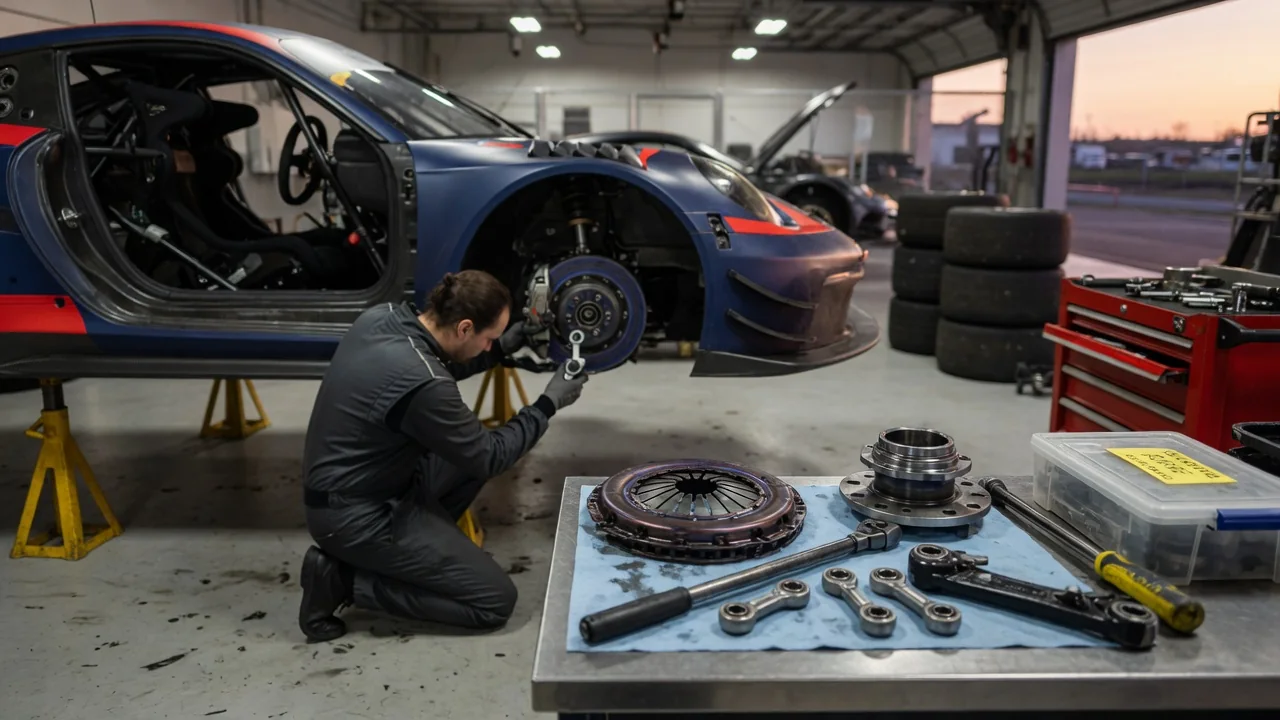
Many racing components have a defined service life measured in hours, distance, race events, or heat cycles. Road car parts are usually expected to last indefinitely with routine care. A service limit is not a sign of poor quality. It reflects a deliberate engineering choice: parts are made as light and efficient as possible, run close to their limits, and are retired on a schedule before hidden damage can turn into a failure on track.
High loads and why they shorten component life
Motorsport engineering trades safety margin for performance. Road car parts are designed with generous margins because they must survive years of varied use, occasional neglect, and unknown maintenance habits. Race parts are optimized for low weight, high stiffness, and maximum output, so they operate much closer to the stress their materials can tolerate. Lighter connecting rods, thinner-walled tubing, hollow shafts, and smaller fasteners all reduce mass. Each removal of material, however, raises the stress carried by whatever material remains.
The main enemy is fatigue. A part can be loaded repeatedly well below the force needed to break it in one go and still fail eventually, because each load cycle can grow microscopic cracks. High engine speeds multiply the number of cycles that reciprocating and rotating parts experience. Suspension, steering, and drivetrain components take repeated peaks from hard braking, cornering, curb strikes, and aggressive gear changes. This damage accumulates silently, so a part can look perfect while it approaches the end of its useful life. Heat makes the picture worse. Brakes, pistons, exhaust parts, and turbochargers go through repeated temperature swings. These swings can change material properties, relax fastener clamping force, and degrade seals.
Material choice adds its own behavior. Aluminum alloys are light and widely used, but unlike many steels they do not have a clearly defined fatigue endurance limit, meaning cyclic loading keeps adding damage over time. Carbon fiber composites are strong and stiff for their weight, yet internal damage such as delamination may not be visible on the surface. For these reasons, the life of many racing components is defined by accumulated use rather than by appearance alone.
Inspection and what it can and cannot reveal
Inspection is the first line of defense. Common practices include visual checks, measuring wear and clearances, verifying fastener torque, and using crack detection methods. Dye penetrant testing reveals surface cracks, magnetic particle testing works on ferrous parts, and ultrasonic methods can help assess composites and internal flaws. Many teams also track critical components individually, often by serial number, recording the distance, hours, or events each part has accumulated. That record turns a loose collection of parts into a managed inventory with known histories.
Inspection has real limits, though. Crack detection methods find flaws only once they reach a detectable size, and early fatigue damage may be invisible to any practical test. Some components cannot be fully examined without destroying them. Frequent disassembly costs time and can itself introduce wear, disturb fasteners, or create assembly errors. Inspection therefore answers one question: is this part fit to continue right now? The service limit answers another: how long may it remain in use, even if every check comes back clean? Combining the two is the core logic behind service-limited parts.
Replacement schedules and component lifing
A life limit is typically set by the manufacturer or the engineering team. It draws on design calculations, material data, testing, and experience from previous use, with a margin applied on top. The unit depends on how damage accumulates. Engines and gearboxes are often tracked in hours or distance, while some parts are tracked by starts, events, or heat cycles. Reaching a limit does not always mean scrapping the whole assembly. Engines may be rebuilt with fresh bearings, fasteners, and other wear-sensitive parts at set intervals. Dampers and gearboxes are commonly serviced or refreshed rather than replaced outright.
It helps to separate consumables from life-limited components. Tires and brake pads wear visibly and are replaced when worn. Life-limited parts such as highly stressed fasteners, uprights, driveshafts, or wheel studs may be retired while they still appear serviceable. Some fasteners are designed for a single installation because tightening them stretches them permanently. Safety equipment such as harnesses, helmets, and seats commonly carries certification or expiry dates under the rules of the relevant sanctioning body, independent of visible condition.
Scheduled replacement is often the economical option as well as the safe one. A failed part can destroy surrounding components, end a race, or cause a crash with serious consequences. Predictable replacement also lets teams plan budgets, spare stock, and workshop time, instead of reacting to unexpected failures.
Practical implications and limits
For anyone buying used racing parts or a former race car, documentation matters as much as appearance. Without records of use, the remaining race car component service life is simply unknown. A cautious approach treats undocumented critical parts as being at or near the end of their life. Serial numbers, rebuild records, and logbooks are valuable because they turn guesswork into an informed decision.
Service limits are tied to a specific use case, so they do not transfer neatly between environments. A component designed for short, intense race use may react differently to long road hours, moisture, road salt, and different load patterns. The reverse is also true. A road car part used on track faces loads beyond many of its design assumptions, so its wear and inspection needs can change noticeably. Its owner manual or the manufacturer is the right place to check how track use affects maintenance.
There is no universal life figure for any category of part. Limits depend on the specific design, the manufacturer, the series rules, and how the part is used. Where official guidance exists, it should take priority. Where it does not, a qualified motorsport specialist is the appropriate source of advice. A remaining life allowance is also not a guarantee. An over-rev, impact, crash, or overheating event can use up a component's life instantly. Affected parts should be inspected or replaced after any such incident, regardless of the hours left on paper.