Why Are Engine Cylinders Lined? Wear Surface, Block Material and Service
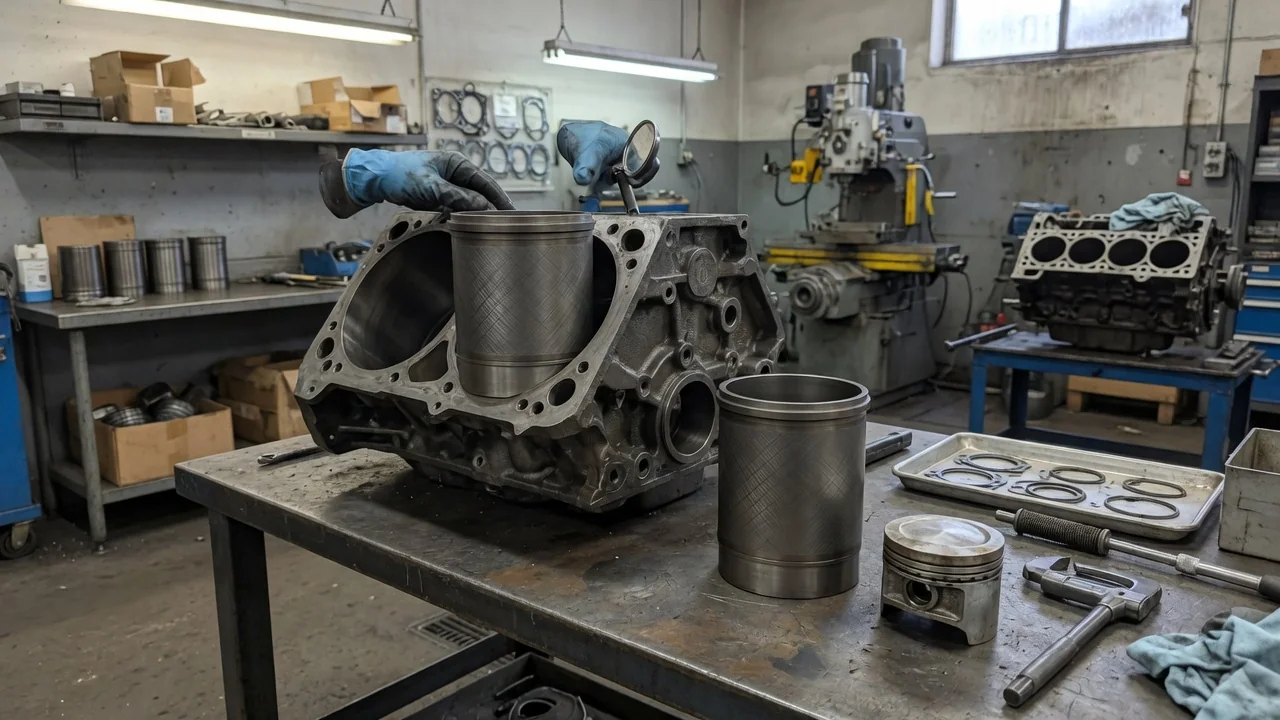
Engine cylinders are lined so the piston rings run against a surface built for friction, heat and pressure, even when the block around it is made from a material that could not do that job on its own. Liners, often called sleeves, can also make it possible to renew a worn bore instead of scrapping the block. The engine cylinder liner purpose explains why some engines are rebuilt one way and others another.
Wear surface
Inside every cylinder, the piston rings slide up and down against the bore wall many times per second at normal engine speeds. Each stroke drags the rings across a thin film of oil while combustion pressure pushes the top ring outward and hot gases try to slip past. The bore wall therefore has to resist abrasion, scuffing and heat while keeping a precise round, straight shape. If it wears unevenly, the rings can no longer seal well, and the engine starts losing compression and burning oil.
A liner gives the rings a dedicated running surface. Gray cast iron is the traditional choice because the graphite in its structure helps it tolerate sliding contact and hold lubricant, and it machines to an accurate finish. After machining, the bore is usually honed to leave a fine crosshatch pattern. Those shallow grooves retain oil for the rings and help new rings bed in, so the surface is engineered rather than simply polished smooth.
Not every engine needs a separate part to achieve this. In many cast iron blocks, the bore is machined directly into the block, so the block itself acts as the wear surface. Some aluminum blocks skip a sleeve and instead rely on a hard coating or a specially treated alloy on the bore wall. The goal is the same in every case: put a hard, oil-retaining surface where the rings run.
Block material
The answer to why are engine cylinders lined often comes down to what the block is made of. Aluminum is attractive for blocks because it is lighter than cast iron and conducts heat well, which helps with both weight and cooling. Ordinary aluminum alloys, however, are relatively soft, and an untreated aluminum bore would scuff and wear quickly under ring contact. Pairing an aluminum block with iron liners lets designers keep much of the weight advantage while giving the rings a durable surface.
Liners are commonly described as dry or wet. A dry liner is pressed or cast into the block and is supported by block metal along its outside, so it never touches coolant directly; heat passes from the liner into the block and then into the coolant passages. A wet liner forms the cylinder wall on the coolant side: coolant flows directly around its outer surface, and seals near the bottom keep coolant out of the crankcase. Wet liners are typically clamped in place by the cylinder head, so how they sit relative to the block deck matters for head gasket sealing.
Cast-in liners lock mechanically into the surrounding aluminum during casting, while pressed-in liners rely on an interference fit. Each approach is a manufacturing trade-off involving heat transfer, bore stability, cost and how easily the cylinder can be repaired later. Which arrangement a particular engine uses is a design decision that should be confirmed in its service information rather than assumed from the block material alone.
Service
Liners strongly influence how a worn engine can be restored. When a bore machined directly into a cast iron block, or a sufficiently thick dry liner, wears, a machine shop can often bore it slightly larger and fit oversize pistons and rings, provided enough material remains and the manufacturer supplies or approves those parts. If the wear is minor and the bore is still within limits, honing alone may be enough.
Wet liners are designed with replacement in mind. In engines built this way, a rebuild can involve removing the old liners and installing new ones, sometimes supplied as a matched set with pistons and rings. Correct installation usually means cleaning the seating areas, fitting new seals and checking how far each liner stands above the block deck, because that height affects head gasket clamping. These steps follow the specific engine's procedure, so its service manual is the authority.
When a bore is damaged beyond oversizing, or when an engine was not built with replaceable liners, a machine shop may be able to install a new dry sleeve by machining the old bore oversize, fitting the sleeve and then finishing it to the original size. Coated aluminum bores generally cannot be rebored in the conventional way; restoring them may require recoating, sleeving or replacing the block, depending on what the manufacturer and available shops support.
Practical implications and limits
For an owner, the liner stays invisible until it starts causing symptoms. Rising oil consumption, increased crankcase blow-by, or poor compression and leak-down readings can point toward worn bores or rings, although valves, head gaskets and other faults can produce similar signs. Testing followed by physical inspection is what separates a bore problem from something else.
Wet-liner designs carry one specific risk worth knowing: if a liner seal fails, coolant can find its way into the oil. Milky oil or unexplained coolant loss deserves prompt diagnosis on any engine, but on a wet-liner engine the liner seals belong on the list of suspects. Overheating can also distort bores and liners regardless of design, which is one reason cooling system maintenance matters for cylinder life.
There are limits to what the bore type tells you. Whether an engine is lined, coated or plain iron does not by itself predict how long it will last; oil quality, change intervals, air filtration, operating temperature and driving patterns all weigh heavily on bore wear. Repair options and their cost also vary by engine, parts availability and local machine shop capability. Before planning a rebuild, check the manufacturer's service information for the bore type, approved oversizes and liner procedures, and have a qualified shop measure the cylinders rather than relying on general rules.