Why Are Clean Threads Important Before Tightening Bolts?
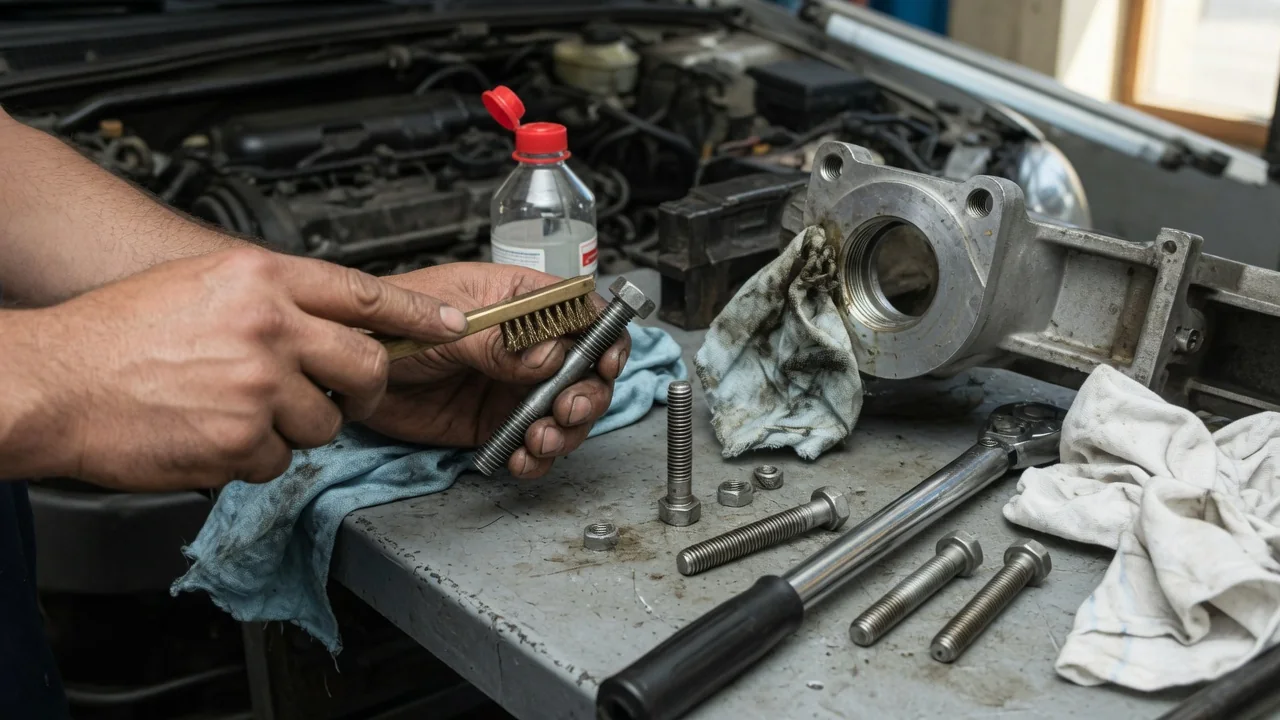
Clean threads matter before tightening bolts because a torque wrench measures resistance to turning, not how firmly the parts are actually held together. Dirt, rust, old thread locker and damaged threads all add friction, and the wrench cannot tell that friction apart from useful bolt tension. The result can be a joint that feels tight and reads correctly but is under-clamped. This guide explains how clean car bolt threads affect clamp force, corrosion and correct torque.
Clamp force
A bolted joint works by stretching the bolt slightly, much like a stiff spring. As the bolt stretches, it pulls the joined parts together, and that tension is called clamp force or preload. Clamp force is what keeps a bracket from shifting, a gasket from leaking and a wheel or suspension component from moving under load. The bolt itself is not meant to act as a pin carrying the load sideways; in most joints, friction between the clamped surfaces does that work, and that friction depends on adequate clamp force.
When you turn a bolt, most of the torque you apply is spent overcoming friction, both under the bolt head or nut face and between the threads. Only a smaller share actually stretches the bolt. Anything that adds friction in the threads, such as grit, rust flakes, dried sealant, metal shavings or remnants of old thread locker, consumes more of the applied torque. The wrench reaches its setting, but the bolt has stretched less than intended, so the joint carries less clamp force than its design assumes.
An under-clamped joint can slip slightly every time it is loaded or vibrated. Those small movements can let the fastener work loose, wear the mating surfaces, allow gaskets to leak and, in some cases, expose the bolt to repeated bending that can contribute to fatigue cracking. Debris in the threads can also cause galling or cross-threading during assembly, which is especially unwelcome in softer materials such as aluminum.
Corrosion
Rust on threads behaves like an abrasive filler. Corrosion products take up more space than the metal they replace, so a rusty bolt fits more tightly in its hole and drags as it turns. That drag is rarely even along the length of the thread, which makes friction unpredictable from one fastener to the next. Two bolts on the same part, tightened to the same setting, can end up with noticeably different clamp force if one has clean threads and the other is corroded.
Corrosion left in place also tends to continue after assembly. Rough, rusty threads can trap moisture and road salt, and over time the fastener may seize in its hole. A seized bolt is harder to remove at the next repair and is more likely to snap or strip the internal threads when someone tries. The risk is generally higher where dissimilar metals meet, such as steel fasteners threaded into aluminum, because that combination can encourage galvanic corrosion when moisture is present.
Cleaning the threads removes loose corrosion so the bolt and hole can engage over their full thread profile. Just as importantly, it lets you see the condition of the metal underneath. Pitting, thinned or flattened threads, and visible necking or stretching of the bolt shank are signs that the fastener or the hole may need replacement or repair rather than reuse.
Correct torque
A torque specification is not a standalone number. It is calibrated for a particular thread condition, usually clean threads that are either dry or treated with a specified oil, anti-seize, sealant or thread locker. Service information typically states which condition applies. When the actual threads match that condition, the specified torque produces roughly the clamp force the engineers intended. When they do not match, the same torque value produces a different result.
Dirty threads push the result toward too little clamp force, but the opposite mistake is just as real. Adding oil or anti-seize to a fastener whose specification assumes dry threads lowers friction, so the same torque reading stretches the bolt further than intended. That can overstretch the bolt past its elastic range, strip threads or crush a gasket. Clean threads therefore do not mean lubricated threads; they mean threads prepared to match whatever condition the specification calls for.
Some critical fasteners are tightened with a torque-plus-angle method, where an initial torque step brings the joint to a consistent starting point and a measured rotation then stretches the bolt. Contamination can distort that initial step, so the starting point is wrong before the angle is applied. Many fasteners tightened this way are designed to stretch permanently and are specified as single-use, which is another reason to follow the service information for the exact part.
Practical implications and limits
In a home workshop, external bolt threads can usually be cleaned with a wire brush and a suitable solvent. For internal threads, a thread chaser is generally preferred over a cutting tap, because a chaser restores the existing thread form instead of removing more metal. Blind holes deserve extra attention: leftover liquid or debris at the bottom can stop the bolt short of full engagement or give a false torque reading, and trapped fluid in some castings can create enough pressure to cause damage. Clearing those holes with compressed air while wearing eye protection is a common precaution.
Cleaning has clear limits. It cannot restore a stretched bolt, rebuild missing thread material or turn the wrong grade of fastener into the right one. If threads are badly damaged, the appropriate fix may be a new fastener, a thread repair insert or professional repair, depending on the part and its importance. Cleaning also does not override the manufacturer's instructions about lubricants, sealants or thread locker, and torque values differ between vehicles and between locations on the same vehicle, so general guidance is never a substitute for the service information for your specific car.
Even with perfectly prepared threads, torque remains an indirect way of estimating clamp force. Wrench accuracy, a smooth and steady pull, correct tightening sequence on multi-bolt joints and clean contact faces under the bolt head all influence the outcome. Clean threads remove one of the largest and most avoidable sources of error, which is why they are worth the few extra minutes before any fastener that matters is tightened.