Why Are Car Floors Covered With Damping Material?
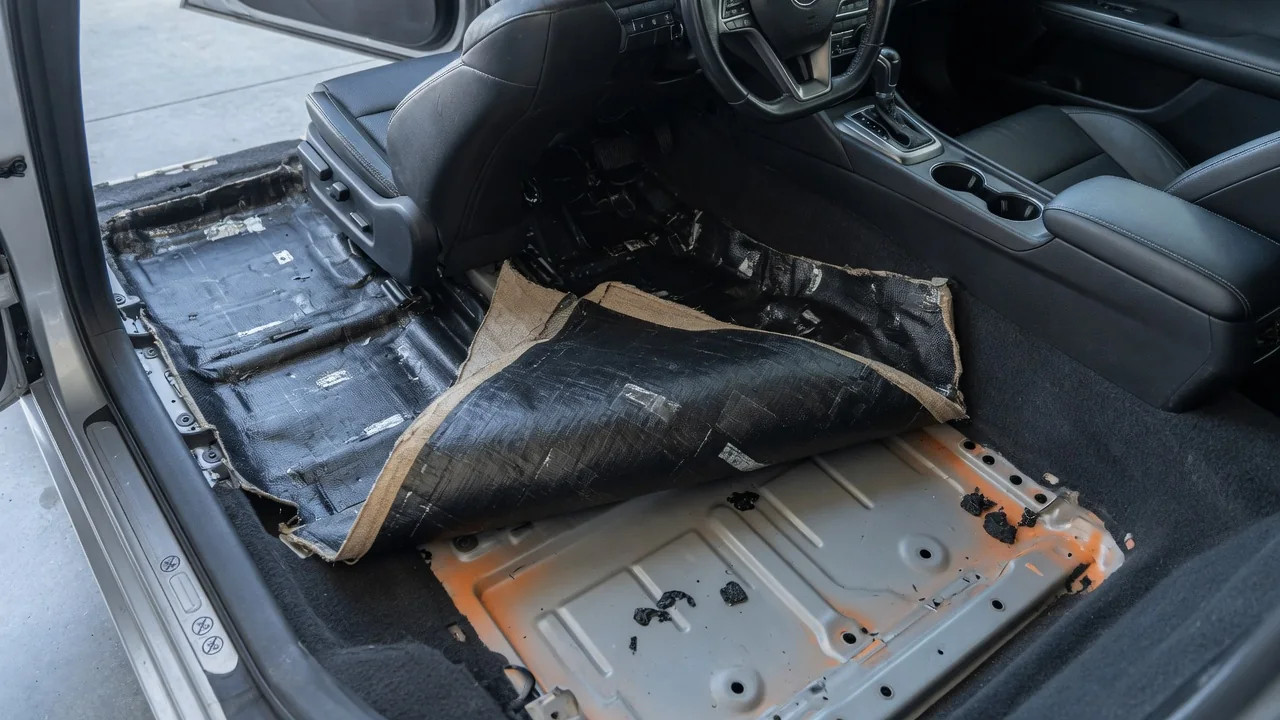
Lift the carpet in almost any modern car and you will find patches or sheets of dense, rubbery material bonded to the steel floor. Car floor sound damping is not decoration, and it is not primarily rust protection. It exists because a large, thin metal floor behaves like a drumhead, picking up vibration from the road and drivetrain and radiating it into the cabin as noise. How that material works also explains why automakers use only as much of it as they need.
Panel vibration and why floors resonate
The floor pan is one of the largest single surfaces in a vehicle body. It is typically stamped from relatively thin sheet steel, sometimes aluminum, and joined to rails, crossmembers and rocker sections. Between those stiff supports, the open areas of sheet metal can flex. Every panel like this has natural frequencies at which it vibrates most easily, and when energy arrives at or near one of them, the panel's motion builds up far more than the input alone would suggest. That build-up is resonance, and a bare steel panel has very little internal friction to stop it.
Energy reaches the floor constantly. The suspension transmits tire and road inputs into the body through its mounts and bushings, the engine and transmission add vibration through their mounts, and the exhaust system hangs beneath the floor on its own hangers. Damping material is bonded directly to the steel so that when the panel bends, the material bends with it. Most automotive dampers are viscoelastic, meaning they deform partly like rubber and partly like a very thick liquid. That deformation converts some of the vibration energy into a small amount of heat instead of letting it keep the panel ringing. Some designs place a thin stiff layer over the viscoelastic layer, an approach called constrained-layer damping, which forces the middle layer to shear and generally makes better use of its weight. The goal is not to stop the floor from moving entirely but to lower its peak response at resonance, so the panel settles quickly instead of sustaining a hum or drone.
How floor damping affects road noise
Road noise reaches occupants by two broad paths. Structure-borne noise travels as vibration through the suspension and body, then becomes audible when a panel such as the floor radiates it into the cabin air. Airborne noise is sound already traveling through the air, from tread contact with the pavement, water spray, the exhaust and the underbody, and it passes through gaps and through the panels themselves. The floor sits directly above the tires, the road surface and much of the drivetrain, so it is exposed to both paths at once.
Damping material is most effective against the first path. A vibrating floor acts much like a loudspeaker cone, and reducing its vibration at resonance lowers the low- and mid-frequency boom and drone that become tiring on long drives, especially on coarse pavement. On its own, damping does far less against airborne sound. Blocking airborne noise relies mainly on mass and good sealing, while absorbing it relies on porous materials such as fibers and foams. That is why a typical floor is a layered system: damping patches or a sprayed damping coating on the steel, then fibrous padding or foam, then carpet that may carry a heavy backing acting as a barrier. Each layer handles a different part of the problem, and the damper's specific job is to keep the steel itself quiet.
The weight tradeoff
Every pound added to a vehicle affects fuel consumption, electric driving range and acceleration. Damping materials are dense by design, because both their mass and their internal losses contribute to how well they work. Covering every square inch of floor would add weight without a proportional reduction in noise, so manufacturers generally treat damping as a targeted engineering choice rather than a blanket coating.
The most useful locations are the parts of a panel that move most in its troublesome vibration patterns, usually larger unsupported areas away from welds, ribs and crossmembers. Engineers can identify these areas through analysis and testing during development and apply material only where it reduces noise efficiently. Some vehicles use liquid-applied damping sprayed by robots, which allows thickness and coverage to follow vibration patterns closely. Body design shares the work as well: stamped beads and ribs stiffen panels and shift their natural frequencies, structural adhesives and bracing change how the floor responds, and some manufacturers use laminated steel with a thin damping core in selected panels. Because vehicles differ in their priorities for cost, mass, refinement and powertrain noise, the amount and type of floor damping varies widely. In electric vehicles, the absence of engine sound can make road noise more noticeable, which raises its importance while range pressure makes extra mass more costly.
Practical implications and limits
For owners, floor damping usually becomes relevant when the carpet comes out for a repair, a leak cleanup or an audio or sound upgrade. Factory damping pads are normally well bonded and are not meant to be peeled off casually; removing them can make the floor sound noticeably more tinny, so they should be restored or replaced if a repair disturbs them. Moisture is the more serious concern. Wet padding and carpet can hold water against the steel for a long time, so a leak or soaked carpet deserves prompt drying regardless of what lies underneath.
Adding aftermarket damping can reduce panel resonance further, but the benefit has limits. Once the large resonant areas are treated, extra layers mostly add weight with diminishing returns, and damping alone will not stop airborne tire roar, wind noise or sound leaking through door seals and gaps. Product choice matters too: materials intended for vehicle interiors are formulated to stay adhered and tolerate cabin temperatures, while unsuitable products may soften, give off odors or detach, particularly near exhaust heat. Clearance under carpet, seat mounts and trim also limits how thick any treatment can be.
It also helps to separate a damping issue from other noise sources. A new or worsening hum that changes with road speed may come from tires or wheel bearings, a vibration that tracks engine speed points toward mounts or the exhaust, and rattles usually come from loose parts rather than an under-damped panel. Floor damping lowers the background noise the body contributes; it does not mask mechanical faults, and a change in sound is worth diagnosing rather than covering up.