Why Are Car Door Windows Shaped Differently at the Front Edge?
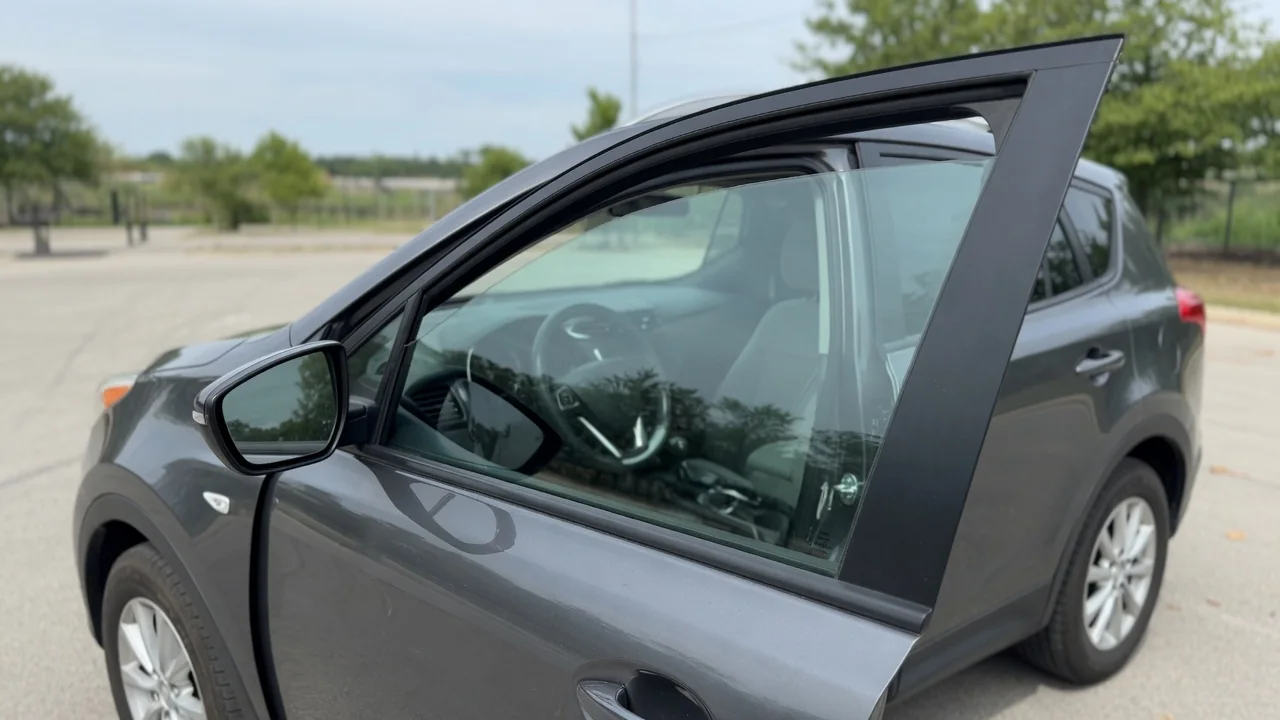
On most front door windows, the leading edge looks different from the trailing edge. You may see a small fixed triangle, a black plastic panel, or a vertical bar between the front of the door and the glass that moves. These features are not styling accidents. The glass has to travel down into the door and stay guided and sealed the whole way, and it has to share space with the side mirror. This article explains the general mechanisms and what they mean for owners.
Frame geometry: why the front edge cannot simply follow the pillar
A front door window has to do two jobs that pull in different directions. When it is closed, its outline should fill the opening formed by the door frame or the body. At the front, that opening follows the steeply raked A-pillar. When it is lowered, the same piece of glass must fit inside a door shell with limited space. The glass does not slide diagonally. It moves down along a defined path, usually a gentle arc that matches the glass's curvature. The regulator and the channels at its edges guide it along that path.
That travel path causes the problem. Suppose the moving glass had a front edge cut to match the slanted pillar. As soon as the window started to drop, that edge would pull away from a sloped guide and be left unsupported and unsealed. Designers therefore often give the moving glass a front edge that runs close to its direction of travel. Along that edge they place a division bar, which is a rigid channel lined with rubber. The triangle left between the bar and the pillar is then filled with fixed glass, a trim panel, or the mirror mount. The front of the door is also crowded below the beltline. The hinges and door check, and often wiring and a speaker, sit there, so a long pointed nose of glass would have nowhere to go when lowered.
The edge outline is set before the glass is strengthened, so it is fixed from the start. Tempered side glass is typically cut, edge-ground, heated, bent, and quenched. Once tempered, it cannot be trimmed without shattering. Laminated side glass, used on some vehicles for acoustic or security reasons, is also made to a finished shape. Door glass shape and seals are designed together. The front edge you see is the result of fixed production geometry matched to the door's channels and weatherstrips.
The mirror area and the fixed front section
The exterior mirror usually sits at the front corner of the door. It needs a stiff mounting point and a path for adjustment cables or wiring. It often also needs room for a heater, a folding motor, or a turn signal connector. Many doors mount it in a small fixed area at the front of the window frame, sometimes called a sail panel or mirror patch. This solves several problems at once. It puts the mirror where the driver can see it, it uses the awkward triangle left by the division bar, and it keeps the mounting clear of the moving glass.
Other designs attach the mirror to the door skin below the beltline instead. That frees the area above the beltline. The window can then appear to reach further forward, or the triangle can become a small fixed pane that improves the view past the A-pillar. Neither approach is better in every case. A lower mirror changes how the mirror base, trim, and seals are packaged. A fixed pane adds another glass part and another sealing joint. The choice depends on the overall door structure, the styling, and how much visibility the designers want at that corner.
Guidance for reading your own door's front edge
To understand your own door, start by finding where the moving glass ends at the front. A vertical or near-vertical bar running down into the door usually marks a division channel, with fixed glass or trim ahead of it. On frameless doors, the glass is held mainly by its regulator and by seals on the body. Many frameless designs briefly drop the glass when the door opens so its edge can clear the seal. This behavior is vehicle-specific. The owner's manual describes any reset procedure needed after the battery is disconnected or the door is repaired.
Replacement glass must match the original exactly. The front edge profile, whether there is a fixed vent pane, and how the mirror is mounted all distinguish one part from another. These can differ even between body styles of the same model line. Match the part using the vehicle's identification details, not appearance alone. For noise, leaks, or a window that binds near the top, the front edge is a good place to look. The division bar channel and the beltline seals do much of the guiding and sealing work there. Worn, displaced, or dirty run channels can make the glass rattle or drag. A service manual for the specific vehicle shows how its channels and adjustments are arranged.
Practical implications and limits
In daily driving, the front-edge layout affects what you see and hear. A wide black sail panel or thick division bar adds to the blind area already created by the A-pillar and mirror housing. This matters at intersections and traffic circles, where pedestrians can be hidden in that zone. Moving your head slightly before pulling out is still the practical countermeasure. Wind noise at highway speed can also be strongest near the mirror and the front glass corner, where airflow separates around the housing. A small seal gap there may be more audible than one further back.
A general explanation also has limits. Door glass geometry is engineered for each body shell, so two vehicles with similar-looking windows may guide and seal the glass very differently. Some everyday choices also interact with these edges. Aftermarket window film is usually trimmed to clear the edges that slide into channels. Ice in a run channel can hold the glass harder than the regulator is meant to handle, so forcing a frozen window can cause damage. These mechanisms explain why front edges differ, but they do not replace the manufacturer's service information when diagnosing or repairing a particular door.