Why Are Bridges Often Different From Nearby Pavement in Winter?
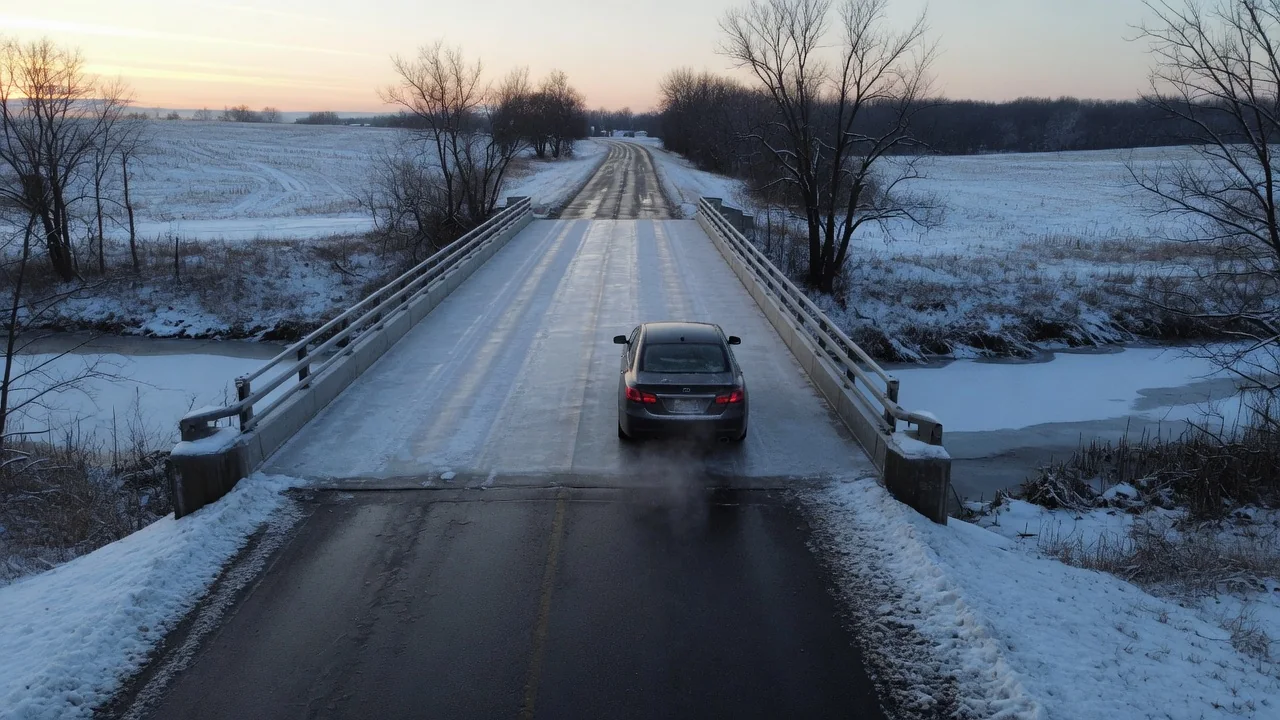
Drivers who wonder why are bridges often different from nearby pavement in winter are noticing a real physical effect. A bridge deck is surrounded by cold air and cut off from the ground, so it loses heat faster than the road leading up to it. That difference in temperature and exposure can change grip within a few car lengths, even when the rest of the route feels ordinary.
Air around structure
A normal road sits on soil and gravel that hold warmth collected over the previous days and months. That stored heat rises slowly into the pavement and slows its cooling after sunset. A bridge deck has no such support. Cold air moves across the top, along the sides, and underneath the span, so heat escapes from every face at once. The deck therefore tracks the air temperature closely, while the approach road lags behind and stays slightly warmer for longer.
Wind adds to the effect. Bridges usually cross valleys, rivers, rail lines, or other roads, which are open places where moving air is rarely blocked by trees, buildings, or embankments. Constant airflow strips warmth from the concrete and steel more quickly than still air would. Water below can also supply moisture that settles on the cold surface. A driver may notice the outside temperature reading on the dashboard dip slightly on a long span, although sensor placement and response time differ between vehicles.
Surface changes
Because the deck cools first, moisture on it can freeze while the adjoining pavement is merely wet. Rain, melted snow, fog, or dew that would remain liquid on ground-supported asphalt may turn to a thin glaze on the span. This is the reason warning signs commonly state that a bridge ices before the road. The change is often invisible, since a thin clear layer of ice looks much like a damp, dark surface, particularly at night or under flat gray daylight.
Materials and construction play a part as well. Concrete decks, steel grid surfaces, and metal expansion joints each shed heat and hold moisture differently from asphalt, so grip can vary even across one structure. Shaded sections beneath overhead trusses or beside tall barriers may stay frozen after sunlit portions have thawed. Road salt and other treatments can also behave differently on a deck that is colder than the road around it, which means a treated bridge is not guaranteed to match the treated approach.
Driver caution
The practical response is to prepare before reaching the span rather than reacting on it. Easing off the accelerator and reducing speed while the tires are still on the approach road leaves the vehicle settled when the surface changes. On the deck itself, smooth and modest inputs matter most. Abrupt braking, sharp steering, or sudden acceleration ask the tires for grip that may not be there, while steady speed and a straight path demand very little from the contact patches.
Following distance deserves extra attention, because stopping takes much longer on ice and the vehicle ahead may slow unexpectedly. Lane changes are better completed before or after the structure. Cruise control is generally best switched off in freezing conditions so the driver controls throttle directly. Curved ramps and elevated interchange flyovers combine the cooling of a bridge with cornering loads, which makes them especially demanding. Staying relaxed and looking well ahead helps a driver respond calmly if the vehicle begins to drift.
Everyday Use and Observations
Several cues can suggest that a deck differs from the pavement around it. Tire noise may become quieter when the surface is glazed, and spray from vehicles ahead can stop even though the road still looks wet. The steering may feel lighter than usual. Frost on guardrails, signs, or the barrier walls hints that the deck is at or below freezing. Early mornings, late evenings, and clear, calm nights after a damp day are common times for this contrast to appear.
Modern vehicles offer some help, although the details vary by make, model, and equipment. Many display an outside temperature reading and show a low temperature alert, yet the trigger point and sensor location are set by the manufacturer and the reading describes air rather than the road itself. A flashing stability or traction control indicator on a bridge signals that the system detected wheel slip. Tire type, tread depth, and inflation also shape how any particular car behaves on a cold span.
Limits and Next Steps
This explanation is conceptual, and real conditions do not follow a single rule. A bridge can be dry and safe while a shaded hollow on the regular road is icy, and the reverse is just as possible. Deck design, traffic volume, sunlight, humidity, wind, and local road treatment all influence the outcome. No dashboard reading, driver assistance feature, or drivetrain layout can confirm that a surface has grip. All-wheel drive helps a vehicle move off, but it does not shorten braking distances on ice.
Sensible next steps begin before the trip. Checking the forecast and local road reports shows whether freezing temperatures and moisture are likely to coincide along the route. The owner's manual explains how that vehicle's temperature warning, traction control, and stability systems behave, and what their indicators mean. Tires suited to the season and in good condition make the largest difference to winter grip. If a warning light stays on after the drive, a qualified technician can confirm the cause for that specific vehicle.