Why Are Body Panel Flanges Important? Joining, Stiffness and Sealing
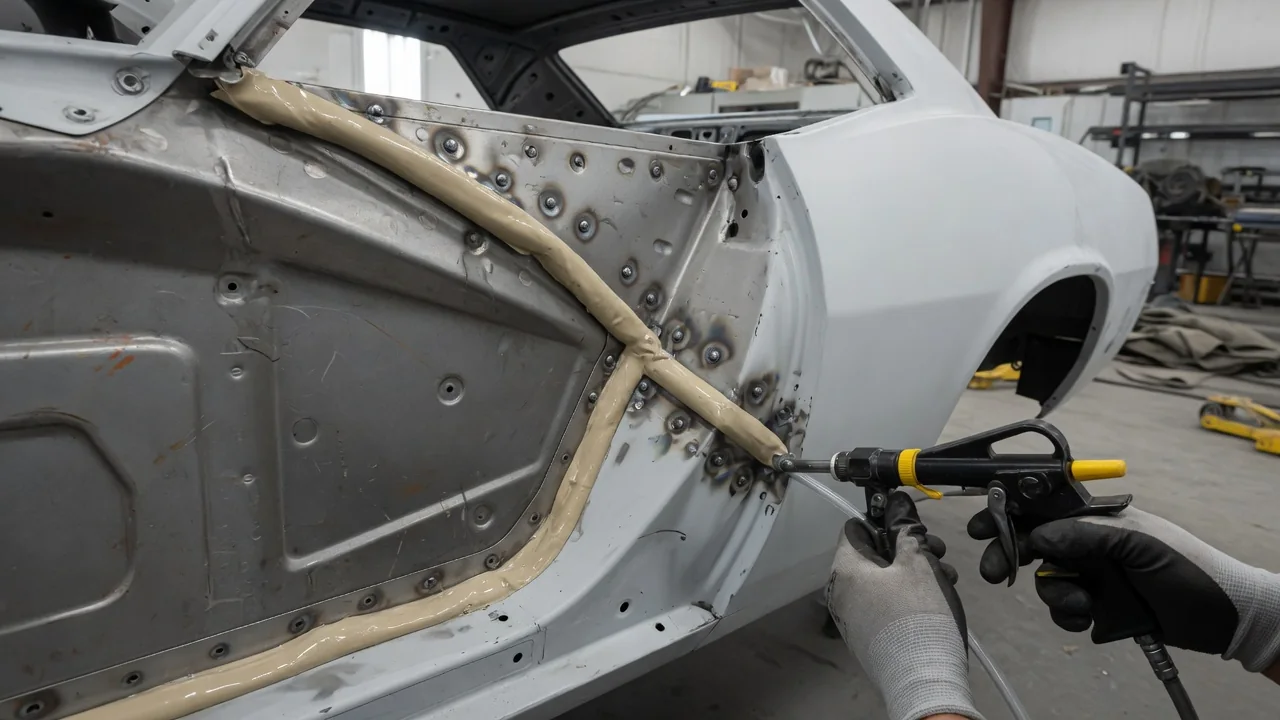
A flange is the narrow strip of sheet metal bent at an angle along the edge of a body panel. It is easy to overlook, yet it does a large share of the work in a car body. The answer to why body panel flanges are important comes down to three jobs: giving panels an edge to join, stiffening thin metal, and creating a surface that can be sealed against water, air, and noise.
Joining edge
A flat sheet of steel or aluminum offers almost nothing to attach to along its edge. Its thickness is far too small for a reliable weld or bond. Bending the edge into a flange turns that thin edge into a face with real surface area. Two panels can then overlap flange to flange, or flange to flat surface, and be joined across that contact area. This is the basic car panel flange purpose in body construction: it converts the edge of a panel into a joint.
Different joining methods depend on that surface in different ways. Resistance spot welding clamps two overlapping flanges between electrodes, so the flange must be wide enough and accessible enough for the welding equipment to reach it. Structural adhesives need a consistent bond line, which a flat, well-formed flange provides. Rivets and clinched joints also rely on overlapping flanges. On closure panels such as doors, hoods, and trunk lids, the outer skin is commonly folded over the edge of the inner frame in a hem flange, which locks the two parts together and often works alongside adhesive. In many body openings, two flanges are welded together to form a pinch weld seam.
Flanges also help with location and fit. Because they define where one panel meets another, their position and angle influence panel gaps, flushness, and alignment. A flange that is bent at the wrong angle or in the wrong place can push a panel out of position even when the rest of the panel is correct.
Stiffness
Thin sheet metal bends easily when it is flat. Its resistance to bending depends heavily on how the material is distributed relative to the direction of the load, not only on how thick it is. A flange moves material out of the plane of the sheet, which increases the edge's resistance to bending in much the same way that an angle section is far stiffer than a flat strip of the same thickness. That is why a flanged edge feels firm while the unsupported middle of the same panel may flex under hand pressure.
This stiffening effect matters in several places. A flanged edge is less likely to ripple, wave, or distort, both in service and during manufacturing steps such as welding, where heat can warp unsupported metal. Flanges around openings, such as wheel arches, window openings, and door apertures, keep those edges from flexing or tearing. The bending process itself can also add some local strength through work hardening, depending on the material.
Flanges often contribute stiffness indirectly as well. When two formed panels are joined along their flanges, they can create a closed or partly closed box section, such as a rocker, pillar, or rail. That closed shape is much stiffer than either panel alone, and the flanges are what allow it to be assembled in the first place. In this sense, flanges are part of how a vehicle body achieves rigidity, although the overall result depends on the full design of the structure rather than any single edge.
Sealing
Every joint between panels is a potential path for water, dust, air, and noise. Flanges give those joints a defined, continuous line where a seal can be applied. Seam sealer is typically laid along overlapping flanges to close the gap between them, and adhesives or sealers placed in hem flanges help keep moisture out of the fold. Without a flange, there would be no consistent surface for these materials to bridge.
Flanges also serve as mounting surfaces for other sealing parts. Door and trunk weatherstrips are often designed to clip or push onto a pinch weld flange around the opening. Bonded glass, such as many windshields, is commonly attached with urethane to a flange that runs around the window opening, so the flange's shape and condition affect how well the glass seals.
Sealing is closely tied to corrosion protection. The tight overlap at a flange joint can trap moisture if it is not sealed or drained properly, and trapped moisture in a crevice is a common starting point for rust. Factory coatings, sealers, and drain paths are intended to manage this risk. When they fail or are damaged, flange areas are among the places where corrosion tends to appear first.
Practical implications and limits
For owners, the most visible consequence is where rust shows up. Lower door edges, hemmed hood and trunk lid edges, wheel arch lips, and rocker seams are flange areas worth inspecting, especially on older vehicles or those used in wet or salted conditions. Bubbling paint along a seam often indicates corrosion that started inside the joint rather than on the open surface, which means the visible damage may understate what is underneath.
Flanges can also be damaged by everyday handling. A pinch weld seam under the rocker is sometimes used as a lifting point, but lifting on the wrong spot or without a suitable pad can bend or crush it. A bent flange may affect weatherstrip fit, panel alignment, or the integrity of its protective coating. Where the owner's manual or service information specifies lifting points, those instructions take precedence over general habits.
In repair work, preserving or correctly reproducing flange geometry is part of a sound panel replacement or patch. Repairers may form new flanges with hand tools or flanging and joggling tools when fitting patch panels, and replacement panels that arrive with poorly formed flanges can be difficult to fit cleanly. There are limits to what general guidance can say, however. Joining methods, sealer locations, and whether a panel may be sectioned vary by vehicle and material, and high-strength steels and aluminum often carry specific manufacturer restrictions. A flange that looks intact cannot confirm that a joint is structurally sound, so the manufacturer's repair procedures for the specific vehicle should guide any structural or safety-related work.