Which Battery Cable to Disconnect First
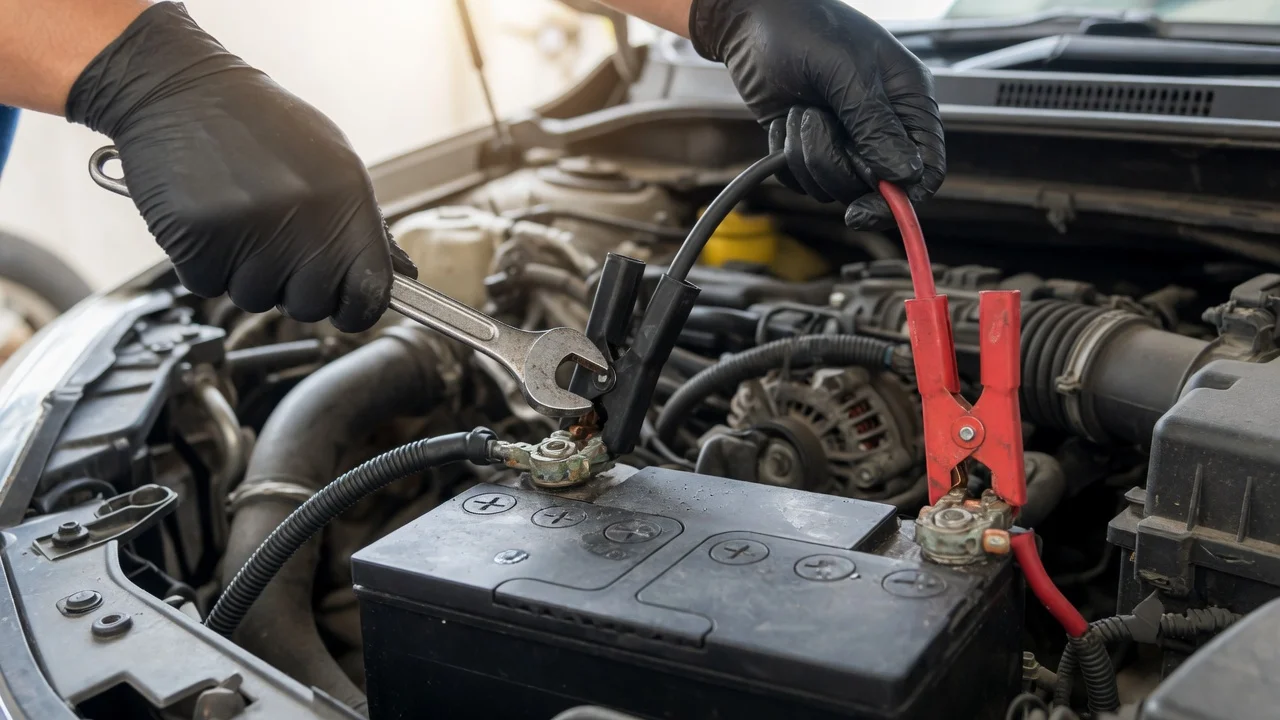
The short answer: negative first, negative last
On a typical car or light truck with a negative-ground electrical system, disconnect the negative (black, marked with a minus sign) cable first. When reconnecting, attach the positive (red, marked with a plus sign) cable first and the negative cable last. Most modern road vehicles use negative-ground systems, so this order applies to most of them.
Why the order matters
In a negative-ground system, the negative battery terminal connects directly to the vehicle's metal body and engine block, which is called the chassis ground. Almost any bare metal under the hood is therefore electrically tied to the negative side of the battery.
Suppose you loosen the positive terminal first while the negative is still connected. If your wrench touches the positive terminal and any grounded metal at the same time, it completes a direct short circuit. That can produce sparks, heat the tool, damage electrical components or, in the worst case, ignite hydrogen gas that lead-acid batteries can release.
Removing the negative cable first breaks the connection to ground. After that, an accidental touch between the wrench on the positive terminal and the car's body no longer completes a circuit. Reconnecting the negative cable last keeps that protection in place for as long as possible.
Basic sequence
Turn off the ignition and remove the key or switch off the keyless system. Identify the negative terminal by its minus sign or black cable, and confirm it rather than relying on color alone. Loosen the negative clamp and move the cable away so it cannot spring back onto the terminal. Loosen and remove the positive cable. To reconnect, attach and tighten the positive cable first, then the negative cable.
When the answer changes
Positive-ground vehicles: Some older vehicles, including certain classic cars, tractors and motorcycles, use a positive-ground system. On these vehicles the positive terminal is connected to the chassis, so the logic reverses: disconnect the positive (grounded) cable first and reconnect it last. The general principle is to disconnect whichever cable goes to the chassis first. If you are unsure which system a vehicle uses, trace the cable that bolts to the body or engine block.
Hybrids and electric vehicles: These vehicles usually have a conventional 12-volt auxiliary battery in addition to the high-voltage traction battery. The negative-first rule commonly applies to the 12-volt battery, but the high-voltage system is a separate matter and should not be disconnected or serviced without the manufacturer's procedure and appropriate training. Disconnection steps for the 12-volt battery also vary by model, so follow the owner's manual or service information for the specific vehicle.
Remote or hidden batteries: Some vehicles mount the battery in the trunk, under a seat or beneath the floor, and provide remote jump-start terminals under the hood. Procedures for these layouts vary by model and model year, so the owner's manual is the reliable reference.
Side effects to expect
Disconnecting the battery can erase stored settings such as radio presets, clock time and seat or mirror memory. On some vehicles it can also reset learned engine idle or transmission behavior, require a radio security code, or require reinitializing power windows or a sunroof. Whether any of this applies, and how to restore it, depends on the make, model and year. Some manufacturers also specify waiting periods after disconnection before working near airbag components; check the service information rather than assuming a fixed time.
Bottom line
For most negative-ground cars and trucks, take the negative cable off first and put it back on last. On positive-ground, hybrid, electric or unusual battery layouts, confirm the procedure in the vehicle's documentation before starting.