Where Is the 4WD Actuator Located?
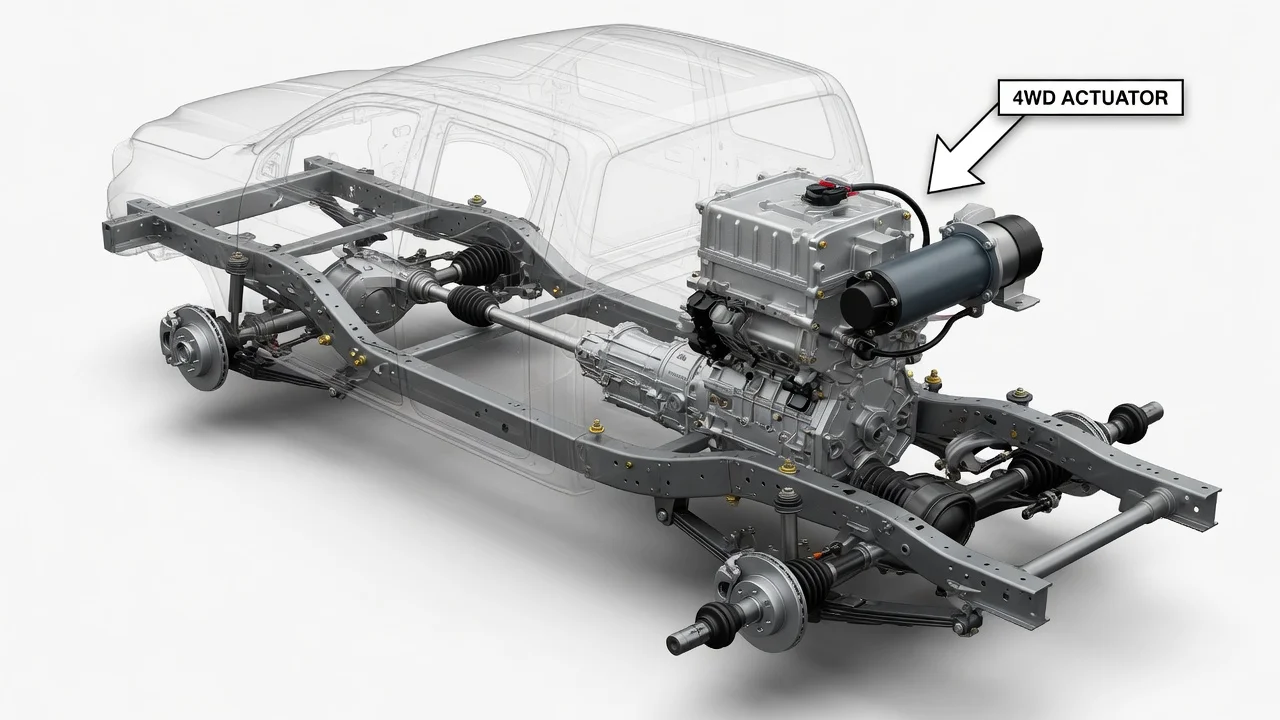
On most part-time four-wheel-drive trucks and SUVs, the 4WD actuator sits on the front axle. It is either bolted to the front differential housing or mounted on the axle tube beside it. Many vehicles also have a second actuator, the transfer case shift motor, attached to the transfer case behind the transmission. The drivetrain design determines which of these parts you need to find and where it sits. This guide explains how to identify the right one on your vehicle.
Where the 4WD Actuator Is Usually Found
When owners and shops talk about the 4WD actuator, they usually mean the front axle actuator. On vehicles with independent front suspension, it is commonly mounted on the front differential housing or on the short axle tube that extends from the differential toward one wheel. On solid front axles, it may sit on the axle housing near the differential. You reach it from underneath the vehicle. An electrical connector or one or two small vacuum hoses usually run to it.
The second component often called a 4WD actuator is the transfer case shift motor, sometimes called an encoder motor. It bolts to the outside of the transfer case, which sits behind the transmission roughly under the middle of the vehicle. A third possibility is locking hubs. Some vehicles connect the front wheels at the hubs, so the engaging parts are at each front wheel instead of at the axle. In short, check the front axle first and the transfer case second. Your vehicle configuration decides which of these applies.
How a 4WD Actuator Works
In a part-time system, the front driveshaft and front axle are disconnected during normal two-wheel-drive driving to reduce wear and drag. When you select 4WD with a switch or lever, two things must happen. The transfer case must send power to the front driveshaft. The front axle must then connect its shafts so that power reaches the front wheels. Actuators handle one or both of these jobs.
The front axle actuator typically moves a sliding collar or fork that locks two sections of axle shaft together, or it locks the hubs. Depending on the design, it is driven by engine vacuum routed through a solenoid or by a small electric motor. Some older designs use a heated plunger that extends as it warms. The transfer case shift motor rotates a shaft inside the case to move between positions such as 2WD, 4-high, neutral and 4-low. On electronically controlled systems, a position sensor reports the selected range back to a control module, which then commands the front actuator.
What Changes the Location on Your Vehicle
The biggest factor is the drivetrain type. Part-time 4WD trucks and SUVs are the most likely to have a separate front axle actuator. Full-time 4WD and all-wheel-drive vehicles often keep the front axle connected at all times and may use a clutch pack or coupling instead, so there may be no front axle actuator at all. Vehicles with a manual transfer case lever usually have no shift motor on the transfer case, although they can still have an actuator on the front axle.
Suspension layout and model year also matter. Independent front suspension and solid front axles place the actuator differently. Manufacturers have also switched between vacuum, electric and hub-based systems across generations of the same model. Trim level and options can change the setup within a single model year, so two similar-looking trucks may not use the same part. The most reliable reference is your exact vehicle configuration, ideally confirmed by VIN.
How to Find and Check the Actuator Yourself
Park on level ground, set the parking brake, turn the engine off and let the drivetrain cool. If you need to raise the vehicle, support it on proper jack stands, never on a jack alone. Then look at the front differential from below. Follow any wiring harness or vacuum lines that lead to the differential or axle tube. The component they end at is usually the actuator. To find the transfer case motor, trace the wiring to the transfer case and look for a motor bolted to its side or rear.
A basic visual inspection can reveal common problems. Look for a loose or corroded electrical connector, cracked or disconnected vacuum hoses, damage from road debris, or fluid seepage around the mounting area. Some owners can hear a click or hum when 4WD is selected, which suggests the actuator is receiving a command. Write down what the 4WD indicator light does, any grinding, and whether the front end fails to engage, along with recent repairs. These notes and the vehicle's service history make later diagnosis faster and cheaper.
The owner's manual usually explains the 4WD controls, hub type and correct engagement procedure, so check it before assuming a fault. Keep transfer case and front differential fluid service on the manufacturer's maintenance schedule as well.
Limitations and When to Get Help
This guide describes common layouts, not the exact position on every vehicle. The mounting side, access, and whether a vehicle has one actuator, two or none all depend on the make, model, year and drivetrain. Some actuators can only be reached after removing skid plates or other components. For the precise location, part number and test procedure, use the factory service information and manufacturer specifications for your VIN, or ask a dealer or qualified shop.
Get professional help if 4WD engages only some of the time, warning lights or stored codes appear, you hear grinding or clunking, or the vehicle will not shift out of 4WD. Electronic systems may need a scan tool to read actuator commands and position data, and some replacements require a calibration or relearn. A part-time system that stays engaged on dry pavement can bind and damage driveline parts. Avoid demanding operating conditions until the system has been checked.