When to Use Regenerative Braking and How to Get the Most From It
Knowing when to use regenerative braking in an electric or hybrid vehicle can directly improve range and reduce brake wear. The system recovers energy whenever the car slows without touching the brake pedal, but it works best with deliberate driving habits. Many drivers wonder whether to rely on aggressive regen modes, coast freely, or blend both depending on the road. This guide explains practical times to use energy recovery, when coasting is smarter, and how to adapt as battery conditions or road surfaces change.
When Regenerative Braking Recovers the Most Energy
Regenerative braking pays off most when you would otherwise need to slow down, such as approaching a red light, a stop sign, or slower traffic ahead. Instead of pressing the brake pedal late and converting motion into heat, lifting off the accelerator early lets the motor resist the car’s momentum and feed energy back to the battery. The more gradual the deceleration, the greater the share of stopping done by regen rather than friction brakes. In practical terms, if you can see a stop coming from a block away, start easing off the throttle immediately rather than maintaining speed until the last moment.
City and suburban driving with frequent slowdowns offers many opportunities for energy recovery, while steady highway cruising provides few. On an open freeway at constant speed, regen is rarely used because there is no deceleration event. However, in stop-and-go traffic or on streets with lights every few blocks, lift-off regeneration can reclaim a meaningful portion of the energy spent accelerating. Keep in mind that regen recovers only part of what was used to gain speed—sometimes 10 to 30 percent depending on conditions and vehicle calibration—so smooth driving and anticipation matter more than braking often just to 'charge' the battery.
When Coasting Is the Better Choice
On open roads with no need to slow down, coasting or light throttle is usually the better choice because it preserves momentum. Electric motors spin freely when no power is applied, and maintaining speed without regen means you avoid the losses of slowing and then speeding up again. Gentle downhill stretches before a flat or uphill section are classic examples: allowing the car to roll with minimal regen can use gravity to your advantage, while stronger lift-off regeneration would scrub off speed that you would later have to replace with battery power.
To judge when to coast versus use regen, watch the road far ahead. If a stop is very far away, lift off just enough to let the vehicle settle into a mild coast and then reapply light throttle as needed. If the stop is closer and you need to scrub speed more quickly, a higher regen mode or one-pedal driving can finish the job smoothly. Remember that coasting should never mean shifting into neutral unless the owner’s manual specifically allows it; many EVs and hybrids have a dedicated coast mode or a low regen setting that accomplishes the same effect safely.
Using Stronger Regen Modes and One-Pedal Driving in Stop-and-Go Traffic
Higher regen levels and one-pedal driving make heavy stop-and-go traffic much easier because the car slows as soon as you lift off the accelerator, reducing the need to move your foot back and forth to the brake pedal. In a typical commute, one-pedal driving can turn creeping traffic into a single-foot exercise: accelerate gently, then lift off to slow, and the car may even come to a complete stop depending on the system. This reduces fatigue and lets regenerative braking capture energy at every slowdown instead of using the friction brakes.
When first trying a stronger regen mode, start in a quiet area with little traffic and practice lifting off smoothly. The deceleration can feel abrupt until you learn to modulate the accelerator pedal rather than simply releasing it. Vehicle controls vary: some cars have steering-wheel regen paddles that adjust the level on the fly, while others use a B mode on the shifter or a menu setting. Always keep the brake pedal ready, because one-pedal driving may not bring every vehicle to a full stop or hold it on a slope, and some systems require the brake pedal for the final stop.
Managing Speed on Long Downhill Descents
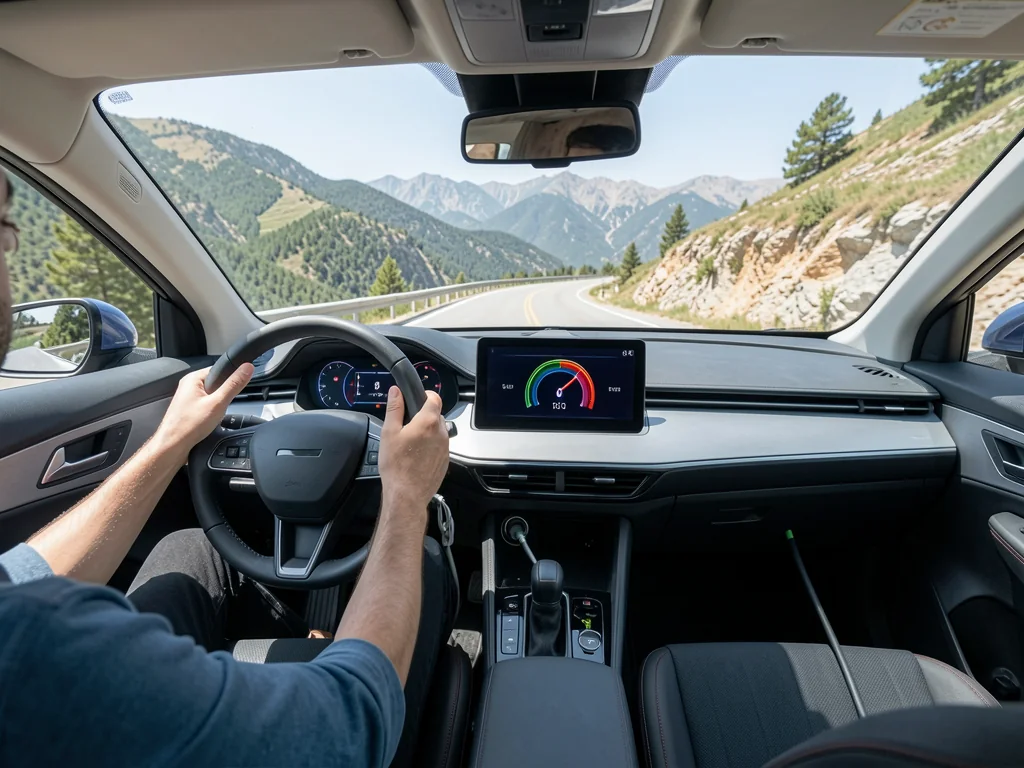
On long downhill descents, a stronger regen setting can help hold a steady speed without overheating the friction brakes. When you lift off the accelerator on a grade, the motor provides resistance that acts like engine braking in a gasoline car, but it also recovers energy. Watch the power or energy gauge on the dashboard: if the needle moves into the regen zone or a green charge icon appears, the car is actively converting downhill motion into battery charge. This is usually the most efficient way to manage a mountain pass.
However, regen may weaken on a descent if the battery is close to full. When the pack cannot accept more charge, the vehicle must reduce motor braking, and the car may suddenly feel like it is freewheeling faster. Drivers should expect this change and be ready to apply friction brakes as needed. Planning ahead helps: if you are about to descend a long grade, avoid charging to 100% right before the descent, or use a charge limit if the vehicle allows it, so the battery has room to absorb regen energy.
Situations Where Regen Is Limited or Unavailable
Many electric and hybrid vehicles reduce regenerative braking when the battery is full or very cold. A full battery has nowhere to store recovered energy, so the system lowers motor resistance to protect the pack. Cold temperatures also limit how quickly the battery can accept charge, so regen may feel weaker on a freezing morning. Some cars show a dashboard message or a reduced-regen icon, while others simply change the brake feel subtly. As the battery warms up during driving, regen strength often returns gradually.
Regen strength can also change with state of charge during a single drive; at high charge it may be muted, and as the battery discharges it becomes stronger. On slippery roads such as ice, snow, or wet leaves, strong lift-off slowing can feel abrupt and may even affect stability, so a gentler regen setting is often wiser. Check the owner’s manual for how your vehicle handles low-traction conditions; some systems automatically reduce regen. If regen seems missing for long periods, a warning light stays on, or braking feels unusual, have a dealer or qualified technician inspect the vehicle.
Everyday Habits to Get More From Regenerative Braking
To get more from regenerative braking every day, look far ahead and lift off the accelerator early so the car can slow smoothly instead of braking hard at the last moment. This habit not only recovers more energy but also reduces brake pad wear and makes the drive more comfortable for passengers. Pair the regen level with the type of driving: use a strong mode or one-pedal driving on city streets and descents, but switch to a lighter or coast-friendly setting on open highways where maintaining momentum is more efficient than frequent regen.
Gentle acceleration and steady speeds work together with regen to improve overall range. Hard acceleration followed by hard regen loses more energy than smooth inputs because the system cannot recover all the energy spent. Regen is a range and comfort tool, not a replacement for safe following distances and normal braking when needed. Use it to make driving smoother, but always leave enough space and be ready to brake firmly in an emergency.