Wheel Balancing vs. Alignment: Which Does Your Car Need?
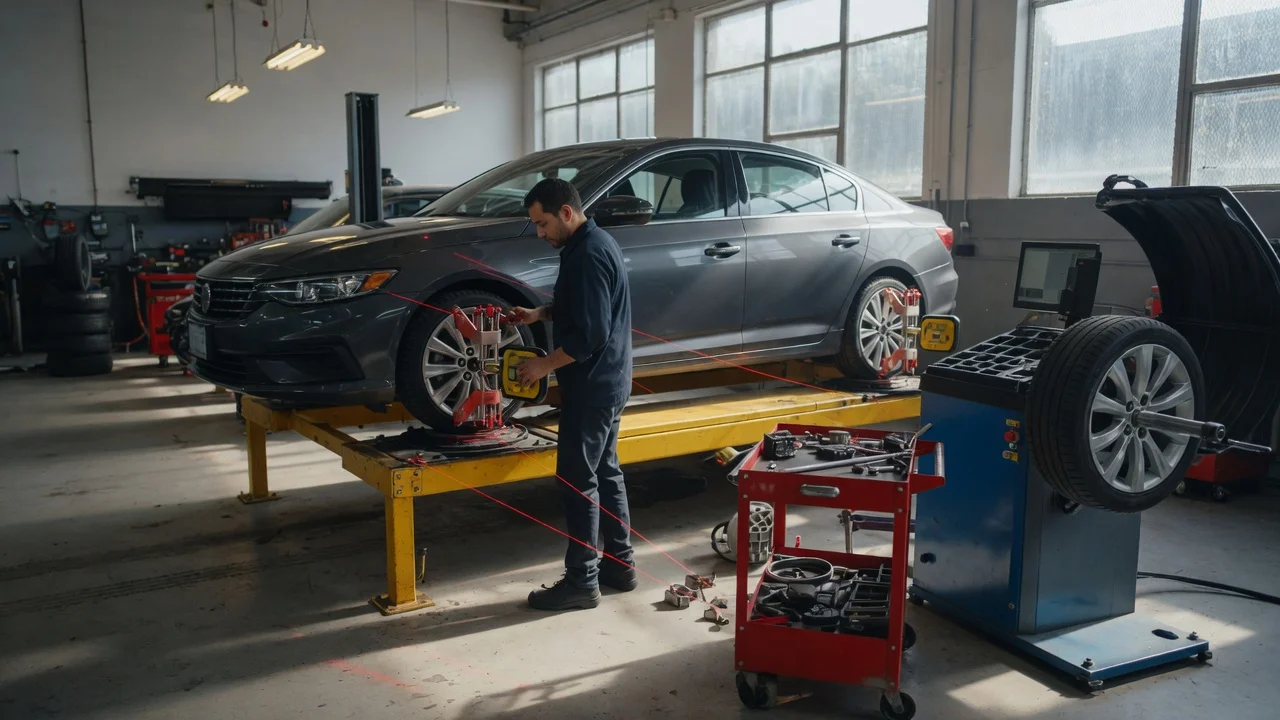
Your car may need wheel balancing, a wheel alignment, or both. They correct different faults. Balancing evens out the mass of a tire-and-wheel assembly, which often shows up as a shake or vibration that builds with speed. Alignment sets the wheel angles so the vehicle tracks straight and the tires wear evenly. Match the service to the symptoms. If those symptoms overlap, or a recent job did not fix the car, have the tires, wheels, and suspension inspected together.
What wheel balancing does
A tire-and-wheel assembly is balanced when its mass is distributed evenly around the hub. A heavy spot can make the assembly hop or wobble as it spins. A technician corrects that by adding small weights to the rim. Balancing is commonly done when new tires are mounted, after a tire is repaired or taken off the wheel, or when a weight has fallen off.
Imbalance is a rotating-mass problem. It does not change the direction the wheels point, and it will not straighten a car that pulls.
What a wheel alignment does
Alignment adjusts the angles of the wheels relative to the vehicle and to each other. Shops typically set toe (whether the wheels point slightly inward or outward), camber (inward or outward tilt when viewed from the front), and caster (the steering-axis tilt that affects straight-line stability). Not every vehicle offers adjustment on every angle; the shop works within what the suspension allows. Alignment is a geometry setting, not a wheel-weight job.
How to tell which service fits
Start with the main complaint, then confirm with a look at the tires. These patterns are typical, not exclusive. A bent wheel, a damaged or out-of-round tire, or worn steering and suspension parts can copy either set of symptoms.
Signs that often point to balancing:
A vibration in the steering wheel, seat, or floor that grows as speed increases; A shake that is strongest in one speed range and eases when you slow down; Tread that looks cupped or scalloped, which can also have other causes
Signs that often point to alignment:
The vehicle pulls or drifts to one side on a reasonably level road; The steering wheel sits off-center when the car is going straight; Uneven wear on an inner or outer shoulder, or a feathered tread pattern; Wander, vague steering, or a car that does not return to center as expected
Question Wheel balancing Wheel alignment; What it corrects Uneven mass in the tire and wheel Incorrect wheel angles; Typical feel Shake or vibration with speed Pull, wander, or an off-center steering wheel; Tire wear often seen Cupping or scalloping Inner or outer shoulder wear, or feathering; What the shop changes Small weights on the rim Toe, camber, and caster as the vehicle allows
When both, or neither, may be the answer
A car can have unbalanced assemblies and incorrect alignment at the same time. New tires are usually balanced when they are mounted; that is a good moment to check alignment as well, especially after a pothole or curb impact or after steering or suspension parts were replaced. Balancing will not fix a pull caused by geometry. Alignment will not fix a vibration caused by an unbalanced, bent, or out-of-round tire and wheel.
If one service did not solve the problem, repeating the same job is a weak next step. Ask for a combined check of tire condition, wheel condition, balance, alignment, and the related suspension parts.
What to do next
Tell the shop when the vibration happens, whether the car pulls, whether the steering wheel is straight, and how the tires look. A tire or alignment shop can measure both. Follow the vehicle maker’s inspection guidance for your model, year, and market when it specifies intervals; those intervals are not the same for every car. This article does not give dollar figures, degree specifications, or a single mileage interval, because those vary by vehicle, shop, and local conditions.