What Was a Distributor in a Car Engine?
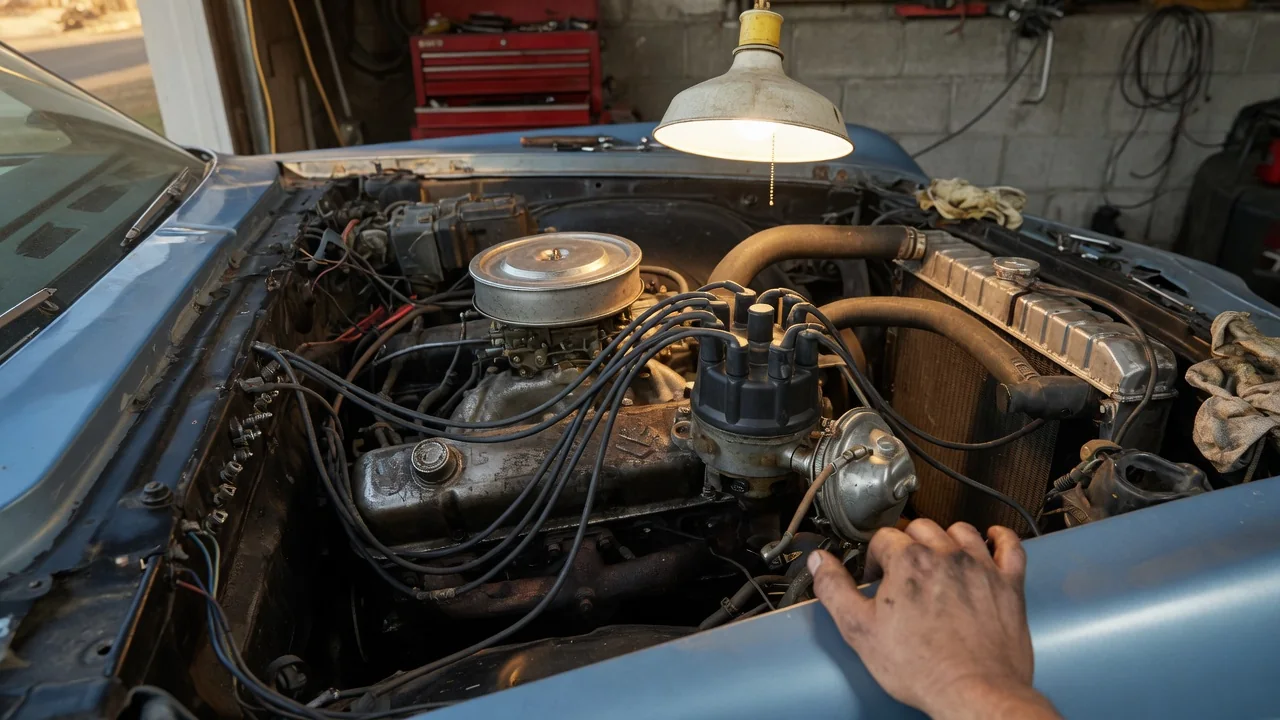
Anyone asking what was a distributor in a car engine is really asking how older gasoline engines decided which cylinder received a spark and when. The distributor was a mechanically driven switch that took high voltage from a single ignition coil and routed it to each spark plug in the correct firing order, while also helping set the moment that spark occurred.
Rotor and cap
The distributor cap is a molded insulating cover with one terminal for the coil wire and one terminal for each cylinder's spark plug wire. On many designs the coil lead enters at the center and the plug leads sit in a ring around it, although some units housed the coil inside the cap itself. Beneath the cap, a small rotor is mounted on the distributor shaft and spins with it, carrying a metal blade that sweeps past each outer terminal in turn.
High voltage from the coil reaches the rotor through a spring-loaded contact or carbon button, travels along the blade, and jumps a small air gap to whichever terminal the rotor tip is facing. That terminal's wire carries the pulse to its spark plug. Because the spark must cross a gap inside the cap every time, the terminals and rotor tip gradually erode and collect deposits. Removing a cap on an older vehicle often reveals this wear as roughened or discolored metal contacts.
Timing
The distributor shaft was usually driven from the camshaft, either by a gear or directly off its end, so it turned at half crankshaft speed in a four-stroke engine. That relationship meant the rotor pointed at each cylinder's terminal once per complete engine cycle, matching the compression stroke of that cylinder. Inside the housing, breaker points or a later electronic pickup signaled the coil to fire at the instant the rotor was aligned with the correct terminal.
Engines need the spark to arrive earlier as speed rises and to shift with load, so many distributors carried their own advance mechanisms. Centrifugal weights moved outward with speed to advance the trigger, and a vacuum diaphragm connected to the intake adjusted timing under light throttle. Base timing was typically set by rotating the distributor body slightly and checking marks with a timing light. The correct setting and method differ between engines, so the vehicle's own service information is the reference.
Modern ignition
Distributors faded from new vehicles as engine computers took over spark control. Instead of one coil feeding a spinning rotor, later systems used coil packs that served cylinders in pairs, and then individual coils mounted directly on each spark plug. A crankshaft position sensor, often supported by a camshaft sensor, tells the control module exactly where the engine is in its cycle, and the module commands each coil electronically with no moving high-voltage parts.
This change removed the cap, rotor, and mechanical advance hardware, along with the wear and moisture sensitivity that came with them. Timing can now be adjusted continuously based on temperature, load, and knock sensor feedback, which supports cleaner combustion and lower emissions. There was also a transition period in which some engines kept a distributor to route the spark but let a computer control the timing, so the presence of a distributor does not always mean a fully mechanical system.
Everyday Use and Observations
On a vehicle that has one, the distributor is usually easy to spot by following the thick spark plug wires back to a round or oval cap where they all converge. Depending on the engine, it may stand upright near the firewall, sit at the front of the block, or protrude horizontally from the end of a cylinder head. The cap is commonly held by spring clips or small screws, and the number of plug wire towers matches the cylinder count.
Owners of older cars learned to associate certain behavior with distributor trouble. Hard starting on damp mornings, misfires under load, hesitation, or a rough idle could point to moisture inside the cap, carbon tracking across the plastic, a worn rotor, or deteriorated points. These symptoms overlap heavily with faulty plug wires, worn spark plugs, fuel delivery problems, and vacuum leaks, so the same stumble can have several origins and the distributor is only one candidate among them.
Limits and Next Steps
A distributor had built-in limits. A single coil had to recharge between every firing event, which left less time per spark as engine speed and cylinder count increased. Shaft bushings, drive gears, and advance weights wore with age, allowing timing to drift or scatter. The cap and rotor were routine wear items, and breaker points needed periodic adjustment. These weaknesses, rather than any single flaw, explain why manufacturers moved toward sensor-driven ignition with fewer mechanical parts.
For anyone maintaining a classic or older daily driver, the practical next step is to confirm what the specific vehicle actually uses before assuming a cause or ordering parts. Firing order, rotor direction, timing procedure, and component layout are engine-specific. Ignition systems also produce very high voltage, so inspection is safest with the engine off. On computer-controlled engines, a stored misfire or ignition code is a starting clue to investigate, not proof that a particular part has failed.