What to Do After Unhitching a Trailer
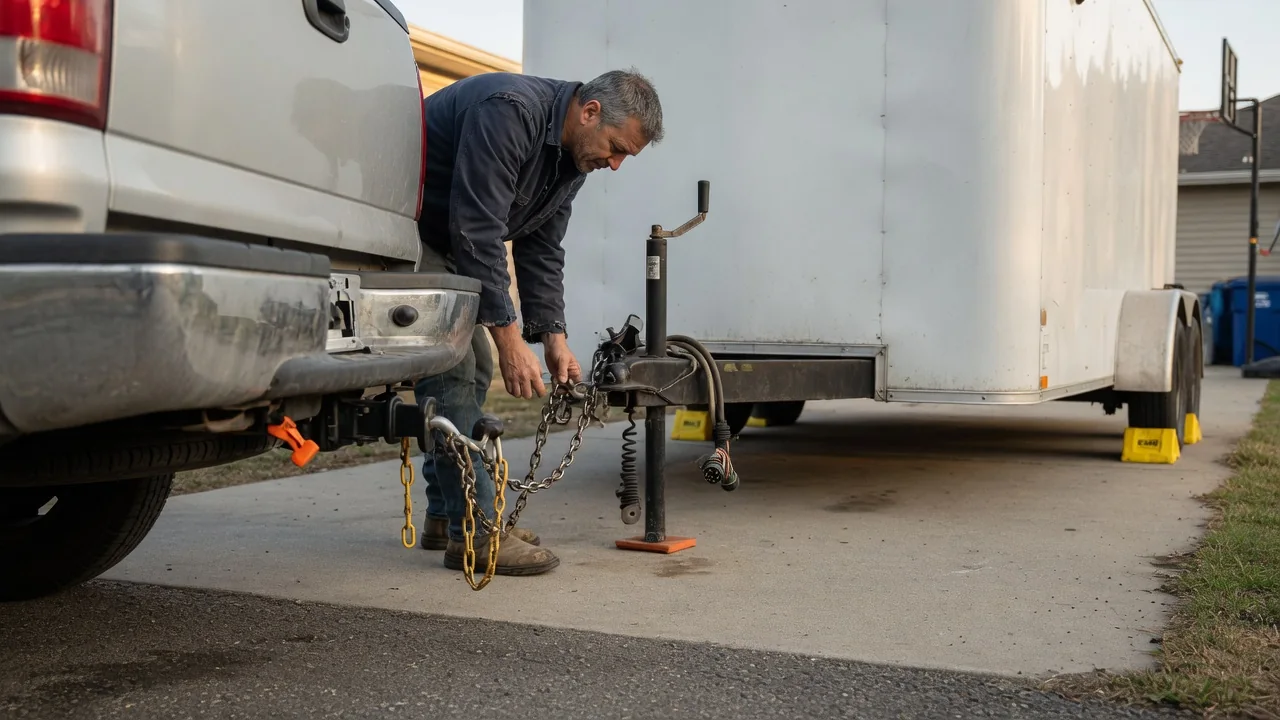
Knowing what to do after unhitching a trailer matters as much as hooking it up correctly. Once the coupler lifts off the ball, the trailer depends entirely on its own supports, and the tow vehicle returns to normal driving with hardware still attached. A short, consistent routine keeps the trailer stable in storage, protects electrical and mechanical connections, and helps you spot wear before the next trip.
Secure trailer
A trailer that has been separated from the tow vehicle has lost its strongest anchor, so the first job is making sure it cannot roll or tip. Wheel chocks placed snugly against the tires on both sides of an axle resist movement in either direction, which matters on driveways that look flat but slope slightly toward the street. The tongue jack or landing legs should sit on firm ground or a support pad, because soft soil and hot asphalt can let a narrow foot sink over time.
Leveling comes next. A trailer left nose-high or nose-low can shift its load, pool rainwater on a roof or deck, and place uneven strain on the jack. Stabilizer legs, where fitted, steady the frame but are generally not designed to lift it, so the owner's manual for the specific trailer is the right reference. A coupler lock or wheel lock adds theft protection during storage, and a firm push against the frame confirms that nothing rocks or creeps before you walk away.
Store connections
The wiring harness, safety chains and breakaway cable are easy to forget once the coupler is free, yet they suffer most from careless storage. A plug left dangling on the ground collects moisture and grit that corrode its terminals, leading to flickering lights or brake controller warnings on the next trip. Tucking the connector into a holder on the tongue, or fitting its protective cap, keeps the contacts clean. Chains should be hooked up or coiled off the ground so they do not rust or get run over.
The vehicle side deserves the same attention. Most tow sockets have a spring-loaded cover that should snap fully closed; if it stays partly open, road spray reaches the pins. Connector styles differ between vehicles and trailers, with flat and round plugs carrying different circuits, so any adapter used should be removed, dried and stored inside the vehicle rather than left in the socket. Trailers with an onboard breakaway battery vary in how they are kept charged during storage, which makes the trailer documentation worth checking.
Check vehicle hitch
With the trailer parked, look over the receiver, ball mount and hitch ball before driving off. Fresh shiny scuffs, a ball that turns on its shank, a bent pin or clip, or cracked paint around welds all suggest that something moved more than it should have under load. Grease on the ball attracts dirt and stains clothing, so many owners wipe it down or fit a cover. Any looseness in the mounting hardware is a reason to have the assembly inspected rather than simply tightened by feel.
Deciding whether to leave the ball mount in the receiver depends on the vehicle and how often you tow. A protruding mount can catch shins, reduce rear clearance on steep driveways, and on some vehicles interfere with parking sensors or a rear camera view. Removing it and plugging the receiver with a cover limits rust inside the tube. Weight distribution bars, sway control arms and fifth-wheel or gooseneck components each have their own storage and lubrication needs, which the equipment manufacturer's instructions describe.
Everyday Use and Observations
The vehicle itself behaves differently once the load is gone, and the first few miles are a useful time to notice. Braking will feel sharper, the rear suspension sits higher, and steering is lighter. If a tow or haul mode was selected, switching it off restores normal shift behavior on vehicles that do not cancel it automatically. Extended towing mirrors should be folded in or removed, and tire pressures raised for towing may need returning to the everyday figure shown on the door-jamb placard.
A walk around the tow vehicle also pays off. Warm, slightly dusty wheels are normal after a trip, but one wheel that is noticeably hotter than the others, a burning smell, or fluid spots under the transmission or rear axle deserve attention. The dashboard may still show a trailer-related message for a moment after disconnection; a warning that persists, or a stored fault code, is a clue to investigate, not confirmation that a particular component has failed, and its meaning can depend on the manufacturer.
Limits and Next Steps
A post-trip routine like this catches obvious problems, but it has limits. Visual checks cannot reveal worn wheel bearings, internal brake wear, or fatigue hidden inside a hitch frame, and the correct torque values, lubrication points and inspection schedules differ between vehicles and trailers. Those details belong to the owner's manuals and to a qualified technician who can examine the equipment properly. Heavy towing may also bring earlier fluid service on some vehicles, which the maintenance schedule for your model will state.
For longer storage, think ahead to the next departure. Covering the tires shields them from sunlight, and checking their pressure periodically helps avoid flat spots and sidewall cracking on a trailer that sits for months. Noting anything unusual from the trip, such as a dim marker light, a stiff jack, or a coupler latch that felt sticky, means the repair can be arranged while the trailer is idle. Keeping the pins, locks, chocks and adapters together in one place makes the next hookup quicker and less error-prone.