What Makes Laminated Car Glass Stay Together?
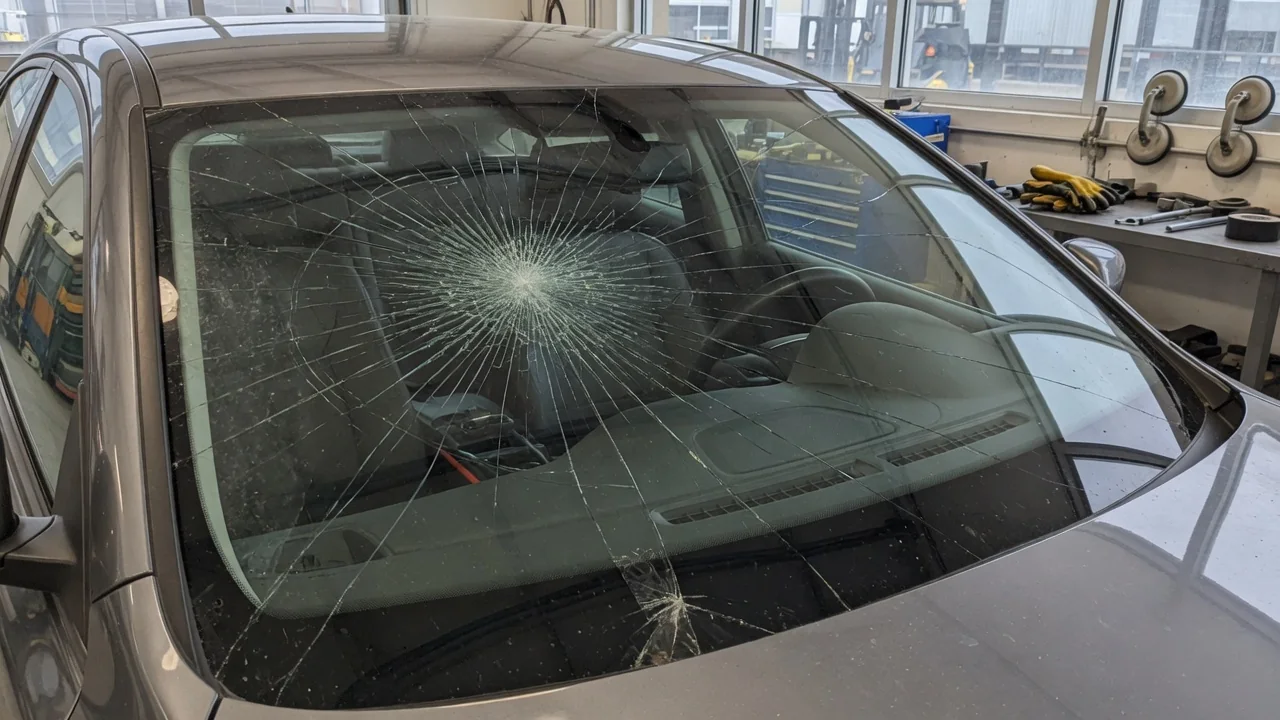
Laminated car glass stays together because it is not a single sheet of glass. It is a bonded sandwich of two glass layers permanently joined to a tough plastic interlayer. When the glass breaks, the interlayer holds the pieces in place instead of letting them fall away. Looking at how the layers are built, how the bond forms, and how the assembly behaves under impact explains why windshields crack in place rather than shattering into the cabin.
Glass layers
A typical laminated automotive pane has an outer glass ply, an inner glass ply, and a polymer interlayer between them. The outer ply faces weather, road debris, and wiper contact, while the inner ply faces the cabin. Both glass sheets are usually annealed float glass that has been cut and shaped together, often bent as a matched pair so their curves line up closely. Matching the curvature matters because a gap or mismatch between the sheets would make uniform bonding harder and could introduce optical distortion.
The interlayer does most of the work of holding the pane together. The most common laminated automotive glass interlayer is polyvinyl butyral, usually called PVB. It is a clear, tough, flexible film that contains plasticizers to keep it pliable across the temperatures a vehicle sees. Some glass uses specialized versions of the interlayer, such as acoustic films designed to damp sound or films with a tinted band along the top edge of a windshield. Other interlayer materials exist for particular applications, but the basic principle stays the same: a ductile polymer layer sits between two brittle glass layers.
This combination gives laminated glass its character. Glass is hard, scratch resistant, and optically clear, but it fails suddenly and has almost no ability to stretch. The interlayer is soft and stretchy but would scratch easily and be far too flexible on its own. Bonded together, each material covers the weakness of the other.
Bonding
Placing a plastic film between two pieces of glass does not by itself create laminated glass. The layers must be fused into a single unit through a controlled process. In general terms, the glass plies and interlayer are assembled in a clean, humidity-controlled environment, then pressed or vacuum-treated to remove air trapped between the surfaces. At this stage the assembly can look hazy because the interlayer has not yet fully bonded and become transparent.
The final bond is typically formed in an autoclave, a pressure vessel that applies heat and pressure at the same time. Heat softens the interlayer so it flows into full contact with the glass, and pressure drives remaining air into solution. When the process is complete, the interlayer becomes optically clear and the layers behave as one laminate. The exact temperatures, pressures, and cycle times vary by manufacturer and product and cannot be determined by looking at the finished glass.
The adhesion itself comes from chemistry at the interface. PVB contains hydroxyl groups that form hydrogen bonds with silanol groups on the glass surface, creating attachment across the entire contact area. Manufacturers deliberately control how strong that adhesion is. If the interlayer gripped the glass too tightly, it could not release slightly and stretch during an impact, so the laminate would absorb less energy. If adhesion were too weak, glass fragments could separate from the film. The goal is a balanced bond that holds fragments firmly while still letting the interlayer deform locally when the glass breaks.
Damage behavior
When laminated glass is struck hard enough to break, the glass plies crack but the interlayer usually stays intact. Broken fragments remain stuck to the film, so the pane keeps its overall shape. This is why a damaged windshield often shows a star break, a bullseye, or a spreading crack line rather than a hole. A severe impact can produce a web of cracks radiating from the point of contact, yet the pieces remain bonded to the interlayer instead of scattering.
Under a strong impact, the interlayer can also stretch. Around the break, the film releases slightly from the glass fragments and elongates, absorbing energy as it deforms. This helps reduce the chance of an object or occupant passing through the glass. The protection has limits: a sufficiently severe or sharp impact can tear the interlayer, and the outcome depends on the energy involved, the glass construction, and how the pane is mounted in the vehicle.
Damage can also develop without a single dramatic event. A stone chip concentrates stress in the glass, so it can grow into a longer crack with temperature swings, body flex, or vibration. Laminated glass can also suffer delamination, where the interlayer separates from the glass, often starting at the edges. It may appear as cloudy, milky, or bubbled areas and is commonly associated with moisture intrusion or with manufacturing or installation problems. Because the bond is what holds the laminate together, delaminated areas no longer perform like the rest of the pane.
Practical implications and limits
For owners, the key takeaway is that a cracked laminated windshield is still a damaged part even if it looks stable. The fact that the glass has not fallen apart does not mean it keeps its original strength or clarity. Small chips are often treated with resin repair, which fills the damaged area to slow crack growth and improve appearance, but repair does not return the glass to new condition. Whether a particular chip or crack can be repaired depends on its size, type, and location, the judgment of a qualified glass technician, and applicable local rules.
It also helps not to confuse two different bonds. The interlayer bond holds the glass layers together, while a separate adhesive, commonly urethane, holds the windshield in the body opening. On many vehicles the installed windshield contributes to body structure and supports passenger airbag deployment, so installation quality matters as much as the laminate itself. How much structural role the glass plays, and whether cameras or sensors mounted to it need calibration after replacement, varies by vehicle and should be confirmed in the manufacturer's service information.
Finally, not every window on a car is laminated. Windshields are commonly laminated, while side and rear windows on many vehicles use tempered glass, which breaks into small granular pieces instead of staying in one sheet. Some vehicles use laminated glass in side windows or roofs for noise reduction or security. Markings in a corner of the glass often identify its type, and the vehicle's documentation is a better guide than assumptions.