What Makes an Off-Road Vehicle Different in Packaging?
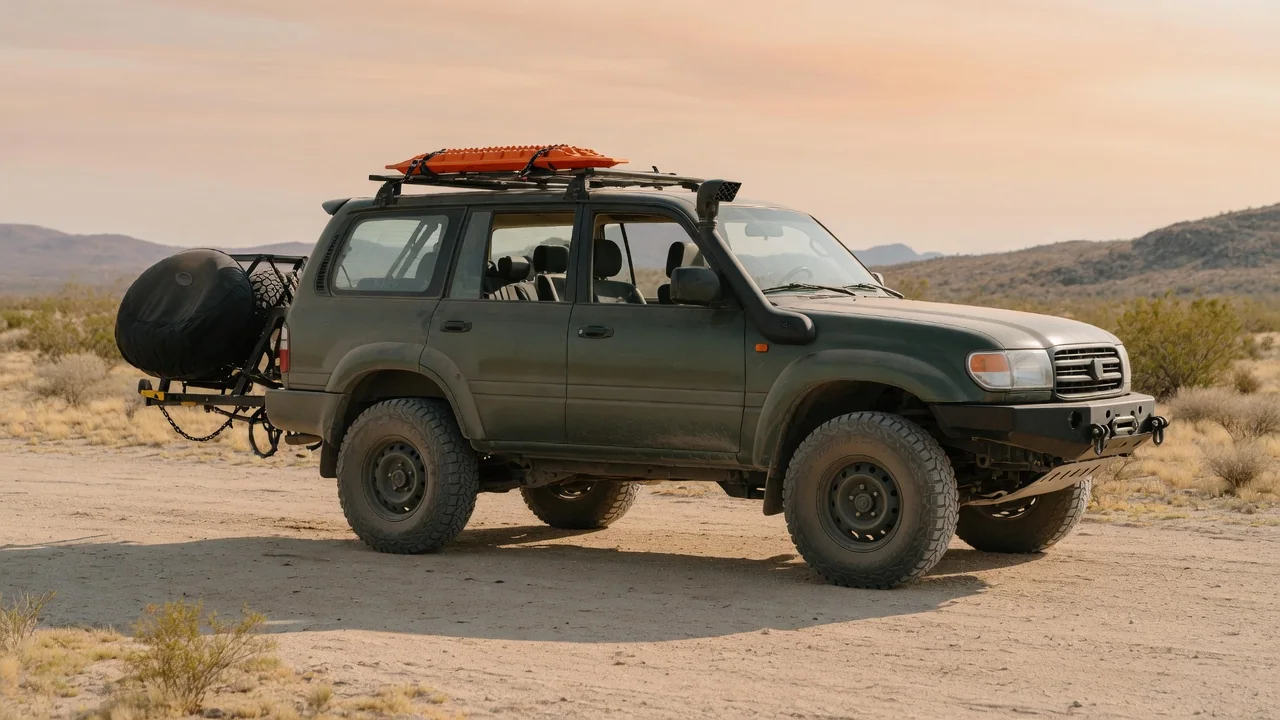
An off-road vehicle is not simply a taller version of an ordinary car. Its packaging, meaning how the body, drivetrain, suspension, fuel system, and wheels are arranged within its footprint, is shaped by three demands: clearing obstacles, surviving contact with terrain, and keeping traction on loose or uneven ground. Looking at clearance, the underbody, and tires explains most of the off-road vehicle design traits that set these vehicles apart, and why those traits carry trade-offs.
Clearance
Ground clearance is measured to the lowest point of the vehicle, and that point is rarely the body itself. It is usually a differential housing, a suspension arm, a crossmember, or part of the exhaust. Packaging for off-road use therefore focuses on raising or tucking those components rather than only lifting the body. Suspension type matters here. With a solid axle, the differential housing moves with the wheels, so the clearance beneath it stays roughly constant relative to the ground, but the housing itself is often the lowest point. With independent suspension, the differential is mounted to the frame or body, so clearance under it can shrink as the suspension compresses, while the wheels gain more independent movement.
Clearance also has a geometric side. The approach angle at the front, the departure angle at the rear, and the breakover angle between the axles describe how steep a slope or crest the vehicle can meet without the bumper or belly touching first. Short overhangs, bumpers that sweep upward toward the corners, and careful placement of items such as tow hitches, exhaust outlets, and spare tire mounts all influence these angles. Wheelbase plays a role as well: a longer wheelbase generally reduces breakover clearance, while a shorter one tends to improve it at some cost to stability.
Vertical space inside the body matters too. To keep tires on the ground over uneven terrain, the suspension needs travel, and the tire needs room to move up into the wheel well at full compression and while turning. Providing that room pushes the fenders and body higher relative to the wheels, which is one reason off-road vehicles often look tall with generous wheel openings.
Underbody
On a typical road car, the underside is designed mainly around cost, airflow, and noise. On an off-road vehicle, the underbody is designed on the assumption that it will eventually touch rocks, logs, or hard-packed ruts. That changes the layout. Vulnerable parts such as the oil pan, transmission, transfer case, and fuel tank are positioned as high as practical and are often covered by skid plates, which are sturdy panels meant to slide over obstacles rather than snag on them. Rocker panels along the sides may be protected by sliders attached to the structure. Where a vehicle uses body-on-frame construction, the frame rails provide strong mounting points and a natural line above which components can be tucked; unibody designs intended for rough use typically rely on added reinforcement and shielding instead.
Routing is part of the same thinking. Brake lines, fuel lines, and wiring are ideally kept above the lowest structural members so that an impact hits steel before it hits a line. A four-wheel-drive system adds a transfer case and a second driveshaft, both of which need space and protection. Axle and transmission vent breathers are often routed upward so water is less likely to enter during crossings, and the engine air intake location affects how much water the vehicle can tolerate before risking ingestion. Recovery points are mounted to the structure so the vehicle can be pulled out without damaging bodywork.
Tires
Tires are tied directly to clearance. Because axles and differentials sit at wheel-center height or relative to it, a larger tire diameter raises those parts and increases clearance under them in a way a body lift cannot. That is why off-road packaging often starts with tire size: the wheel wells, steering lock, suspension travel, and spare tire storage must all accommodate a larger, heavier tire. Larger tires also add rotating and unsprung mass, which the brakes, suspension, and drivetrain must be designed to manage.
Beyond size, the tire's shape and construction matter. A taller sidewall lets the tire flex over sharp edges and allows drivers to lower pressure on soft surfaces, which lengthens the contact patch and can improve flotation and grip; the sidewall also keeps the wheel rim further from rocks. Tread patterns for off-road use generally have larger blocks and wider voids to bite into loose material and clear mud, and construction is often reinforced to resist punctures. Because tire diameter changes the effective final drive ratio, off-road vehicles frequently pair larger tires with gearing that suits slow, controlled climbing, often including a low-range setting in the transfer case.
Practical Implications and Limits
These packaging choices carry costs in everyday driving. A higher body and taller suspension raise the center of gravity, which can mean more body roll, greater sensitivity to crosswinds, and a need for more care in abrupt maneuvers. Larger frontal area and aggressive tread usually increase aerodynamic drag, rolling resistance, and road noise, which tends to reduce fuel economy. Step-in height and cargo floor height rise, which can make loading and entry less convenient. Heavier tires and protective plating add weight that the vehicle carries on every trip, not only off pavement.
Published figures also have limits. Manufacturers do not always measure clearance or angles under the same load conditions, so numbers from different sources may not be directly comparable, and a single clearance figure does not show where the low points are or how they move with suspension travel. Protection hardware reduces the risk of damage but does not make components invulnerable, and wading or towing capability depends on the specific vehicle, so the owner's manual remains the authority for limits, tire pressures, and load ratings.
Modifications deserve caution for the same reason. Fitting larger tires or a lift changes the geometry the original packaging was built around, which can affect steering, braking, speedometer accuracy, driveline angles, and stability, and may have warranty implications. Finally, packaging sets the potential, but terrain conditions, line choice, and driver judgment determine how much of that potential is used safely.