What Made Streamlined Cars Look Different?
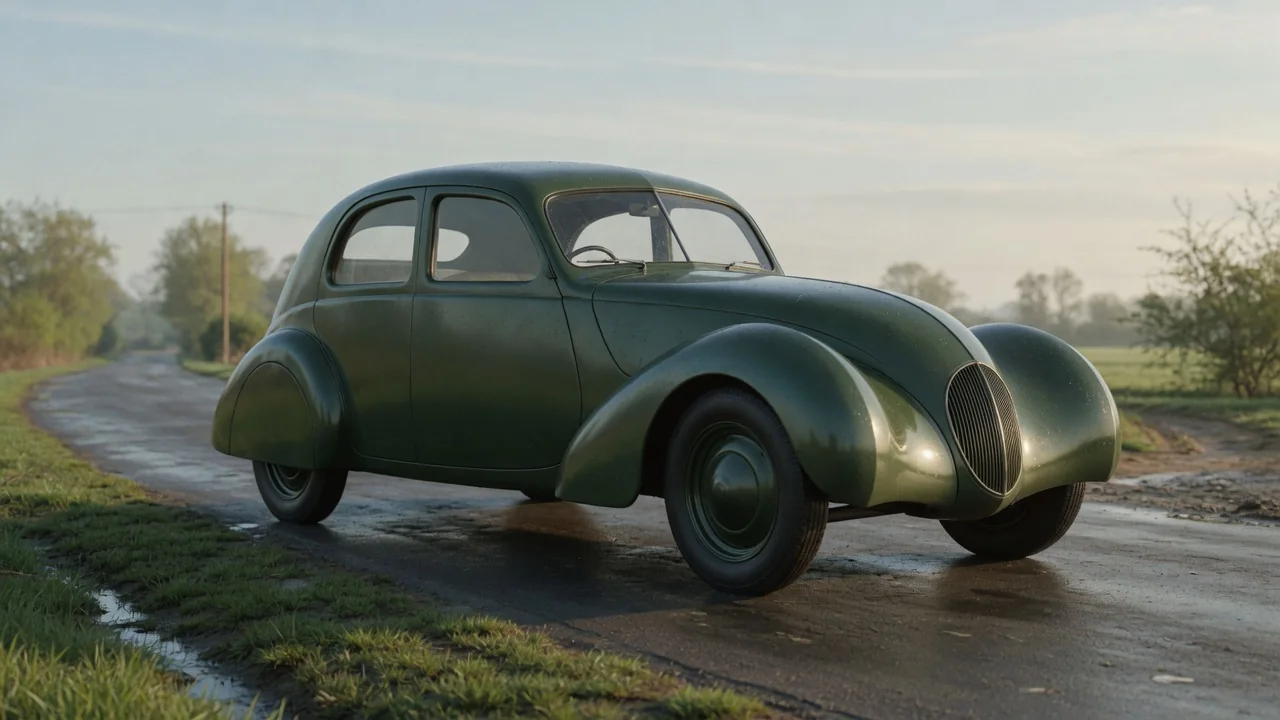
Streamlined cars stood apart from the upright, boxy automobiles that came before them because designers began treating the body as one continuous shape moving through air instead of a collection of separate parts. Rounded noses, sloping rear ends, enclosed wheels and smooth surfaces all grew from that idea. Answering what made streamlined cars look different means looking at three linked factors: the body shape itself, the airflow ideas behind it, and the packaging changes that allowed the shape to work on a real vehicle.
Body shape
Earlier cars were assembled visually from distinct elements. An upright radiator stood at the front, headlamps sat on separate mounts, fenders arched independently over each wheel, running boards bridged the gap between them, and the passenger compartment rose as a tall box with a flat windshield and a nearly vertical back. Streamlined automobile design pulled these elements together. Fenders were blended into the body sides, headlamps were set into the front panels, the grille leaned back, the windshield was angled or curved, and the roofline flowed down toward the tail instead of ending abruptly.
The reference form behind much of this thinking was the teardrop: a rounded front that widens smoothly and then tapers gradually to a point at the rear. A full teardrop is far too long to be practical for a road vehicle, so designers shortened and adapted it, which produced fastback roofs, sloping trunks and tapered tails. Bodies also tended to become lower and wider, with horizontal lines that emphasized length. It is worth separating function from fashion here. Once the streamlined look became popular, many cars adopted rounded panels, chrome speed lines and teardrop-shaped details as styling, without the overall form necessarily doing much for airflow.
Airflow ideas
The central concern was aerodynamic drag, the force the air exerts against a moving car. At road speeds, much of the drag on a bluff body comes from pressure differences. The front pushes air aside and creates higher pressure, while air that cannot follow the body's contours breaks away at the rear, leaving a turbulent, low-pressure wake that effectively pulls the car backward. A gently tapering rear was meant to keep the airflow attached to the surface for longer, shrinking that wake. Rounding the front edges served a related purpose, guiding air around the body rather than letting it pile up against flat surfaces.
Designers also paid attention to the many small disturbances that add up. Exposed headlamps, external spare wheels, protruding door handles, deep panel gaps and an open underside all disrupt smooth flow. Spinning wheels churn the surrounding air, which is one reason rear wheel openings were sometimes covered with skirts or spats. Because aerodynamic drag rises roughly with the square of speed, these refinements matter more as speed increases, which helps explain why streamlining became associated with the idea of fast, efficient highway travel.
Many early airflow ideas were borrowed from aviation and airship design, and wind tunnels made it possible to study scale models. Understanding was still incomplete, however. Some shapes that looked fast were never tested, and some assumptions were later refined. A well-known example is the truncated tail: research showed that cutting off a tapering rear at the right point could retain much of the benefit of a long tail while saving length. Designers also learned that rounded bodies can generate lift at speed and that some shapes are sensitive to crosswinds, so lower drag was never the only consideration.
Packaging
A smooth outer shape only works if the mechanical and passenger layout underneath cooperates. The traditional arrangement placed a tall engine behind an upright radiator, mounted a separate body on a chassis frame, and seated passengers high above the axles. That arrangement made a low, flowing body difficult. To lower the hood and roofline, designers moved occupants forward and lower, often placing them between the axles rather than above or behind the rear one. Bodies grew wider and extended over the wheels, which removed the need for running boards and allowed the sides to become flat, continuous surfaces.
Structure and cooling changed as well. Integrating the body and frame into a single load-bearing structure, an approach that became more common over time, suited smooth, enclosed shells. Cooling remained a persistent conflict, because a radiator needs incoming air while a streamlined nose ideally has as few openings as possible. Grilles became lower, wider or partly hidden, and some designs relocated the engine to the rear, freeing the front for a low, rounded profile but creating new cooling and weight-distribution challenges at the back.
Packaging also involved compromises inside the cabin. A roof that slopes toward the tail reduces rear headroom, a tapered rear can shrink luggage space, and steeply raked or curved glass may limit visibility. Enclosed wheel arches can restrict how far the front wheels turn. Every streamlined body reflected a balance between aerodynamic intent and the space people and their belongings actually needed.
Practical implications and limits
For anyone maintaining or restoring an older streamlined design, the integrated construction has direct consequences. Blended fenders and continuous panels are usually not simple bolt-on parts, so body damage can require more extensive repair than on a car with separate fenders. Wheel skirts or covers typically have to be removed before a tire can be changed, and underbody panels must come off before some components can be reached. Curved glass and complex trim pieces can also be harder to replace than flat equivalents. Specific procedures depend on the individual vehicle, so its own service documentation remains the authority.
On the road, aerodynamic benefits show up mainly at sustained higher speeds; in slow urban driving, weight, gearing and engine condition generally matter far more. The effect depends on the complete shape working together, so a single feature such as a sloping tail does not guarantee low drag on its own, and additions like roof racks, missing trim or altered ride height can disturb the intended flow. Behavior such as crosswind sensitivity or high-speed stability varies between designs and cannot be assumed from appearance.
The most important limit is interpretive. A rounded, flowing look signals design intent, not measured performance. Some cars that appeared streamlined performed only modestly in the air, while others with less dramatic styling were carefully refined. Judging aerodynamic efficiency by eye is unreliable, and any claim about a particular vehicle's drag should rest on documented testing rather than impressions. Understanding the general principles of body shape, airflow and packaging makes it easier to read what designers were attempting, while recognizing that the visual vocabulary of streamlining often outlived its engineering purpose.