What Is Wheel Runout? Roundness, Vibration and Measurement Explained
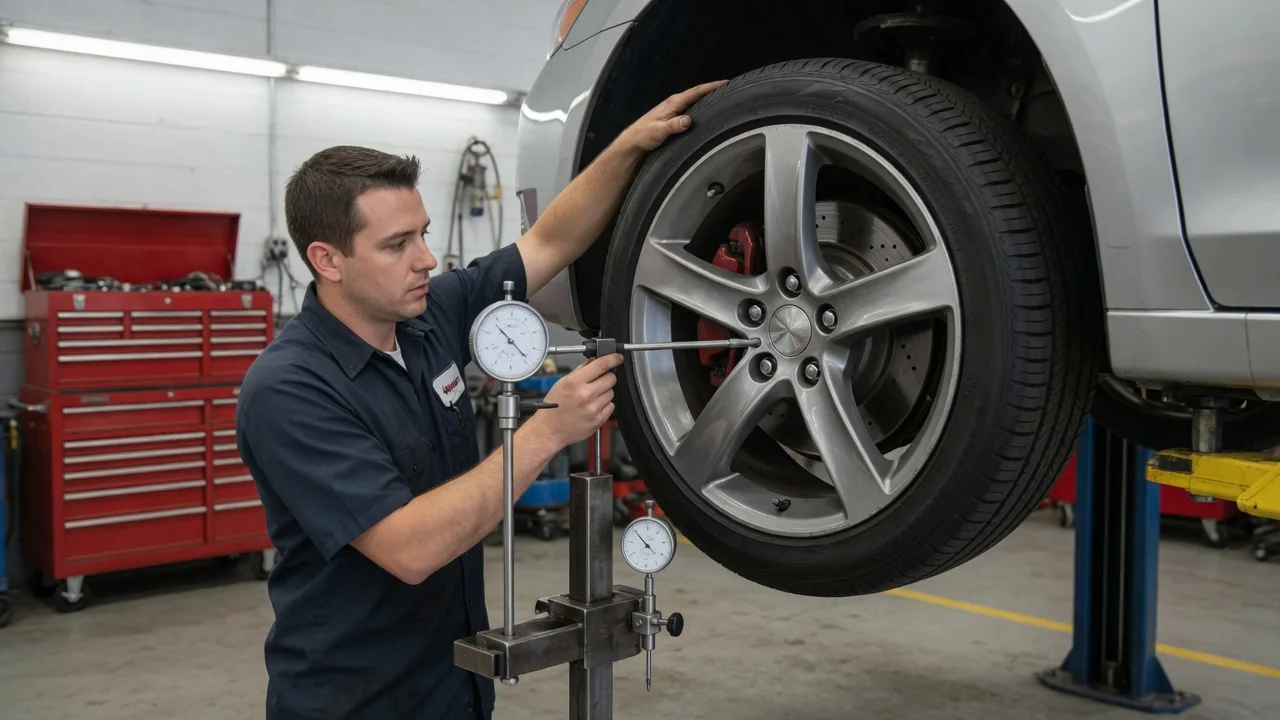
Wheel runout is how far a rotating wheel strays from a perfect circle or a perfectly flat plane as it turns on its axis. The basic wheel runout meaning is wobble or eccentricity: the rim either moves toward and away from the center of rotation or sways from side to side. Every wheel has some runout, but too much can cause vibration, uneven tire wear and steering complaints, which is why technicians measure it when diagnosing a ride problem.
Roundness: Radial and Lateral Runout
Runout is usually described in two directions. Radial runout is out-of-roundness: as the wheel turns, the distance from the axis of rotation to the rim surface changes, so the wheel behaves slightly like an egg rather than a circle. Lateral runout is side-to-side wobble: the rim flange does not travel in a single plane perpendicular to the axle, so it appears to weave when viewed from the front of the car. Either type can come from manufacturing tolerances, from a bead seat that is not concentric with the center bore, or from damage such as a pothole impact or a curb strike that bends the rim.
What the driver experiences is the runout of the whole rotating assembly, not just the bare wheel. The tire has its own radial and lateral runout from its construction, and the hub, the brake rotor or drum, and the way the wheel is mounted all contribute. When the wheel's high spot lines up with the tire's high spot, the errors add together; when they are opposite each other, they partly cancel. Mounting matters too. Rust, debris or a burr between the wheel and the hub face can tilt the wheel and create lateral runout even if the wheel itself is true, and a wheel that is not properly centered on the hub pilot or lug seats can show radial runout that disappears once it is remounted correctly.
Vibration: How Runout Becomes Something You Feel
With radial runout, the effective rolling radius of the tire changes once per revolution. The axle is pushed up and down a small amount each time the high spot meets the road, producing a repeating force whose frequency rises with vehicle speed. Drivers often notice this most within a particular speed range, where the forcing frequency happens to match a natural frequency of the suspension, steering system or body. As a general tendency, runout at the front wheels is more often felt through the steering wheel, while runout at the rear is more often felt in the seat or floor, but how strongly and where it is transmitted depends on the individual vehicle's design.
Runout is not the same as imbalance, even though both produce once-per-revolution vibration. Imbalance is an uneven distribution of mass and can be corrected with balance weights. Runout is a geometric error, and weights cannot make an out-of-round or wobbling assembly true. That is why a wheel and tire can be perfectly balanced on a machine and still vibrate on the road. Adding extra weight in an attempt to cancel runout may change the symptom without removing its cause.
Lateral runout tends to show up as shimmy or a side-to-side wobble rather than a vertical shake, and it can contribute to irregular tire wear. Runout at the hub flange or brake rotor deserves particular attention: as a rotor with lateral runout spins, the pads can contact it unevenly, which over time may lead to rotor thickness variation that drivers feel as a pulsating brake pedal or steering wheel during braking.
Measurement: Dial Indicators and Balancer Checks
The classic tool for measuring runout is a dial indicator mounted on a rigid stand or magnetic base. The indicator's plunger rests against the surface being checked, the wheel is rotated slowly by hand, and the technician notes the highest and lowest readings. The difference between them is the total indicator reading, which is the runout value. For radial runout the plunger contacts the tread center or the rim's bead seat area; for lateral runout it contacts the rim flange or a smooth band of the tire sidewall. Raised lettering, mold seams and tread grooves give false readings, so a smooth reference surface is chosen.
Where the measurement is taken changes what it reveals. Checking the mounted assembly on the vehicle includes the hub and bearing in the result, while checking it on a balancer isolates the wheel and tire. Measuring the bare wheel at its bead seats, with the tire removed, shows whether the wheel itself is the source. Hub flange and brake rotor runout are measured separately with the indicator against those surfaces. Comparing these readings lets a technician narrow down which component is responsible instead of replacing parts by guesswork. Readings are judged against the limits published by the vehicle manufacturer or the wheel and tire makers, since acceptable values are not universal.
Many modern wheel balancers can measure runout electronically, and some use a load roller pressed against the tire to estimate road force variation. That measurement captures not only geometric runout but also uneven stiffness around the tire, which can cause vibration even when the tire is nearly round. The results are often used for match mounting, where the tire is rotated on the rim so its high point sits at the wheel's low point, reducing the combined runout of the assembly.
Practical Implications and Limits
For an owner, the most common practical signal is a vibration that persists after the wheels have been balanced. That pattern points toward runout or force variation rather than simple imbalance, and it is a reasonable point to ask a shop for a runout or road force check. Routine habits also help prevent runout from mounting errors: clean hub and wheel mating surfaces, tightening lug nuts in a crisscross sequence to the manufacturer's specified torque, and avoiding uneven tightening with an impact tool, which can distort brake rotors or seat a wheel unevenly. A tire that has sat parked for a long time may develop a temporary flat spot that feels like runout until the tire warms up, so a vibration noticed only in the first miles of a drive may not indicate a permanent problem.
Runout also has limits as a diagnostic idea. Zero runout is not achievable in production parts, and no single acceptable figure applies to every vehicle, wheel size or tire type. Several other faults can feel similar, including worn suspension or steering components, an unbalanced driveshaft, a bent axle and internal tire damage such as a belt separation, so a runout reading is one piece of evidence rather than a complete diagnosis. Remedies range from remounting and match mounting to replacing the tire, the wheel, a rotor or a hub. Some bent wheels can be repaired by specialists, but cracks or severe damage generally call for replacement, and that judgment belongs to a qualified inspection guided by manufacturer information.