What Is Wake-Up Signaling Between Car Modules?
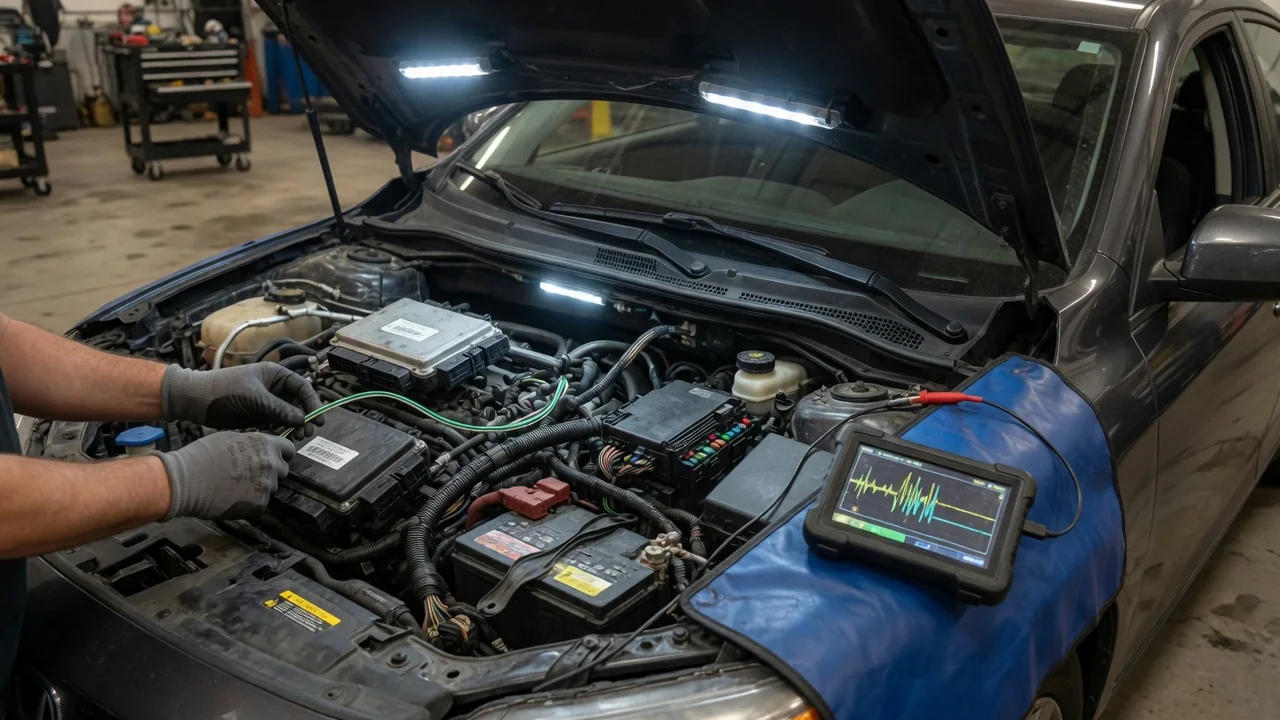
Modern vehicles spread their functions across many electronic control modules linked by in-vehicle networks such as CAN and LIN. When the car is parked, most of these modules go quiet to save battery power, yet some must still respond to a door handle, a key fob, or a charging cable. Wake-up signaling between car modules is the set of electrical and message-based mechanisms that bring a sleeping network back to life, together with the coordinated process that lets it fall asleep again.
Sleep State: What a Resting Module Still Does
In its sleep state, a module shuts down its main microcontroller or places it in a deep low-power mode, and its network transceiver switches from normal operation into a standby or sleep mode. The module is not truly off. The transceiver keeps a small portion of its circuitry powered so it can watch the bus lines or a dedicated wake input for a valid wake-up pattern. Everything else, including message processing, outputs, and most sensors, waits until that pattern arrives. This split design lets a module react within a short time while consuming only a small fraction of the power it uses when fully awake.
Going to sleep is usually a coordinated event rather than each module simply switching off on its own. Many vehicles use a network management scheme in which modules periodically broadcast messages indicating that they still need the bus. As long as any participant keeps requesting communication, the network stays awake. When every module has stopped requesting and a defined timeout has passed, the nodes on that network enter bus-sleep together. This coordination prevents one module from going silent while others are still trying to talk to it, which could otherwise cause communication errors or an endless cycle of waking. The delay between switching the vehicle off and full network sleep varies by design and may include time for functions such as retained accessory power, cooling fan run-on, or saving data.
Not every module sleeps in the same way. Some modules, such as a keyless entry receiver or a body controller, may stay partially alert and sample their inputs at intervals. Some newer architectures also support partial networking, where selected nodes on a CAN bus remain asleep while other nodes on the same wires communicate, rather than the entire bus waking at once.
Trigger: What Wakes the Network
Wake-up triggers generally fall into two groups: local wake-ups and bus wake-ups. A local wake-up arrives at one module directly through a hardwired input or an internal event. Typical examples include an ignition or start button signal, a door or trunk switch, a dedicated wake line from another module, a radio receiver detecting a key fob, a charge port event on an electrified vehicle, or an internal timer. The module that receives the local trigger wakes first and then wakes the rest of the network by transmitting on the bus.
A bus wake-up happens when a sleeping transceiver detects qualifying activity on the network wires. With conventional CAN transceivers, sufficient dominant bus activity is enough, so any traffic tends to wake every node on that bus. Transceivers that support selective wake-up, a feature defined in later revisions of the ISO 11898-2 CAN physical layer standard, can decode incoming frames while the rest of the module sleeps and wake only when a specifically configured wake-up frame appears. On a LIN bus, the master or a slave node can wake the cluster by sending a dominant wake-up pulse, after which the master resumes its normal message schedule. Gateway modules often relay a wake-up from one network to another, so an event on one bus can propagate across several.
Once awake, modules use network management messages again to keep the network active only as long as needed. For example, unlocking a door may wake a body module, which in turn wakes the bus so that lighting, mirrors, and the instrument cluster can prepare for the driver. When the task ends and no module still requests the bus, the shutdown sequence repeats.
Battery Draw: Why Sleep Quality Matters
The main purpose of a sleep state is to limit quiescent current, often called parasitic draw or key-off draw. A module with an active microcontroller and a fully powered transceiver consumes far more current than the same module asleep. While a vehicle is parked, its low-voltage battery supplies these loads alone, and on many electrified vehicles that battery is recharged from the high-voltage system only when certain systems are active. Manufacturers design each vehicle with a target for total sleep current, and the exact acceptable value depends on the vehicle, so it should be taken from that vehicle's service information rather than from a general rule.
Problems arise when a module fails to sleep or when unintended wake-ups repeat. Because network management keeps the whole network awake while any single node requests communication, one misbehaving module can hold many others awake and multiply the draw. Possible causes include a faulty module that keeps transmitting, an aftermarket device connected to the bus or to a constant power feed, a switch that reports a door, hood, or trunk as open, moisture in a connector, or a software fault. In these cases the battery may discharge much faster than intended, even though no single component appears to be using much power.
Some wake-ups are normal and planned. Depending on equipment, a parked vehicle may wake briefly for telematics communication, battery monitoring, scheduled charging, or climate preconditioning. Short, periodic wake cycles like these are part of expected behavior; a network that stays awake continuously is not.
Practical Implications and Limits
Wake-up behavior directly shapes how parasitic draw tests are performed. A measurement taken before the network has completed its shutdown captures awake current and can make a healthy vehicle look faulty. Actions taken during the test, such as opening a door, connecting a scan tool, or disconnecting and reconnecting the battery, can wake modules or restart their timers. For this reason, service procedures typically describe how to latch door and hood switches, how to connect test equipment without interrupting power, and how long to wait before reading results. Those vehicle-specific steps take priority over any general approach.
For owners, the practical lessons are modest but useful. Features that rely on remaining partly alert, such as remote app access, passive keyless entry, and alarm systems, add to standby consumption, so a vehicle stored for a long period may benefit from the battery maintenance practices recommended in its owner's manual. Aftermarket electronics should be installed according to the vehicle manufacturer's guidance so they do not keep the network from sleeping or trigger repeated wake-ups.
The limits of a general explanation should be kept in mind. Which modules sleep, which events act as triggers, how long shutdown takes, and whether selective wake-up is used all differ between manufacturers, models, and even software versions. A general description of wake-up signaling explains why a battery might drain or why a system responds the way it does, but it cannot predict a particular vehicle's behavior. Diagnostic tools that report network status or the last wake-up reason, where the vehicle supports them, along with manufacturer documentation, provide the definitive answer for a specific car.