What Is Vehicle-to-Load Power? How EV V2L Outlets Work
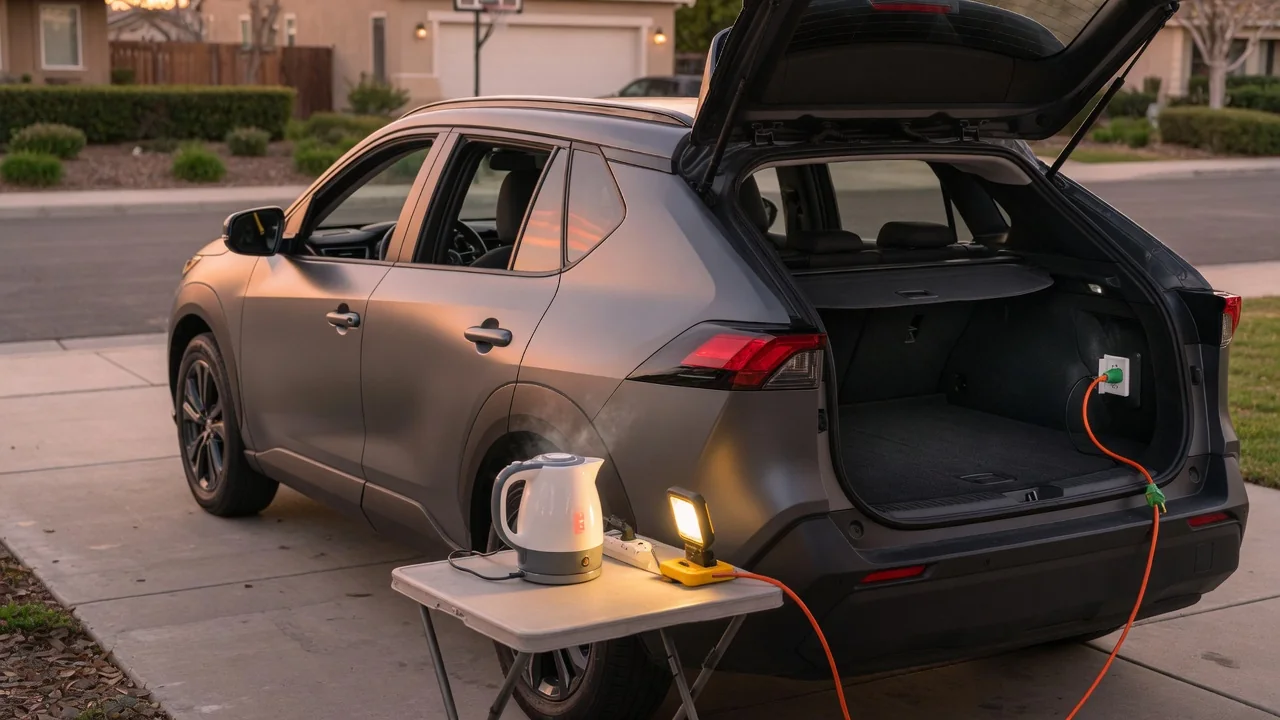
Vehicle-to-load power, usually shortened to V2L, is a feature that lets an electric vehicle supply alternating-current electricity from its high-voltage battery to ordinary electrical devices. Instead of only receiving energy from a charger, the car acts as a portable power source for tools, small appliances, or camping equipment. To understand what the EV vehicle-to-load function can do, it helps to look at three things: the power outlet itself, the limit on connected devices, and how the battery is used while power flows out.
Power Outlet: Where V2L Electricity Comes From
An EV battery stores energy as direct current, while most household devices are built to run on alternating current. Vehicle-to-load works by converting battery DC into AC through an inverter. Depending on the design, this conversion may be handled by onboard charging hardware that is capable of operating in both directions, or by a separate inverter dedicated to supplying external loads. In either case, the output is intended to resemble standard household electricity for the market where the vehicle is sold, so that common plugs and devices can be used without special equipment.
There are two general ways the power reaches a device. Some vehicles provide outlets inside the cabin, in the cargo area, or in a storage compartment. Others supply power outside the vehicle through an adapter that plugs into the charging inlet and offers one or more standard sockets. Some vehicles offer both. The adapter is not just a passive plug shape; it typically signals to the vehicle through the charging connector that an external load is attached, which allows the car to switch the inlet from receiving power to delivering it.
V2L output is generally not live at all times. The function is usually enabled through a vehicle menu or setting, and the vehicle may need to be in a particular state, such as parked and powered on, before the outlet becomes active. The exact steps, outlet locations, and adapter requirements are vehicle-specific, so the owner's manual is the reliable reference for how a particular car exposes this feature.
Device Limit: How Much a Vehicle-to-Load Outlet Can Run
Every V2L system has a maximum continuous power rating. That limit is set by the inverter, the internal wiring, the connector or adapter, and the system's ability to manage heat. The rating applies to the combined load of everything connected at the same time, not to each device separately. In addition, an individual interior outlet may be rated lower than the total system, so a socket inside the cabin and a socket on a charge-port adapter on the same vehicle can have different capabilities.
To judge whether a device will work, compare its power draw in watts, usually printed on its label or power supply, against the rating listed for the vehicle. Pay attention to devices with electric motors or compressors, such as refrigerators, pumps, and some power tools. These can draw a brief surge of power when starting that is noticeably higher than their running draw. Devices that produce heat, such as kettles, heaters, and cooking appliances, also tend to draw large amounts of power continuously and can approach or exceed an outlet's capacity on their own.
When the combined load goes over the limit, the system's protection is designed to stop or interrupt the output rather than let components overheat. A shutdown under load is therefore normally a sign that the device or combination of devices asked for more than the outlet can provide, not necessarily a fault in the car. Reducing the number of devices running at once, or choosing lower-draw equipment, is usually the fix.
Battery Use: What Powering Devices Does to the Charge
Energy taken from the outlet comes directly out of the traction battery. The amount used depends on power multiplied by time: a device drawing more watts, or the same device running for longer, consumes more stored energy. The battery also supplies some overhead. Converting DC to AC involves losses, and the vehicle's control modules, and in some conditions its thermal management system, may stay active while V2L is running. As a result, the drop in state of charge can be somewhat larger than the devices' ratings alone would suggest.
Because the same battery provides driving range, V2L systems are typically designed to stop supplying power before the battery is fully depleted. Many vehicles let the driver set a minimum charge level at which output is cut off, protecting enough energy to drive to a charger afterward. Where such a setting exists, choosing it deliberately is one of the most important parts of using V2L sensibly, particularly away from charging infrastructure.
In terms of battery stress, typical V2L loads are modest compared with the currents involved in acceleration or DC fast charging. Running small devices from the outlet is part of the battery's normal energy use rather than an unusual demand. Any manufacturer-specific guidance about extended or frequent use, especially in very hot or cold conditions, should still take priority over general expectations.
Practical Implications and Limits
In real use, vehicle-to-load works best with planning. Before relying on it, add up the devices you intend to run together, stagger high-draw items so they do not start at the same moment, and estimate how long you need power so you can judge the remaining range. For outdoor use, use extension cords rated for outdoor conditions and for the load they carry, and keep the charge-port adapter and connections protected from rain, standing water, and physical strain. One practical advantage over a fuel generator is that an EV produces no exhaust while supplying power, though normal electrical safety precautions still apply.
V2L is not the same as home backup power. It is meant to feed devices plugged directly into its outlets, not to energize household wiring. Connecting a V2L outlet to a home's electrical system through improvised cords or adapters can be dangerous to people and to utility workers, and can damage equipment. Supplying a house is the role of vehicle-to-home or vehicle-to-grid systems, which require compatible vehicles, dedicated equipment, professional installation, and in some cases utility approval.
Finally, availability and behavior differ widely. Whether a vehicle offers V2L at all, where its outlets are, what output it is rated for, whether an adapter is included or sold separately, and how it responds to low temperatures or low charge can vary by model, trim, market, and software version. Cold weather can also reduce the energy a battery can deliver. Treat general explanations as a guide to how the technology works, and confirm the specifics for any individual vehicle in its official documentation.