What Is Vehicle-to-Home Power? How an EV Can Supply a House
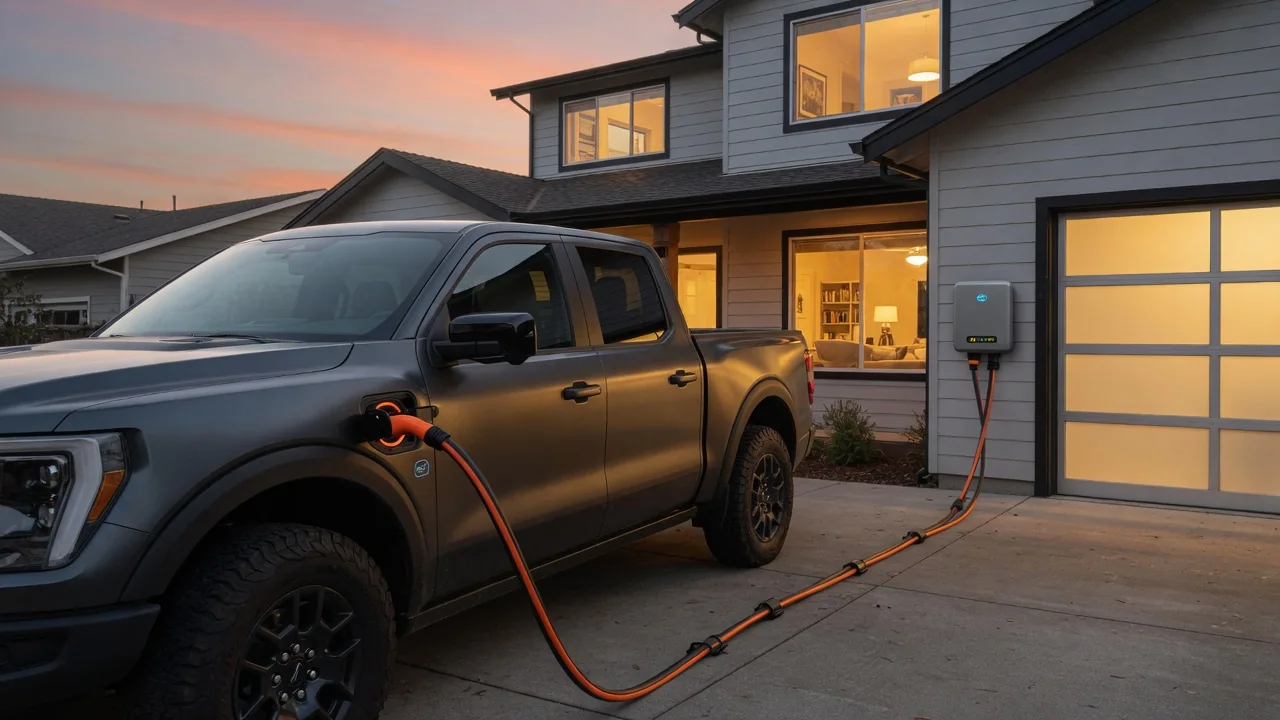
Vehicle-to-home power, usually shortened to V2H, is the ability of an electric vehicle to send energy from its traction battery back into a house. Instead of only drawing electricity to charge, the car acts as a large mobile battery that can supply household circuits, most often during a grid outage. Understanding the EV vehicle-to-home concept comes down to three things: the bidirectional hardware involved, the path electricity takes, and how a system is installed.
Bidirectional equipment: what makes reverse power flow possible
A conventional EV charging setup is designed for one-way flow. With AC charging, the wall unit, technically called electric vehicle supply equipment, mainly acts as a smart, protected switch, while the car's onboard charger converts household alternating current into the direct current the battery stores. With DC fast charging, the conversion happens inside the station instead. In both cases, the hardware is built to push energy into the battery, not pull it out. V2H requires equipment that can run that conversion in reverse, turning the battery's DC back into AC at the voltage and frequency the home expects.
There are two broad architectures. In a DC-based approach, the vehicle supplies direct current through its charging port to an external bidirectional charger, which contains the inverter that produces household AC. In an AC-based approach, the vehicle itself contains a bidirectional onboard charger capable of inverting power, and the wall equipment manages the connection and safety functions. Which architecture applies depends on how a given vehicle and charger were engineered, so compatibility has to be confirmed for the specific car and equipment rather than assumed from the connector shape alone.
The vehicle and charger must also communicate. Reverse power flow is only permitted when both sides agree on limits such as current, the minimum state of charge to preserve, and fault conditions. Because this depends on software on both ends, a car that physically fits a bidirectional charger may still not support V2H unless the manufacturer has enabled the function. V2H is also distinct from vehicle-to-load, where appliances plug directly into outlets on the car, and from vehicle-to-grid, where energy is exported to the utility network.
Power path: how energy moves from the battery to household circuits
In a V2H system, energy starts in the high-voltage traction battery. The vehicle's battery management system decides how much power can be released based on cell temperature, state of charge and other internal limits. That DC energy then passes through the charging port and cable to the bidirectional charger, or through the car's own inverter, depending on the architecture. The inverter converts it into AC that matches the home's electrical service, and the output is routed into the main panel or a dedicated subpanel that feeds selected circuits.
The critical point in the path is isolation from the utility grid. When the grid fails, a V2H system must disconnect the house from the utility lines before supplying power. Without that separation, energy could flow backward onto the distribution network and endanger line workers or damage equipment. This is handled by a transfer switch or an automatic isolation device, often integrated into a gateway or energy management unit. Once the home is islanded, the inverter forms its own local AC supply, and the house runs as a small independent system powered by the car.
When grid power returns, the sequence reverses. The system confirms that utility voltage is stable, ends islanded operation, reconnects the home to the grid and typically resumes normal charging. Some systems also allow the vehicle to supply the home while the grid is present, for example to reduce consumption during expensive periods, but whether that mode is offered depends on the equipment, utility rules and local regulations.
Setup: what a V2H installation involves
Setting up vehicle-to-home power starts with compatibility. The vehicle must support bidirectional output for home backup, and the charger and any gateway hardware must be approved for use with that vehicle. Owner documentation and the charger maker's compatibility information are the right references, because support can vary by model, trim, model year and software version. It is not something an owner can add simply by buying a different cable or adapter.
The physical installation is more involved than a standard Level 2 charger. A licensed electrician typically mounts the bidirectional charger, installs the transfer or isolation equipment, and wires either the whole panel or a critical-loads subpanel that holds essential circuits such as refrigeration, lighting, internet equipment or a furnace blower. Because the system can energize home wiring from a source other than the utility, permits and inspection are usually required, and the local utility may need to review the interconnection, particularly if any export to the grid is possible.
After installation, the system is configured through the charger or energy management software. Common settings include a reserve level below which the car stops supplying the home, so enough range remains for driving, and the choice of which modes are enabled, such as backup only or scheduled discharge where allowed. Testing the changeover under qualified supervision before a real outage helps confirm that isolation, startup and reconnection behave as expected.
Practical implications and limits
The main benefit of V2H is resilience. An EV battery generally holds considerably more energy than typical portable power stations, so a car can keep essential circuits running for a meaningful period. How long a home can run depends on usable battery capacity, the reserve setting and household consumption, which swings widely with heating, cooling and electric cooking. Running only essential loads stretches the available energy much further than powering an entire house.
Output power is a separate constraint from stored energy. The inverter has a continuous rating and a limited surge capability, and large motor loads such as central air conditioners or well pumps can draw a brief starting current well above their running current. If combined demand exceeds what the system can deliver, it may shut down to protect itself, so load planning matters as much as battery size. Battery temperature and the vehicle's own protective limits can also reduce available output.
There are trade-offs to weigh. Bidirectional equipment and the associated electrical work generally cost more than a one-way charger, and the car must stay parked and connected to supply the home, so it cannot be driven and provide backup at the same time. Discharging for home use also adds battery cycling, and how a manufacturer treats V2H use under its warranty is a vehicle-specific question worth checking before relying on the feature. For owners whose vehicle and region support it, V2H turns an EV into a dual-purpose energy asset, but it works best as a planned, properly installed system rather than an improvised connection.