What Is Variable Valve Timing?
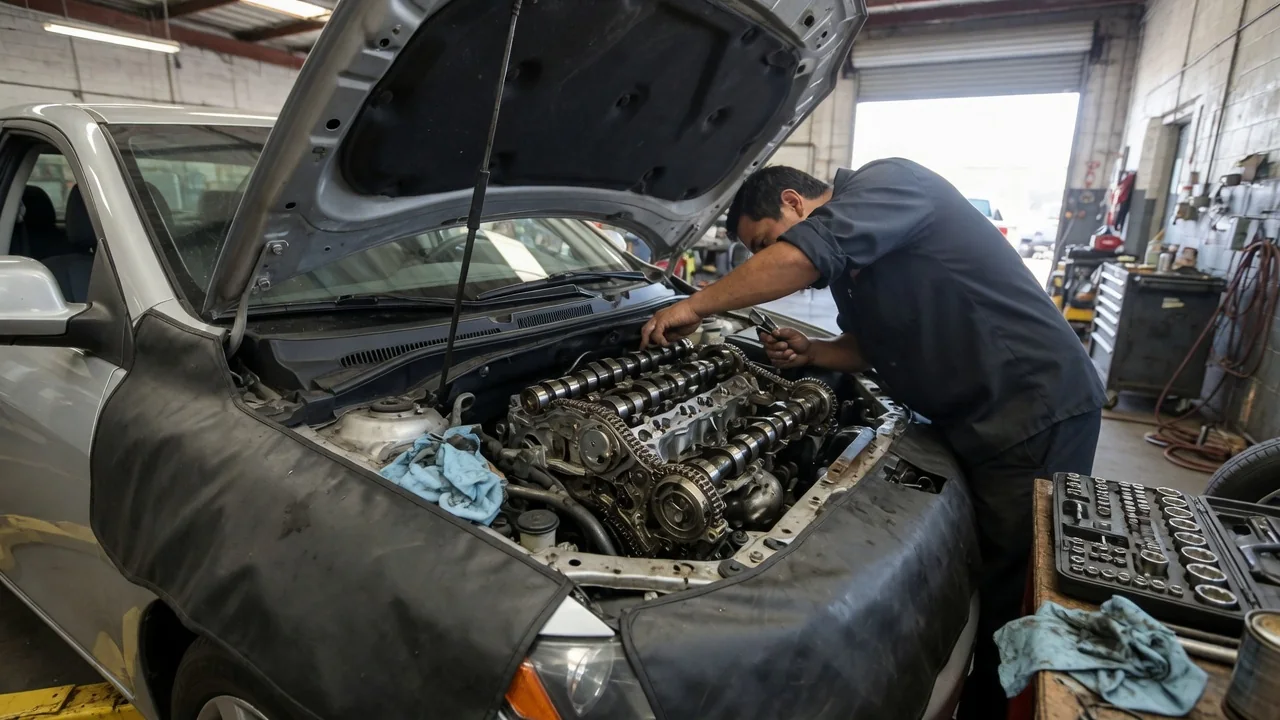
What is variable valve timing? It is a system that lets an engine change when its intake and exhaust valves open and close, rather than locking that timing to a single compromise. By shifting valve events as speed, load, and temperature change, the engine can idle smoothly, pull strongly at low revs, and breathe efficiently at higher speeds while managing fuel use and emissions.
Camshaft and valves
The camshaft is a shaft with egg-shaped lobes that push the valves open as it rotates, driven by the crankshaft through a timing chain, belt, or gears at half crankshaft speed. Intake valves admit air or an air-fuel mixture, and exhaust valves release burned gases. In an engine with fixed timing, the lobe shape and the camshaft's position relative to the crankshaft set every valve event permanently, so the designer must pick one compromise that serves all operating conditions.
Variable valve timing breaks that fixed relationship. Most commonly, a device called a cam phaser sits at the end of the camshaft and rotates it slightly ahead of or behind its drive sprocket, advancing or retarding the valve events. Some engines phase only the intake camshaft, others phase both camshafts, and certain designs also switch between lobe profiles to change lift or duration. The hardware is hidden beneath the valve cover and timing cover, so what an owner can see depends on the specific engine layout.
Control
The engine control module decides how much to shift timing using inputs such as engine speed, load, throttle position, coolant temperature, and oil temperature. In many designs, it commands an oil control solenoid that directs pressurized engine oil into chambers inside the phaser, turning the camshaft relative to its sprocket. Other engines use an electric motor to move the phaser instead. Camshaft and crankshaft position sensors report the actual result, allowing the module to compare the commanded angle with what was achieved.
Typical strategies illustrate why the timing changes. At idle, little valve overlap keeps combustion stable and smooth. Under moderate cruising load, increased overlap or late intake valve closing can draw some exhaust gas back into the cylinder and reduce pumping losses, helping efficiency and lowering certain emissions. During hard acceleration, timing shifts to fill the cylinders as completely as possible at that engine speed. The exact maps, the range of adjustment, and behavior during a cold start differ between manufacturers and engine families.
Fault context
Because many systems rely on engine oil as the working fluid, oil condition matters. Low oil level, the wrong viscosity, sludge, or a restricted screen can slow the phaser's response, and the control module may then record that the camshaft position did not match the commanded position. Worn timing chains, sticking solenoids, wiring problems, and sensor faults can produce similar results. Drivers may notice a check engine light, rough idle, hesitation, reduced fuel economy, or a rattle shortly after startup.
A stored fault code related to camshaft timing is evidence to interpret, not proof that a particular part has failed. A code describing over-advanced or slow-responding timing tells a technician what the module observed, but the cause could be oil-related, electrical, or mechanical. Some codes are generic, while others are manufacturer-specific and require vehicle-specific service information to define them correctly. Proper diagnosis usually involves checking oil level and condition, reviewing live data, and testing the circuit before any component is replaced.
Everyday Use and Observations
In normal driving, a healthy system works unnoticed. The engine idles steadily at a stoplight, responds willingly when pulling away, and continues to pull as revs climb on a highway on-ramp, without a clear step between these states. That seamless breadth is the benefit: a single engine behaves as though tuned for town driving and passing power alike. On some engines with profile switching, drivers may notice a change in sound or urgency at a certain engine speed, though many are tuned to conceal it.
Owners can also spot clues about which system their vehicle has. Manufacturers use various trade names, sometimes displayed on the engine cover or a badge, and the owner's manual or service information describes the design. With a scan tool that shows live data, the commanded and actual camshaft angles can be seen changing as load and speed change. Maintenance habits remain the most practical point: keeping to the specified oil grade and the change schedule the manufacturer publishes supports consistent phaser operation.
Limits and Next Steps
The technology has boundaries. Phasing moves when the valves open and close but, on its own, does not alter how far they open or how long they remain open; that requires variable lift or duration mechanisms, which only some engines include. The range of adjustment is mechanically limited, and many phasers rest in a locked default position at startup until oil pressure builds. The added components also bring complexity, meaning more parts that depend on clean oil and accurate sensor signals.
For readers wanting to go further, vehicle-specific information is the place to start: confirm which camshafts are phased, how the phaser is actuated, and what the manufacturer says about oil. If a warning light or drivability symptom appears, have the stored codes read and note the conditions when the problem occurs, such as cold starts or warm idle. Because phasers and timing components sit within the engine's timing drive, where mistakes can cause serious damage, repairs beyond basic checks belong with a qualified technician.