What Is Torque Vectoring? How Cars Split Torque Between Wheels
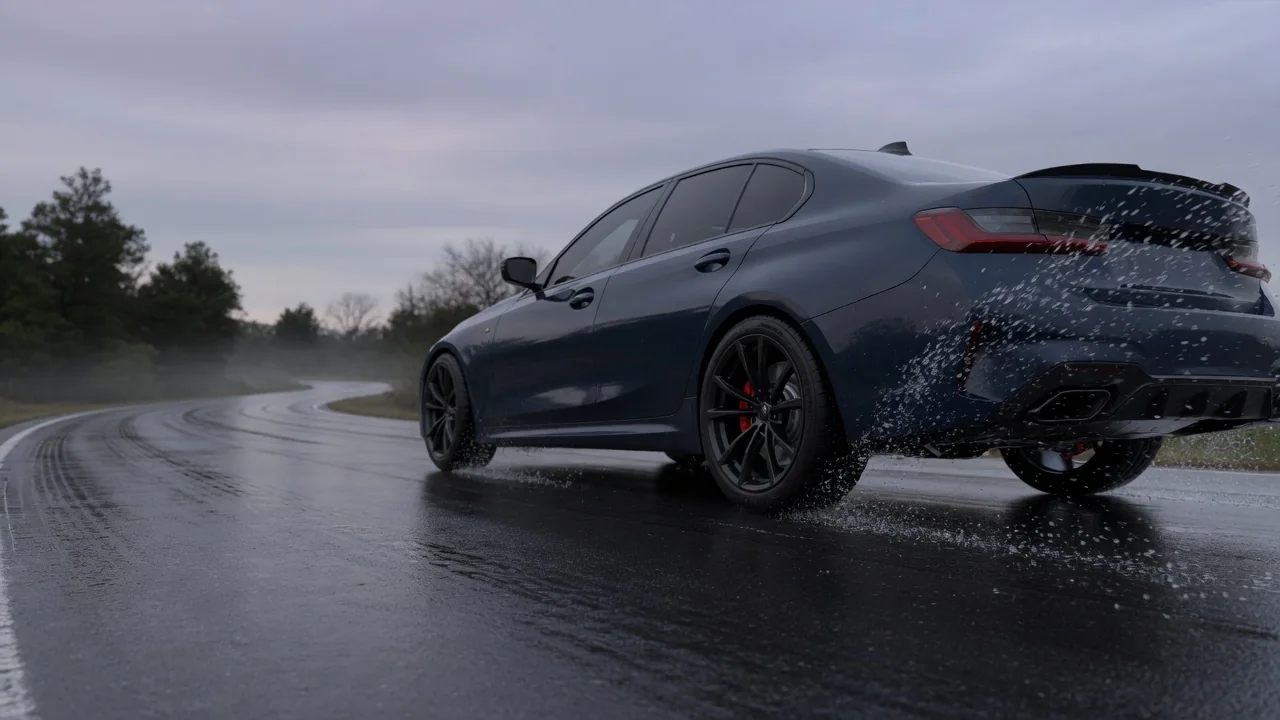
Torque vectoring is a driveline strategy that deliberately sends different amounts of drive or braking torque to individual wheels to help a car turn and stay stable. If you are asking what is torque vectoring, or what the car torque vectoring meaning is on a spec sheet, the short answer is that the system actively chooses which wheel should push harder instead of letting the driveline split torque passively. Below we cover how distribution works, how it is controlled, and where its limits are.
Wheel torque distribution
To understand torque vectoring, start with an ordinary open differential. It lets the left and right wheels turn at different speeds in a corner, but it splits torque roughly equally between them. The weakness is that the wheel with the least grip sets the limit: if one tire spins on ice, the other receives only a similarly small amount of torque. A conventional limited-slip differential reduces that problem by resisting speed differences, which tends to bias torque toward the slower-turning wheel. In a corner, the slower wheel is usually the inside one, so a typical limited-slip unit improves traction but does not actively help the car rotate.
Torque vectoring goes a step further by controlling the split on purpose. When the outside wheel in a turn receives more drive torque than the inside wheel, the difference in forward push across the axle creates a yaw moment, a twisting force around the car's vertical axis. That moment helps the nose follow the steering input and can reduce understeer. Reducing torque to the outside wheel, or adding braking force to it, does the opposite and can help calm a car that is rotating too much. Strictly, the term describes side-to-side distribution on an axle, although some all-wheel-drive systems also vary front-to-rear distribution and describe the combination with the same label.
There are three broad ways to achieve this. Brake-based systems lightly brake the inside wheel; because an open differential balances torque between both sides, the outside wheel can then carry more drive torque. This approach uses existing anti-lock and stability hardware. Mechanical active differentials use electronically controlled clutch packs, and some add gearsets that let a clutch push torque to the faster-turning outside wheel, something a clutch alone cannot do because it only transfers torque from the faster shaft toward the slower one. Electric drivetrains with separate motors for each side can command torque at each wheel directly, including negative torque through regenerative braking.
Control
A torque vectoring controller needs to know both what the driver wants and what the car is actually doing. Typical inputs include steering angle, vehicle speed, individual wheel speeds, yaw rate, lateral acceleration and accelerator position. From steering angle and speed, the controller estimates the yaw rate the driver is asking for. It then compares that target with the measured yaw rate from the vehicle's motion sensors to judge whether the car is turning less than intended, which suggests understeer, or more than intended, which suggests oversteer.
Control strategies generally combine two layers. A predictive, or feedforward, layer reacts to inputs such as steering and throttle before the tires start to slide, adjusting the torque split as the car enters or exits a corner. A corrective, or feedback, layer watches the difference between target and actual behavior and adjusts the split to close that gap. Because these systems share sensors and actuators with traction control, stability control and anti-lock braking, they are usually coordinated so they do not work against one another; stability control typically keeps final authority when the car approaches a loss of control.
How strongly a system intervenes is a calibration choice made by each manufacturer, and some vehicles change it with drive modes. Actuator speed also shapes the feel: brake pressure builds quickly, clutch packs need time to engage and release, and electric motors can change torque rapidly.
Limits
The most important limit is the tire. Each tire can generate only a finite total force, shared between accelerating or braking and cornering, a relationship often illustrated as a friction circle. Torque vectoring redistributes force between tires; it cannot create grip that is not there. If the outside tire is already near its cornering limit, adding drive torque to it uses up lateral capacity and can make it slide. On wet, snowy or icy roads, the usable difference between wheels shrinks along with available grip, so the effect becomes smaller.
Hardware imposes its own limits. Brake-based systems turn energy into heat, which slows the car slightly and adds brake wear; during sustained hard driving, rising brake temperatures can lead the system to reduce its intervention. Clutch-based differentials also generate heat when slipping and are typically protected by software that limits their duty when temperatures climb. Electric systems are bounded by motor output, battery power and thermal management. In every case, a driveline can only redistribute the torque that is available, so at light throttle a drive-based system has little to work with.
Control has limits too. Estimates of intended path and road friction are imperfect on mixed surfaces or during abrupt maneuvers, and no torque split can rescue a corner entered far too fast. Near that point, stability control normally takes over by cutting power and braking individual wheels.
Practical implications and limits
In everyday driving, most owners will rarely notice torque vectoring working. Its effect tends to show up when accelerating through a bend, where a car may hold its line with less steering correction, or in quick direction changes. How it feels depends on the specific vehicle's hardware, calibration, selected drive mode and tire condition, so two cars described with the same term can behave quite differently. The owner's manual is the most reliable place to find which type of system a vehicle uses and how its modes change behavior.
Maintenance and tires deserve attention. Because these systems compare wheel speeds, mismatched tire sizes, uneven tread depth or incorrect pressures can distort the readings the controller relies on. Vehicles with active differentials may have specific fluid or service requirements, and a warning light related to the driveline or stability system is a reason to consult the manual or a qualified technician rather than ignore it.
Finally, treat torque vectoring as an aid to predictability, not a margin of safety you can spend. It can make a car feel more willing to turn and more settled, but it does not shorten braking distances, replace appropriate tires for the season, or change the basic physics of grip. Choosing a sensible speed for the conditions remains the driver's job.