What Is Toe in Wheel Alignment?
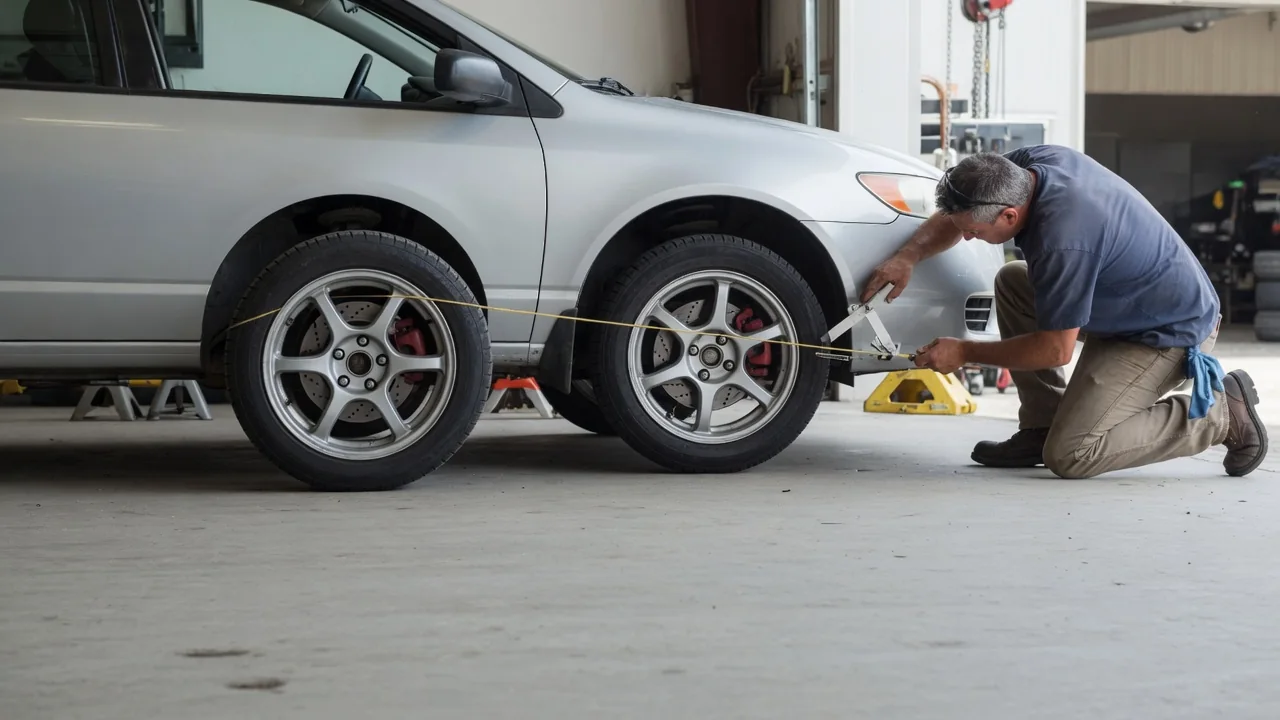
Anyone asking what is toe in wheel alignment is really asking which way the tires point when the steering wheel is centered. Toe describes whether the front edges of a pair of wheels angle toward each other or away, as seen from above. That small angle shapes straight-line stability, steering feel, and how quickly tread scrubs away.
Toe-in and toe-out
Picture looking down on a car from above. If the front edges of the two tires on one axle sit closer together than the rear edges, the wheels have toe-in, sometimes called positive toe. If the front edges sit farther apart, that is toe-out, or negative toe. Zero toe means both wheels point exactly parallel to the vehicle's centerline. The comparison to feet is helpful: pigeon-toed standing resembles toe-in, while a duck-footed stance resembles toe-out. Both front and rear axles have a toe setting, even when the rear is not adjustable.
Manufacturers rarely aim for a perfectly parallel setting at rest, because suspension bushings flex once the car is moving. Rolling resistance tends to push the front wheels of a rear-drive car slightly outward, so a little static toe-in lets them run closer to straight at speed. Driven front wheels pull forward under power, which can change the reasoning. Toe-in generally favors calm straight-line tracking, while toe-out makes the car turn in more eagerly but feel busier on the highway. The correct value depends on the specific vehicle's design and published specification.
Wear pattern
A tire with incorrect toe does not roll cleanly in the direction the car travels. It is dragged slightly sideways with every rotation, and that sideways slip is tire scrub. Because the tread blocks are pushed across the pavement instead of simply rolling over it, rubber wears off unevenly across each block. The classic result is feathering: one edge of each tread rib becomes rounded while the opposite edge stays sharp. Running a flat hand lightly across the tread in both directions often reveals it, since the surface feels smooth one way and rough the other.
The location of the wear offers a clue about direction. Excessive toe-in tends to scrub the outer shoulders of the tires, while excessive toe-out tends to work the inner shoulders, though camber, inflation pressure, and worn suspension parts can produce similar-looking patterns. Inner-edge wear is easy to miss because it hides behind the visible face of the tire, so turning the steering to full lock helps expose it. Toe-related wear can develop quickly compared with other alignment faults, because the tire is scrubbing during every moment of straight driving, not only in corners.
Measurement
Toe is measured either as an angle in degrees or as a linear difference between the front and rear of the tires or rims, expressed in fractions of an inch or millimeters. Alignment readouts usually show individual toe for each wheel and total toe for the axle, which is the two individual values combined. Individual readings matter because total toe can be within specification while one wheel points noticeably off, leaving the steering wheel crooked. On the rear axle, unequal toe creates a thrust angle, meaning the rear wheels steer the car slightly off its own centerline.
Modern alignment racks use cameras or sensors mounted to each wheel, with targets that let the machine calculate angles relative to the vehicle's geometric centerline. The car sits on level turntables and slip plates so the suspension can settle without binding. Readings are compared against the manufacturer's acceptable range for that vehicle, and the printout typically shows before and after values. Ride height, tire pressure, and loads in the cabin or cargo area all influence the result, so a shop normally checks those conditions first. Some vehicles also require a steering angle sensor reset afterward.
Everyday Use and Observations
Day to day, toe problems tend to show up through the steering wheel before they show up on the tread. An off-center steering wheel while driving straight on a flat road is one of the most common signs, since unequal toe forces the driver to hold the wheel at an angle to keep the car going straight. The car may also feel nervous or darty, wandering within the lane and needing constant small corrections. Too much toe-in can make the steering feel heavy and slow to respond, while too much toe-out makes it twitchy.
Other clues are subtler. Tires may squeal faintly in slow parking-lot turns, fuel economy can slip because scrubbing tires add rolling resistance, and a new set of tires may wear far sooner than expected. Toe often shifts after a hard pothole strike, a curb hit, or suspension and steering work such as replacing tie rod ends. It also drifts gradually as bushings and joints age. Road crown naturally nudges a car toward the shoulder, so a slight drift on a sloped road is not automatically an alignment fault and deserves a check on level pavement.
Limits and Next Steps
Toe is only one of the three main alignment angles, and it cannot be judged in isolation. Camber and caster interact with it, and adjusting one can shift another, which is why a complete alignment addresses all of them in sequence. Setting toe accurately also assumes the steering and suspension are tight. A loose tie rod end, worn ball joint, or soft control arm bushing lets the wheel move under load, so the angle measured on the rack does not hold on the road. Bent components from an impact may make the specification unreachable.
Driveway methods using string or a tape measure can reveal a gross error, but they lack the precision needed to set small angles reliably, and steering linkage adjustments affect safety. The practical next step for uneven wear, a crooked steering wheel, or a recent impact is a professional alignment check with a printed report. Asking the shop to inspect suspension parts first avoids paying to align worn components. Rear toe is adjustable on some vehicles and fixed on others, so the options and the correct target values always depend on the specific make and model.